MLOps for LLM Applications: Monitoring, Retraining & Cost Control
MLOps for LLM applications is the operational discipline that keeps your production language models reliable, up-to-date, and cost-effective at scale. Your model shipped three months ago and delivered strong results. Now hallucinations are increasing, inference costs spiked 40% last week, and you’re flying blind on both fronts. This is the reality facing ML teams who deploy large language models without mature monitoring, retraining, and cost control frameworks in place.
Key Takeaway
MLOps for LLM applications rests on three pillars: real-time quality monitoring to detect when models degrade, intelligent retraining to update models at the right moment, and cost visibility to control token spend without sacrificing performance. Without all three, production LLMs become operational liabilities rather than assets.
In This Article
- Why MLOps for LLM Is Different from Traditional ML Operations
- Pillar 1: Monitoring LLM Performance in Production
- Pillar 2: Automated Retraining Pipelines for LLMs
- Pillar 3: Controlling LLM Inference Costs
- Integrating Monitoring, Retraining, and Cost Control into a Unified MLOps Platform
- Industry Applications
- How to Get Started
- Frequently Asked Questions
Why MLOps for LLM Is Different from Traditional ML Operations
Traditional ML operations focus on monitoring feature drift, prediction accuracy, and retraining frequency based on labeled data. MLOps for LLM applications? That’s a different beast entirely. Your language model isn’t predicting a binary outcome or regression value. It’s generating open-ended text, and measuring quality is way harder than checking if a prediction matches ground truth.
Here’s the thing: LLMs operate as black boxes. You can’t easily introspect what the model learned or why it made a particular choice. Traditional feature importance and model explainability techniques just don’t work. Instead, you’re stuck using proxy metrics like hallucination rates, semantic consistency checks, and user satisfaction signals.
Then there’s the cost structure, which is almost inverted from what you’re used to. With traditional ML, training cost dominates and inference is cheap. With LLMs, inference cost scales with every token generated. As your product scales and usage grows, a single model deployed to millions of users can generate tens of millions of dollars in monthly inference costs.
“68% of organizations deploying large language models lack adequate monitoring systems to detect production degradation, according to recent industry surveys examining LLM operational maturity.”
Gartner, 2024 AI Operations Report
And retraining? That’s unique too. You can’t simply retrain an LLM from scratch on new data every week. Most organizations fine-tune existing models, improve retrieval-augmented generation systems, or refine prompts. Each approach requires different infrastructure, testing, and deployment strategies than traditional model retraining.
That’s why off-the-shelf MLOps tools often fall short. They were built for tabular data and classification tasks. MLOps for LLM applications demands specialized monitoring, retraining pipelines, and cost analytics built specifically for how language models behave and degrade in production. Sound familiar? You’re not alone.
Pillar 1: Monitoring LLM Performance in Production
Monitoring LLM performance starts where traditional ML monitoring stops: beyond accuracy. Your model might return technically correct text while hallucinating specific facts or drifting in semantic meaning. Here’s what actually matters.
Latency (P50, P95, P99) tells you how quickly the model responds. When P95 latency doubles, users experience timeouts. This often signals infrastructure bottlenecks or model serving issues that degrade experience before output quality even becomes a factor.
Token usage per request is an early warning system for cost spirals. If average tokens per request climb from 150 to 300, your monthly bill doubles (all else equal). Tracking this metric catches quality regressions that inadvertently increase response length before they snowball.
Hallucination and factuality rates are critical but tough to measure. A model that hallucinates 2% of the time might be acceptable in general chat but unacceptable in finance, healthcare, or legal. Most teams skip this metric because full automation is hard. Here’s what actually works: log outputs, sample for human review weekly, and use NLP consistency checks (comparing model outputs against reference knowledge bases) in high-risk domains.
Semantic drift gets detected by comparing embeddings of model outputs against a reference set. If the embedding space shifts dramatically, the model’s behavior is diverging from its original intent. This is a leading indicator that things are going wrong before users even notice.
User satisfaction proxies include thumbs up/down signals, explicit feedback, conversation dropout rates, and follow-up question frequency. If users suddenly stop engaging or abandon conversations, model quality has likely taken a hit.
Monitoring Architecture in Practice
Building real monitoring for MLOps for LLM applications means instrumenting your inference endpoints properly. Every request should log the prompt, response, tokens consumed, latency, and any user feedback. Use event streaming (Kafka or Pub/Sub) or APM tools (Datadog, New Relic) to collect telemetry without blocking the inference path.
Set up alerting on key thresholds. Hallucination rate exceeds 5%? Alert fires. P95 latency exceeds 2 seconds? Page the on-call team. Daily token spend forecasts to exceed budget by 20%? Warn the product team. Build dashboards where on-call engineers can see real-time model health, cost burn, and incident detection at a glance.
Expert Perspective
Here’s what most teams get wrong with hallucination monitoring: they treat it as an all-or-nothing problem and give up because perfect automation is hard. Teams that actually win implement a hybrid approach: log all outputs automatically, sample for human review weekly or after major releases, and use NLP consistency checks for high-risk use cases. Imperfect monitoring beats no monitoring every time.
Pillar 2: Automated Retraining Pipelines for LLMs
Knowing when to retrain matters as much as knowing how. MLOps for LLM applications involves multiple retraining triggers, not just a fixed schedule.
Scheduled retraining happens weekly or monthly, incorporating new user interactions and feedback. It keeps the model fresh without the operational overhead of constant updates.
Drift-triggered retraining activates when monitoring detects semantic or performance decline. Hallucination rate climbs above threshold? Embeddings shift significantly? A retraining job launches automatically.
Incident-driven retraining occurs after user-reported hallucinations or correctness issues. A user submits a correction, triggering review and potential fine-tuning on high-value examples.
Event-based retraining responds to business changes. A new product feature, market shift, or domain change in customer data might warrant retraining to adapt the model’s behavior.
Retraining Strategies for LLMs
Unlike traditional ML, retraining an LLM isn’t one approach fits all. You’ve got multiple options, each with different trade-offs.
In-context learning injects recent examples directly into the prompt. Zero latency overhead, no retraining needed, but effectiveness is limited to a few examples and doesn’t persist knowledge across sessions.
Fine-tuning updates model weights on new data. It’s effective for significant behavioral changes but requires GPU resources and time. Most organizations fine-tune monthly or quarterly, not daily.
RAG refinement updates the retrieval index or prompt templates without touching model weights. This approach is faster than fine-tuning and maintains the base model’s robustness while adapting behavior for specific use cases.
Prompt engineering iteratively improves instructions based on monitoring feedback. It’s zero-cost and highly scalable but limited to subtle behavioral adjustments, not major capability changes.
Building the Retraining Pipeline
A mature MLOps for LLM applications pipeline includes data collection, curation, validation, A/B testing, and rollback mechanisms. Gather real user prompts and ground-truth labels (corrections, feedback, human review). Filter for quality, remove duplicates, and balance classes. Hold out a test set that mimics production distribution.
Before deploying a retrained model to all users, run A/B tests on a subset. Measure lift in quality metrics. If the new model underperforms, rollback automatically to the previous version. This prevents silent failures and builds confidence in your retraining process.
Pillar 3: Controlling LLM Inference Costs
MLOps for LLM applications must address the unique cost drivers that make inference budgets spiral. Token consumption dominates. Every prompt token and completion token costs money. Larger models cost more per token. Higher inference frequency scales costs linearly. Geographic redundancy and latency SLOs for multi-region deployments compound things further.
But there are multiple levers to pull. Prompt optimization reduces prompt size by trimming instructions, removing redundant examples, or using more efficient instruction formats. Cut your prompt by 30% and you cut costs by 30% (assuming completion size stays constant).
Response caching stores results for common queries. Same prompt hits twice? Serve from cache instantly at near-zero cost. Many applications see 20-40% cache hit rates with thoughtful caching strategies.
Model selection routes simple tasks to smaller, cheaper models and reserves large models for complex reasoning. A GPT-3.5-level model costs 90% less than GPT-4 per token. Identifying which requests genuinely need GPT-4 can cut costs dramatically.
Batch processing aggregates requests and processes them during off-peak hours if latency allows. Batch APIs often cost 50% less than real-time inference.
Token budgeting sets per-user or per-feature spend limits. Throttle requests or downgrade model selection when users or features approach their monthly budget. This prevents runaway costs while maintaining transparency.
Hybrid routing uses open-source or on-premise models for non-critical paths and API-based LLMs only when necessary. A combination of local and cloud models can reduce average cost per request significantly.
Cost Visibility and Accountability
You can’t optimize what you don’t measure. Implement MLOps for LLM applications cost tracking by tagging every request with feature, user tier, and use case. Build dashboards with drill-down capability: total cost, broken down by model, then by endpoint, then by user segment.
Set budgets and alerts. Forecast monthly spend based on current trends. Warn teams when forecasted spend exceeds budget. Run quarterly audits to identify high-cost queries and cost-benefit analysis on optimization opportunities.
Here’s the tension: aggressive cost-cutting (smaller models, shorter prompts) can degrade quality. The recommendation is measuring quality impact alongside cost. Use A/B testing to validate that cost optimization doesn’t hurt user satisfaction. Find the Pareto frontier where you’re maximizing quality per dollar spent.
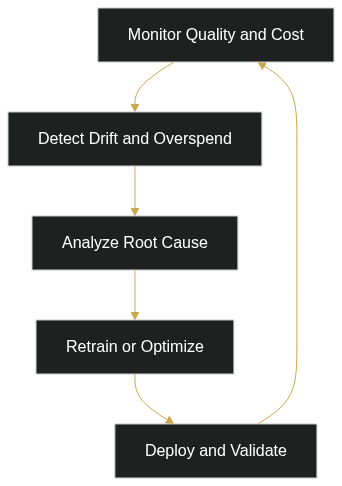
Integrating Monitoring, Retraining, and Cost Control into a Unified MLOps Platform
The three pillars of MLOps for LLM applications work best when integrated. Monitoring detects problems. Retraining solves them. Cost control keeps operations sustainable. A unified platform connects all three.
Inference logging layer captures telemetry from all inference endpoints. Prompts, responses, latency, tokens, user feedback all flow into a central store. This is your source of truth for what happened in production.
Metrics aggregation takes raw logs and computes metrics: hallucination rate, semantic drift, latency percentiles, token usage trends. A time-series database (Prometheus, InfluxDB) stores these metrics and enables fast queries and alerting.
Retraining orchestration is a workflow engine (Airflow, Kubeflow, GitHub Actions) that automates data preparation, training, validation, A/B testing, and deployment. When drift is detected or a schedule triggers, the pipeline launches automatically.
Cost analytics integrates billing data from your LLM provider with custom tracking. Attribute spend to features, models, and users. Compare actual spend against budgets. Recommend optimization opportunities based on cost-per-quality metrics.
Key Integration Patterns
Monitoring detects issues and triggers alerting. Hallucination rate spikes? Slack alert fires. On-call engineers investigate. If root cause is a data quality problem, they manually trigger a retrain job. If root cause is a prompt bug, they fix the prompt and redeploy.
Monitoring can trigger retraining automatically too. Drift detection algorithms identify when model outputs diverge from the reference distribution. Automatically launch a retraining job to bring outputs back in line.
Cost monitoring feeds into retraining decisions. Token spend per request unusually high? Flag it. During the next retraining cycle, prioritize prompt optimization as an experiment. A/B test shorter prompts against the current version. If quality holds, roll out cost-optimized prompts to all users.
This is what makes MLOps for LLM applications different. You’re not just tracking metrics. You’re building a feedback loop where monitoring informs retraining, retraining improves cost efficiency, and cost controls are validated by quality metrics. The three pillars reinforce each other.
Industry Applications of MLOps for LLM
Financial Services and Compliance
Banks and fintech companies deploy LLMs for customer support, risk assessment, and compliance document analysis. Hallucinations are unacceptable. MLOps for LLM applications here demands aggressive hallucination monitoring, human-in-loop review of high-value transactions, and automated retraining on regulatory updates. Cost control comes second to correctness and auditability.
E-Commerce and Recommendations
Retailers use LLMs for product descriptions, customer support, and personalized recommendations. Cost scales with customer interactions. MLOps for LLM applications prioritizes cost control through prompt optimization and model selection. Monitoring focuses on user satisfaction and conversion metrics. Retraining happens weekly to incorporate new product catalogs and seasonal trends.
Healthcare and Diagnostics
Healthcare providers deploy LLMs for patient communication, literature summarization, and clinical decision support. Monitoring must track not just quality but clinical safety too. MLOps for LLM applications includes mandatory human review workflows and incident response protocols. Retraining is careful and conservative, with extensive validation before any model update reaches production.
Content Generation and Publishing
News organizations and content platforms use LLMs for article summarization, headline generation, and content editing. Monitoring focuses on tone, factuality, and editorial consistency. MLOps for LLM applications includes brand voice monitoring and plagiarism checks. Cost optimization matters significantly since content generation scales linearly with publications.
How to Get Started with MLOps for LLM
Building MLOps for LLM applications doesn’t require starting from scratch. Start small, iterate, and scale systematically.
- Instrument your inference endpoint. Add logging to capture prompt, response, tokens, latency, and user feedback. You’ll now have visibility into what’s happening in production.
- Define monitoring metrics aligned with your business goals. If correctness is critical, prioritize hallucination detection. If cost matters most, focus on token usage tracking. You can now measure whether the model is performing as expected.
- Set up alerting and dashboards. When metrics exceed thresholds, send alerts. Build a dashboard for on-call teams. Issues are caught and communicated quickly, reducing mean time to detection.
- Build a data collection pipeline for retraining. Label a small set of production examples with corrections or quality assessments. Store these as a growing dataset for future retraining. You’ll have labeled data ready when retraining becomes necessary.
- Implement a cost tracking system. Tag requests by feature and user. Calculate cost-per-request and cost-per-quality metrics. Identify high-cost use cases. Cost becomes visible, and you can make data-driven decisions about optimization priorities.
Frequently Asked Questions About MLOps for LLM
How do you detect hallucinations in production at scale?
Automated hallucination detection at full scale is still an open problem. Most teams use a hybrid approach: log all outputs, sample outputs for human review on a weekly or trigger-based cadence, and use automated consistency checks (comparing model outputs against trusted reference data) for high-risk domains. Some teams use secondary LLM calls to fact-check outputs, though this adds cost and latency. The key is acknowledging that perfect automation isn’t possible yet and building workflows that combine human judgment with automated signals.
How often should you retrain your LLM models?
Retraining frequency depends on your use case, data freshness requirements, and infrastructure capacity. Scheduled retraining might happen weekly, monthly, or quarterly. Drift-triggered retraining launches when monitoring detects significant quality degradation. The right frequency balances keeping the model current against the operational overhead and cost of retraining. Most teams experiment to find the cadence that fits their business.
What’s the relationship between model quality and inference cost?
They’re tightly coupled. Smaller, cheaper models often produce shorter, lower-quality responses. Larger, expensive models produce longer, higher-quality responses. Cost optimization that pushes the model to answer too concisely can harm quality. The goal is finding the optimal operating point where you’re getting good quality at an acceptable cost. A/B testing is essential to validate that cost optimizations don’t erode user satisfaction.
Which tools should we use to build MLOps for LLM?
The tooling landscape is fragmented and evolving rapidly. For monitoring, consider Datadog, New Relic, or purpose-built LLM observability platforms. For orchestration, Airflow and Kubeflow are solid choices. For experiment tracking and model versioning, MLflow is popular. For cost analytics, you might build custom tracking or use third-party cost intelligence tools. The best approach is choosing tools that integrate with your existing data stack and connecting them with lightweight orchestration logic.
How much does it cost to implement MLOps for LLM?
Cost varies widely based on organization size, existing infrastructure, and implementation approach. Some teams build monitoring and retraining in-house using open-source tools and internal resources. Others partner with specialized vendors or consultants. The investment depends on factors like inference volume, acceptable downtime, regulatory requirements, and internal engineering capacity. We recommend a discovery conversation to understand your specific constraints and build a roadmap tailored to your situation.
Ready to Build Reliable LLM Operations?
MLOps for LLM applications is complex, but the payoff is enormous: models that stay accurate, costs that stay predictable, and teams that sleep at night. Let’s talk about how to implement monitoring, retraining, and cost control specific to your LLM deployment.