

MLOps for Indian Fintech: Building Compliant, Reliable AI Models
MLOps for Indian fintech is transforming how banks, lending platforms, and payment companies manage artificial intelligence in production. India’s regulatory environment, shaped by RBI’s “Principles for Responsible AI” and SEBI’s algorithmic governance requirements, demands that fintech teams move beyond experimentation into structured, auditable model operations. Without it, AI-driven lending algorithms drift in accuracy, fraud detection systems fail silently, and compliance audits become nightmares.
Key Takeaway
MLOps is the operational discipline of versioning, monitoring, and governing AI models in production. For Indian fintech, it’s the bridge between rapid innovation and regulatory compliance. It’s no longer optional; it’s essential.
In This Article
Why AI Model Reliability Matters in Regulated Fintech
Indian fintech is at an inflection point. The industry has grown from early-stage experimentation to delivering billions in credit, processing millions of payments daily, and managing customer wealth through algorithmic recommendations. Yet this explosive growth has outpaced governance maturity. According to NASSCOM’s fintech landscape report, over 50% of Indian fintech startups now employ machine learning for core business decisions, yet fewer than one in three have structured MLOps processes in place.
The regulatory stakes are rising. In 2021, the Reserve Bank of India published its Principles for Responsible AI, signaling zero tolerance for unexplainable or unmonitored algorithms. The Securities and Exchange Board of India (SEBI) has issued guidance on algorithmic trading and risk models. Non-compliance isn’t a technical embarrassment; it’s a regulatory breach with fines, mandatory audits, and potential license suspensions.
67% of Indian fintech firms report challenges in model governance and compliance, primarily due to the absence of structured MLOps processes and real-time monitoring infrastructure.
Industry fintech governance survey, 2024
The human cost is equally real. A lending algorithm that drifts, subtly degrading in accuracy over weeks, approves loans it shouldn’t or denies credit to eligible borrowers. A fraud detection model that wasn’t properly validated flags legitimate transactions, harming customer experience. A robo-advisor recommendation that can’t be explained to a regulator becomes indefensible. These aren’t edge cases; they’re what happens when MLOps maturity is low.

The Core Challenge: Bridging Innovation and Compliance
Fintech founders and CTOs face a real paradox. Investors demand rapid AI-driven feature launches; regulators demand auditability and explainability. Speed and governance feel mutually exclusive. In practice, teams struggle with specific, recurring pain points that MLOps directly addresses.
Model drift unchecked. Production models degrade in performance, lending scores become less discriminative, fraud detectors miss fraud, without real-time alerts. When regulators ask “how do you know your model is still accurate?”, teams can’t answer. They lack the monitoring infrastructure to catch drift early.
Audit readiness gaps. RBI audits expect data lineage, model versioning, and decision explainability. Teams can’t quickly trace why a customer was denied credit or why a transaction was flagged. Model training logic is undocumented; retraining triggers are manual; change logs are spotty. Audits become scrambles.
Data quality and governance. Inconsistent data pipelines, undocumented transformations, and quality checks applied ad hoc lead to biased or unreliable training sets. Compliance teams demand data provenance; data engineering teams lack tools to enforce it.
Explainability debt. Black-box models, gradient boosted trees, neural networks, fail regulatory scrutiny. There’s no systematic way to explain recommendations to customers or authorities. Compliance teams and risk officers feel exposed.
Reproducibility failures. Model development is chaotic. Hyperparameters, training data versions, and feature engineering steps live in Jupyter notebooks or developers’ laptops. Replicating results for audit or retraining becomes impossible; teams rebuild models from scratch, losing institutional knowledge.
Deployment bottlenecks. Moving models from development to production is manual, slow, and risky. Compliance checks are ad hoc. A model might sit in staging for weeks waiting for manual validation, slowing product roadmaps and frustrating engineering teams.
The result: fintech teams either skip compliance corners (regulatory risk) or abandon innovation velocity (business risk). MLOps is the path forward.
The Solution: MLOps Frameworks for Compliance-First Fintech
MLOps for Indian fintech translates regulatory requirements into technical processes. It’s not one tool; it’s a framework spanning data governance, model versioning, continuous monitoring, and automated testing, all designed to keep models accurate, explainable, and auditable.
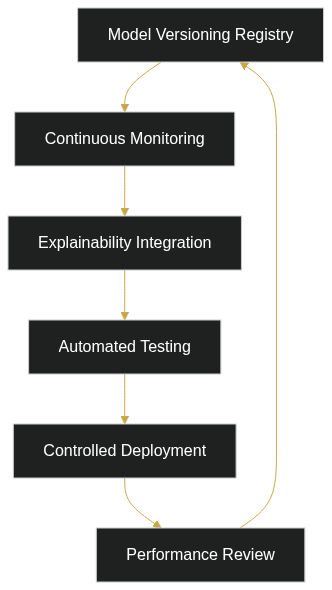
Model Versioning and Registry. Every model artifact, code, hyperparameters, training data snapshot, performance metrics, approval signatures, is centrally tracked. When a regulator asks “what version of your lending model was live on March 15?”, you answer immediately. Reproducibility becomes guaranteed; audit trails, automatic.
Continuous Monitoring and Drift Detection. Real-time dashboards track model performance (accuracy, precision, recall), data quality (missing values, distribution shifts), and prediction behavior (average score, decision rates). Automated alerts fire when performance drops below thresholds or data drifts significantly. Teams proactively retrain before models degrade.
Data Governance and Lineage. Every data source, transformation, and quality check is documented. Teams know exactly which customers’ data trained a model, which features matter most, and where bias might hide. Compliance audits become straightforward; regulators see full transparency.
Model Explainability Integration. SHAP (SHapley Additive exPlanations) and LIME (Local Interpretable Model-agnostic Explanations) outputs are computed for every prediction. When a customer asks “why was I denied?”, your system provides a clear, legally defensible explanation. Compliance teams can justify decisions to regulators.
Automated Testing and Validation. Pre-deployment checks enforce bias thresholds, performance minimums, and regulatory guardrails. Models that don’t meet standards never reach production. Manual audit burden drops; rigor stays high.
Controlled Deployment. Canary releases and A/B tests mean new models launch with guardrails. A model reaches 10% of customers first; if performance holds, it rolls to 100%. Audit trails capture every stage; rollback is instant if needed.
Expert Perspective
In our work with Indian fintech teams, we’ve observed that the highest-maturity operations treat compliance as a first-class design requirement, not an afterthought. They bake explainability, monitoring, and governance into the MLOps pipeline from day one. This approach reduces audit friction, accelerates feature launches, and builds customer trust simultaneously.
When selecting a partner or building in-house, prioritize teams with direct experience in regulated fintech environments. Look for expertise in RBI and SEBI requirements, not just generic MLOps tooling. End-to-end ownership, from data governance through deployment monitoring, beats point solutions that require manual stitching.

Industry Applications in Indian Fintech
MLOps frameworks apply across fintech verticals, each with distinct compliance and reliability requirements.
Digital Lending and Credit Risk
Credit scoring models power loan approvals, pricing, and limit decisions. They must comply with RBI fair lending guidelines, no discrimination on protected characteristics. Explainability is non-negotiable; denied customers deserve clear reasons. MLOps adds continuous retraining as borrower populations shift, drift detection to catch model decay, and audit logs that prove fair treatment. When a regulator audits, you show monitored performance metrics across demographics, evidence of fairness testing, and deployment records.
Fraud Detection and Prevention
Real-time transaction monitoring requires high precision (minimize false positives that frustrate customers) and high recall (catch actual fraud). Fraud tactics evolve constantly; models must retrain frequently to stay effective. MLOps enables continuous retraining pipelines, monitoring for concept drift as fraudster behavior shifts, and documented decision logic for fraud investigation teams. Compliance demands audit trails for every blocked transaction; MLOps makes that auditable and scalable.
Robo-Advisory and Wealth Management
Algorithmic portfolio recommendations must align with customer risk profiles and SEBI suitability rules. Model drift here is subtle but consequential; if recommendation logic drifts, customer portfolios become misaligned with stated risk tolerance. MLOps monitors recommendation accuracy against customer outcomes, detects drift across market regimes, and generates audit reports proving compliance with suitability rules. Explainability ensures customers understand why a particular allocation was recommended.
KYC, AML, and Identity Verification
ML-assisted document verification and customer risk classification must be auditable and unbiased. Models can’t drift toward false-flagging customers of particular backgrounds; compliance frameworks demand periodic re-validation. MLOps tracks model fairness metrics, flags bias signals early, and maintains audit logs showing why customers were flagged or cleared. This level of governance turns identity models from regulatory liabilities into assets.
How to Build and Deploy MLOps in Fintech
Building MLOps maturity doesn’t happen overnight, but a structured approach de-risks the journey. Here’s a roadmap that works.
Step 1: Audit Your Current State. Inventory all production models, their data lineage, current versions, and existing monitoring (if any). Identify which models pose highest compliance risk, usually credit, fraud, or algorithmic trading models. Document what you know and what’s missing. Outcome: Clear visibility into compliance gaps and operational risks.
Step 2: Define Governance and Compliance Requirements. Partner with risk and compliance teams to map RBI and SEBI requirements to MLOps processes. For example: Who must approve model changes? How often must models be re-validated? What explainability methods meet regulatory expectations? What audit logs are required? Outcome: Shared understanding of non-negotiables; reduces back-and-forth during implementation.
Step 3: Implement Core MLOps Infrastructure. Set up a model registry (internal or vendor), data versioning tools, automated testing pipelines, and monitoring dashboards. Start with your highest-risk models. Infrastructure doesn’t need to be perfect; it needs to be functional and auditable. Outcome: Foundation for reliable, traceable model management.
Step 4: Integrate Explainability and Monitoring. Add SHAP or LIME for prediction explanations; set up performance and drift alerts; create compliance-focused dashboards for risk and audit teams. Make sure monitoring feeds into decision-making; alerts without action are just noise. Outcome: Models become transparent; regulators gain confidence.
Step 5: Establish Review and Retraining Cadence. Define regular performance reviews (monthly for high-risk models, quarterly for others) and clear retraining triggers. Automate what you can; document decisions you can’t. This cadence ensures proactive model management and reduces surprises during audits. Outcome: Continuous improvement; reduced regulatory friction.
Frequently Asked Questions
What’s the difference between MLOps and compliance?
MLOps is the infrastructure and operational process for managing models reliably in production: versioning, monitoring, testing, governance. Compliance is the requirement set defined by regulators and internal policies. Think of MLOps as the foundation; compliance is built on top. MLOps enables compliance but doesn’t itself guarantee it. You can have excellent MLOps and still fail compliance if you don’t know the regulatory requirements.
Does my fintech need MLOps if we only have one or two models?
Yes, arguably even more so. Small teams lack redundancy to absorb model failures. A single well-governed model with clear audit trails beats ten ungoverned ones. Start with basics: versioning, monitoring, and audit logs. This foundation becomes your competitive advantage as you scale and regulators intensify scrutiny.
How often should we retrain models for compliance?
There’s no universal answer. Credit models might need quarterly retraining; fraud detection, monthly; a stable risk model, semi-annual. The right cadence depends on model type, data velocity, and regulatory expectations. RBI guidance suggests a risk-based approach: higher-risk models need more frequent validation. Work with your compliance team to define triggers, whether performance degradation, data drift, or time-based, then automate accordingly.
Can we use open-source MLOps tools or do we need commercial vendors?
Both paths work. Open-source tools like MLflow, Airflow, and Kubeflow offer flexibility and cost efficiency; commercial platforms like Datarobot or H2O provide turnkey solutions with built-in compliance features. Choose based on in-house engineering capacity and compliance complexity. A startup with strong data engineering talent might prefer open-source; a regulated enterprise might value vendor support and pre-built compliance templates.
How does MLOps handle model bias and fairness?
MLOps frameworks integrate fairness testing into the pipeline. Before production, models are evaluated for demographic parity, equalized odds, and calibration across protected groups. Monitoring tracks fairness metrics post-deployment; alerts fire if fairness degrades. Explainability tools surface feature importance, revealing bias sources. Regular bias audits, documented in MLOps systems, satisfy regulatory requirements and build customer trust.
Ready to Build Compliant, Reliable AI Models?
MLOps transforms fintech from wrestling with model governance to shipping AI confidently. Whether you’re scaling your first credit model or managing a portfolio of algorithms, structured MLOps reduces audit friction, accelerates launches, and builds customer trust.
ViZRR specializes in helping Indian fintech teams implement MLOps frameworks tailored to RBI and SEBI requirements. We’ve worked with lending platforms, fraud prevention teams, and robo-advisors to turn compliance from a bottleneck into a competitive advantage. Let’s discuss your specific challenges and build a roadmap.
Transform AI Governance Into a Strength
Get expert guidance on implementing MLOps frameworks that satisfy regulators and accelerate feature launches. Our team understands Indian fintech compliance, not just generic MLOps tooling. Reach out for a no-pressure discovery conversation.