

AI Integration Issues? Common Roadblocks and Fixes
AI integration issues are blocking enterprise deployments at scale. Your AI strategy is solid. Your API budget is approved. But six weeks into deployment, your data isn’t flowing where it should, your team is debugging authentication errors, and the promised “AI-powered insights” feel months away. This isn’t a failure of vision or technology. It’s a predictable structural problem that thousands of enterprises face right now.
Key Takeaway
Most AI integration issues aren’t caused by the AI or the API themselves. They’re caused by misaligned expectations, insufficient observability, or underestimated complexity when connecting legacy systems to modern AI platforms.
In This Article
- Why AI Integration Issues Are Blocking Enterprise Deployments
- The 6 Core AI Integration Roadblocks Enterprises Face
- How to Fix AI Integration Roadblocks: A Solution Framework
- Why Leading Enterprise Teams Choose Modern Integration Partners
- AI Integration by Industry: Real-World Scenarios
- How to Get Started: A 5-Step Path Forward
- Frequently Asked Questions
Why AI Integration Issues Are Blocking Enterprise Deployments
The AI adoption paradox is real. Enterprises are investing heavily in AI capability, yet a significant portion of those initiatives stall or miss deployment timelines due to integration complexity. According to Gartner’s latest research on AI adoption maturity, integration challenges rank among the top three reasons enterprise AI projects miss their target dates and budget targets.
That’s why understanding the structural causes matters more than ever. AI integration issues stem from three converging forces.
First, legacy systems are older and more rigid than ever. The average enterprise still runs ERP systems deployed 8 to 15 years ago. These systems weren’t designed for real-time API orchestration or for consuming data from external AI providers. Second, the explosion of AI API options has created decision paralysis and operational complexity. Ten years ago, you had one or two options. Today, OpenAI, Anthropic, Cohere, and dozens of open-source models compete for your attention. Each requires different authentication, input formatting, and rate-limiting strategies. Third, the talent gap is acute. Few engineers have deep expertise in both enterprise architecture and AI API integration simultaneously.
“Integration challenges are cited by 67% of enterprise AI initiatives as a primary driver of deployment delays, adding 2 to 4 months of rework and unplanned engineering overhead.”
Forrester Enterprise AI Maturity Study, 2024
Why this matters now: competitive pressure to deploy AI faster is intense. Your competitors are moving. Your board is asking when “AI-powered outcomes” will show up on the P&L. Yet rushing into point-to-point API integrations without proper architecture, governance, and observability almost guarantees rework, cost overruns, and security risk.

The 6 Core AI Integration Roadblocks Enterprises Face
AI integration issues typically manifest across six structural categories. Understanding each one helps you diagnose where your deployment is stuck.
1. Legacy System Incompatibility
Old databases, ERP systems, or data warehouses weren’t designed for real-time AI API calls. Your data is stored in proprietary schemas, batch processing schedules, and rigid table structures. When you try to push that data into an AI API in real-time, the mismatch creates bottlenecks. Transformation layers break or don’t scale under load.
2. Authentication and Authorization Complexity
Multiple AI vendors mean multiple credential schemes. You’re juggling API keys for OpenAI, OAuth 2.0 flows for others, mutual TLS for some, and service accounts for internal systems. Single sign-on isn’t guaranteed. Rotating credentials becomes an operational nightmare. One forgotten API key refresh and your entire pipeline fails silently.
3. Data Schema and Format Mismatches
AI APIs expect specific input formats: JSON with particular field names, specific data types, maximum token counts, or structured prompts. Your data is stored in a completely different shape. Building one-off transformation scripts works initially. But it doesn’t scale when you add a second AI API, a third vendor, or new data sources.
4. Rate Limiting and Cost Control
Unlimited API calls equal unlimited bills. Without proper queuing, throttling, and cost attribution, your usage spikes unpredictably. Engineers don’t know who spent what on which AI API call. Service degrades when you hit rate limits. And nobody wants to explain a surprise $200K cloud bill to the CFO.
5. Observability and Error Handling Gaps
When an AI API call fails mid-workflow, where does the data go? How do you debug? Many enterprises lack visibility into integration failures. You don’t know if the API timed out, if your request was malformed, or if the vendor’s service went down. Troubleshooting takes hours instead of minutes.
6. Governance, Compliance, and Security Risks
Sending sensitive data, PII, financial records, healthcare information to third-party AI APIs requires audit trails, encryption, and compliance mapping. Most first-pass integrations skip this entirely. You’re exposing regulated data without audit logs. You can’t prove to compliance auditors that data was handled correctly. And you’ve got no way to verify that the AI provider isn’t training on your proprietary information.
Each of these AI integration issues doesn’t just delay deployment. It erodes stakeholder confidence, consumes engineer bandwidth on rework, and increases security and compliance risk.
How to Fix AI Integration Roadblocks: A Solution Framework
Fixing AI integration issues isn’t about quick hacks. It requires a structured, architecture-first approach that addresses root causes, not symptoms.
Step 1: Map Your Integration Architecture
Start with complete clarity on your current state. Audit existing systems: what data lives where? What APIs exist internally? Which external AI APIs do you actually need? Identify integration patterns you’re currently using or could use.
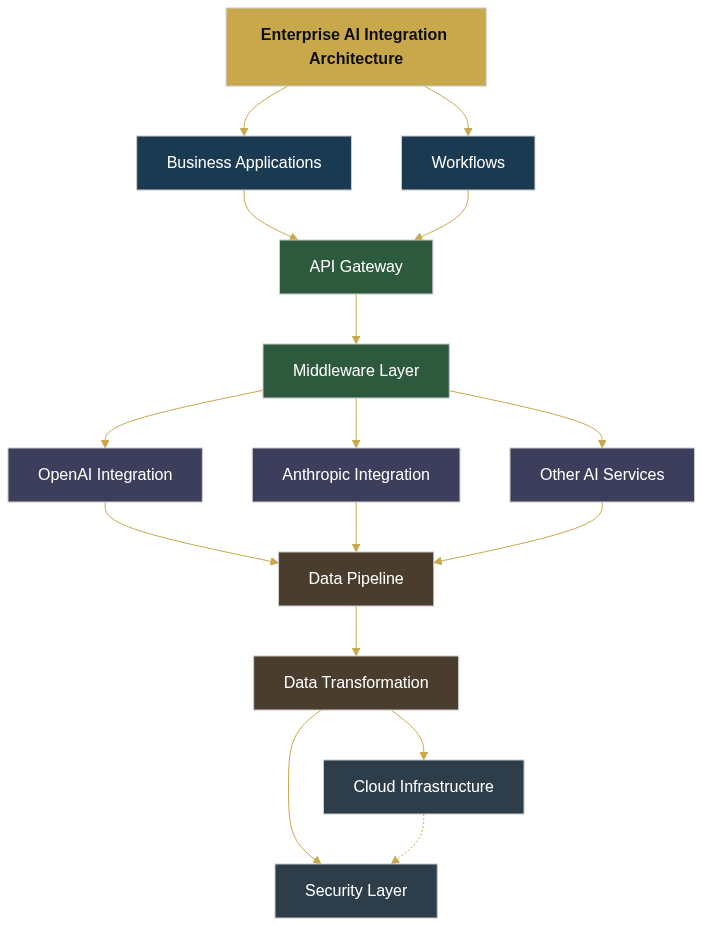
There are three core patterns. Point-to-point integration is fragile. Every system connects directly to every other system, creating chaos at scale. Hub-and-spoke is more scalable: a central middleware layer manages all connections. Event-driven architecture is the most resilient. Systems communicate through event streams, enabling loose coupling and better observability.
Outcome: a visual blueprint showing data flows, dependencies, and risk zones. This map becomes your strategic reference for the next 12 months.
Step 2: Implement an Integration Middleware or API Gateway
Centralize credential management, rate limiting, and request/response transformation in a single gateway layer. This is the single architectural decision that separates successful AI integration projects from struggling ones.
A well-designed gateway enables you to add, swap, or deprecate AI vendors without touching application code. It enforces consistent logging and monitoring. It handles rate limiting, retries, and failover logic. It becomes the single point where you implement governance and compliance controls.
Outcome: reduced coupling between legacy systems and AI APIs. Easier to add new vendors, swap providers, or sunset integrations. And far more resilient when something breaks.
Step 3: Establish Observability and Monitoring
Log every AI API call: prompt, response, latency, cost, and errors. Set up alerts for rate-limit approaches, authentication failures, and anomalous latencies. Build a dashboard that shows health across all integrated AI APIs in one place.
Outcome: when things break, you know why in minutes, not days. You can trace a data flow end-to-end and pinpoint exactly where it failed.
Step 4: Build Governance Checkpoints
Define what data can flow to which AI APIs. Implement approval workflows for new integrations. Run regular audits of API permissions and data residency. Document compliance mappings: which data falls under GDPR, HIPAA, or other regulations, and where can it safely go?
Outcome: security and compliance confidence. When auditors ask, you have logs. When regulators investigate, you have evidence of controls.
Step 5: Start with Low-Risk Use Cases
Don’t pilot AI integration issues on your core business-critical workflows. Start with non-critical use cases: analytics, reporting, customer support, or internal research. Build operational muscle. Integrate learnings before betting the company.
Outcome: faster time-to-value. Reduced enterprise risk. A proven playbook you can scale.
Expert Perspective
Enterprise teams that successfully resolve AI integration issues typically start with middleware and gateway infrastructure, not point-to-point API connections. This architectural choice is the single biggest predictor of long-term success. It’s not the sexiest decision, but it’s the one that prevents rework, cost overruns, and late-night incidents.

Why Leading Enterprise Teams Choose Modern Integration Partners
At this point, you’re facing a decision: build AI integration infrastructure in-house, use a generic integration platform, or partner with an enterprise AI integration specialist. Each path has trade-offs.
| Criteria | DIY / Point-to-Point | Generic Integration Platform | Enterprise AI Integration Specialist |
|---|---|---|---|
| Time to deploy first integration | 8 to 12 weeks (high rework) | 4 to 6 weeks (partial governance) | 3 to 4 weeks (with strategy built in) |
| Governance and compliance readiness | Manual, error-prone | Generic templates (limited) | Comprehensive, audit-ready |
| Support for legacy systems | Limited custom work | Some pre-built connectors | Extensive (deep expertise) |
| Cost predictability | Low initial, high rework | Medium (hidden scaling) | Medium (avoids costly re-architecture) |
| Vendor lock-in risk | High (custom code) | Medium (proprietary platform) | Low (multi-vendor designed in) |
Three factors separate enterprises that solve AI integration issues from those that don’t.
First, a governance-first approach. Not just “connect the API”, but “connect it safely, compliantly, and auditabaly.” This maturity level is what separates enterprises from startups. Generic platforms focus on connectivity. Specialists focus on governance. Second, multi-vendor by design. Pre-built connectors for OpenAI, Anthropic, Cohere, and open-source models. Your strategy isn’t hostage to one vendor’s roadmap or pricing changes. Third, enterprise architecture alignment. Integration patterns built on proven principles: modularity, resilience, scalability. Not just a dashboard. A structural enabler.
Worth noting: consider the support model. When your AI integration issues surface at 2 AM on Friday, who answers the phone? A vendor’s support tier, or a specialist with deep context on your architecture?
AI Integration by Industry: Real-World Scenarios
AI integration issues manifest differently depending on your industry and use case. Here’s how leading enterprises in four sectors address them.
Financial Services
Use case: compliance-heavy ML model integration for fraud detection and risk assessment. Challenge: regulatory audit trails, immutable transaction logs, real-time decision explanations. Solution: governance middleware ensures every AI decision is logged, timestamped, and explained. Compliance teams can audit exactly why a transaction was flagged or approved. Result: faster deployment without regulatory risk.
Healthcare and Life Sciences
Use case: patient data enrichment and diagnostic support with AI models. Challenge: HIPAA compliance, de-identification requirements, multi-system patient records spread across legacy ERP, pharmacy, and lab systems. Solution: secure data transformation layer in the integration gateway enforces encryption, access controls, and audit logging. PHI never leaves your infrastructure in plaintext. Result: AI-powered insights without violating patient privacy.
Retail and E-Commerce
Use case: personalization engine for product recommendations and dynamic pricing. Challenge: real-time data ingestion at massive scale, cost control on API calls (thousands per second). Solution: rate limiting and intelligent caching in the middleware layer prevents runaway costs. Latency optimization ensures customer-facing responses stay under 200ms. Result: AI-powered personalization that doesn’t tank margins or degrade user experience.
Logistics and Supply Chain
Use case: demand forecasting and route optimization powered by AI models. Challenge: legacy ERP integration, multi-site data consolidation, unreliable network connectivity at distributed locations. Solution: hub-and-spoke architecture collects data from 50+ warehouse and distribution systems. Event-driven pipeline ensures data flows reliably even when network is degraded. Unified API orchestration routes all forecasts to AI models. Result: enterprise-wide visibility and optimization without re-platforming legacy systems.

How to Get Started: A 5-Step Path Forward
Ready to fix your AI integration issues? Here’s a clear, phased approach.
- Diagnose Your Current State. Inventory your AI and API needs. Which use cases are highest priority? Audit existing integrations. What’s working? What’s fragile? Identify compliance and security constraints specific to your industry. Outcome: baseline understanding, no surprises later.
- Define Your Integration Architecture. Choose a pattern: middleware gateway, event-driven, or hybrid. Map data flows and identify the systems that must integrate first. Outcome: architectural blueprint that your engineering team can execute against.
- Pilot with a Low-Risk Use Case. Select a non-critical workflow to integrate first. Analytics, reporting, or customer support are good candidates. Build observability and monitoring into this pilot from day one. Outcome: proven integration pattern, operational muscle, faster subsequent rollouts.
- Implement Governance and Compliance Checkpoints. Formalize what data can flow to which AI APIs. Document compliance mappings. Set up approval workflows for new integrations. This step prevents security and regulatory incidents. Outcome: audit-ready controls, reduced risk.
- Scale to Production Use Cases. Armed with a proven architecture and operational playbook, expand to business-critical workflows. Monitor, optimize, and refine based on real-world performance. Outcome: AI-powered insights reliably delivered at enterprise scale.
Frequently Asked Questions
What’s the difference between AI integration issues and regular API integration problems?
Regular API integration typically involves structured, predictable data flows. AI integration adds complexity because AI models consume unstructured data, produce probabilistic outputs, and require careful cost management at scale. Additionally, AI systems often require governance controls and audit trails that generic APIs don’t demand. These extra layers create more failure points.
How do I know if my AI integration is at risk of failing?
Warning signs include: your team is debugging authentication errors regularly, you don’t have visibility into which integrations cost the most, you’ve built multiple one-off transformation scripts instead of a unified layer, or compliance teams haven’t mapped which data flows are regulated. If you’re seeing three or more of these patterns, a strategic review is overdue.
Should we build AI integration infrastructure in-house or buy a platform?
Build in-house if you have senior architects with enterprise integration and AI expertise, and your feature roadmap allows 6+ months of investment before value appears. Buy a platform if you need to move faster, want to avoid vendor lock-in, or lack deep AI integration expertise on your team. Most enterprises benefit from a hybrid: buy the governance and gateway layer, build custom connectors for proprietary systems.
How do we prevent runaway costs with AI APIs?
Implement three controls: (1) rate limiting and request batching in your gateway layer, (2) cost attribution per application or team through a charge-back model, and (3) alerts when spending approaches thresholds. Monitor token usage for LLM APIs especially and optimize prompts regularly. Most teams reduce their AI API spending 20 to 30% after implementing proper observability and cost controls.
What’s the most critical thing to do first when tackling AI integration issues?
Map your current integration landscape honestly. Don’t assume you know which systems are in scope or which data flows are regulated. A half-day workshop with architects, compliance, and engineering usually surfaces hidden dependencies and risk zones that change your entire strategy. This clarity upfront prevents rework later.
Ready to Solve Your AI Integration Issues?
Stop debugging authentication errors and fighting compliance reviews. Partner with an integration specialist who understands enterprise architecture, governance, and the real complexity of connecting legacy systems to modern AI platforms. We’ll help you build a resilient, scalable integration strategy that delivers value without risk.