

How D2C Brands in India Are Using Vibe Coding to Launch Apps Fast
Vibe Coding is transforming how Indian direct-to-consumer brands build and deploy customer applications. Six months ago, a three-person skincare startup in Bangalore faced a choice: wait six to eight months for a custom mobile app from a traditional agency, or find a faster path to market. They chose Vibe Coding and launched their customer loyalty app in just four weeks. Today, hundreds of D2C founders across India are discovering that rapid, AI-assisted development platforms aren’t just faster, they’re fundamentally changing what’s possible for bootstrapped teams competing against well-funded incumbents.
Key Takeaway
Vibe Coding and AI-assisted app development platforms enable D2C brands in India to launch customer apps in a fraction of traditional timelines while maintaining quality and staying within tight budgets.
In This Article
- Why App Speed Matters for D2C Brands Right Now
- The Core Challenge for D2C Founders Building Apps
- The Solution: Vibe Coding for D2C App Development
- Why Leading D2C Brands Choose Vibe Coding
- Real-World Applications Across D2C Verticals
- How to Get Started With Rapid App Development
- Frequently Asked Questions
Why App Speed Matters for D2C Brands Right Now
India’s direct-to-consumer market is growing at an exceptional pace. According to NASSCOM, Indian D2C brands are expanding their market share at roughly 35 to 40 percent annually, with mobile commerce now driving over 60 percent of all e-commerce transactions. For founders, that’s both exciting and terrifying.
Here’s the honest part: brands that can’t move fast lose to competitors who can. A D2C founder launching a customer app today isn’t just competing with other bootstrapped startups. They’re competing with established players who already have mobile presence, with marketplace giants who offer convenience without switching costs, and with consumer expectations shaped by slick, responsive apps. Winning means speed. Full stop.
“D2C brands with owned-channel customer apps show 3x higher customer lifetime value compared to brands relying solely on marketplace channels.”
NASSCOM D2C Market Report, 2024
Here’s the thing most guides won’t tell you: the window for traction in any D2C category is shrinking. Seasonal demand doesn’t wait. Customer attention doesn’t wait. Vibe Coding and rapid development platforms address this directly by collapsing the timeline from months to weeks, letting founders validate ideas and respond to market feedback while their window is still open.

The Core Challenge for D2C Founders Building Apps
Traditional app development for D2C brands creates a painful bottleneck. The standard path looks like this: founders spend four to eight weeks finding the right agency, another two to three weeks in requirements and design lockdown, then four to six months waiting for delivery. By that time, market conditions have shifted, user feedback’s been missed, and your product roadmap’s become outdated.
Sound familiar? Here’s what actually keeps D2C founders up at night.
- Long development timelines: Offshore agencies and boutique shops typically require four to six months for a production-ready app. Communication delays, scope creep, and time zone friction all add up.
- Prohibitive upfront costs: Building a custom app through an agency typically costs ₹20 lakhs to ₹50 lakhs upfront, consuming a significant portion of a bootstrapped brand’s growth budget.
- Dependency on specialized talent: Hiring full-stack engineers in India’s competitive market means either paying premium salaries or settling for junior developers who slow delivery further.
- Slow iteration cycles: Once an app is built, launching new features takes weeks. You can’t respond rapidly to user feedback, competitive threats, or seasonal opportunities.
- Vendor lock-in and maintenance risk: Custom-built apps become difficult to modify or maintain if the agency relationship ends or priorities shift unexpectedly.
- Quality inconsistency: Remote teams across time zones struggle with debugging and post-launch issue resolution, leading to a parade of bugs and user frustration.
The consequence is significant. A D2C brand that can’t launch fast misses seasonal demand spikes, watches competitors gain user loyalty through newer features, and burns runway on extended development cycles. In the current Indian startup ecosystem, speed to market is a survival metric.
The Solution: Vibe Coding for D2C App Development
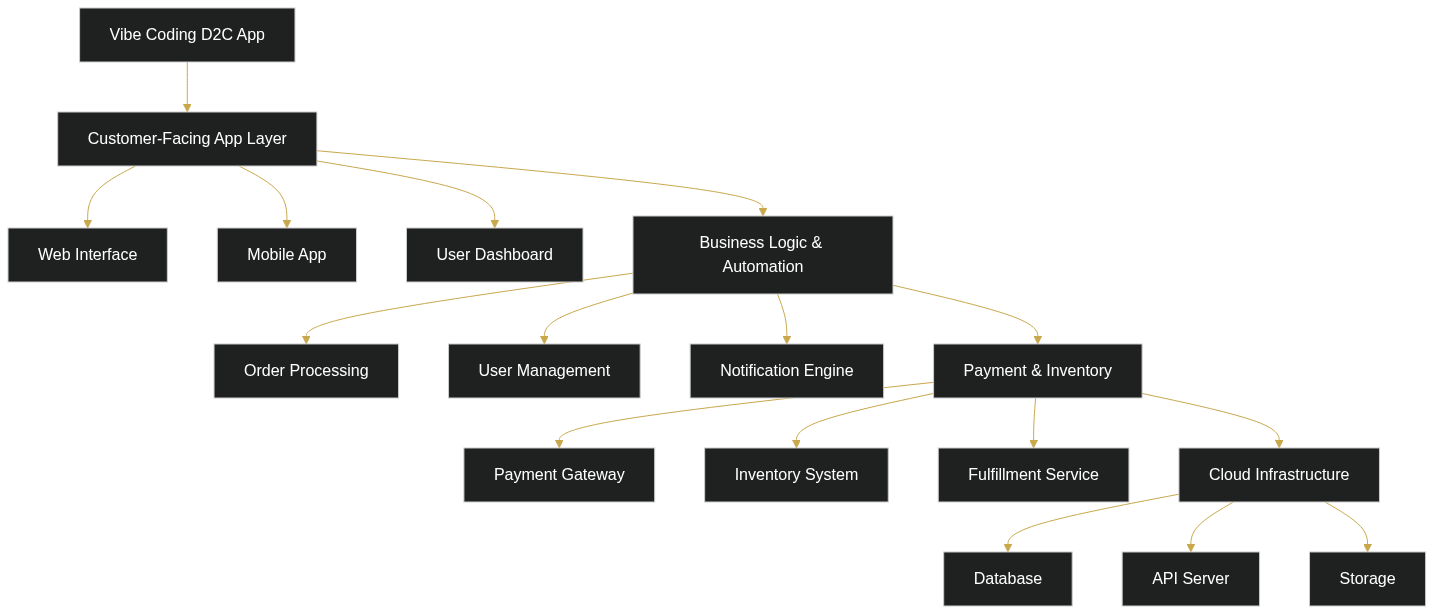
Vibe Coding addresses each of these pain points through a fundamentally different approach to app development. Rather than starting from a blank slate and writing every line of code manually, Vibe Coding uses AI and intelligent templates to automate boilerplate work, pre-built integrations for common D2C needs, and drag-and-drop interfaces that let non-technical team members contribute directly.
Here’s how it solves the core problems. First, it collapses timelines by eliminating weeks of infrastructure setup, database design, and backend scaffolding. AI code generation handles repetitive work, while pre-built e-commerce integrations connect payment gateways, inventory systems, and customer databases instantly. Second, it reduces costs through a subscription model rather than massive upfront payments, making app development predictable and founder-friendly. Third, it reduces your dependency on specialized developers by letting product managers and designers participate in app logic without needing to code. Fourth, it enables rapid iteration because feature updates are fast to ship, days instead of weeks. Fifth, you own the generated code and can export it if needed, avoiding vendor lock-in. Finally, AI co-pilots review code quality, and built-in testing workflows catch issues early, reducing post-launch surprises.
Expert Perspective
Vibe Coding works best when founders are disciplined about MVP scope. The fastest launch isn’t the one that adds fifty features; it’s the one that ships five must-haves and iterates weekly based on user data. Founders who rush poorly-scoped features into launch often create technical debt that slows future iterations. Success requires clear prioritization and honest conversations about what can wait.
When evaluating a rapid app development platform for your D2C brand, look for these capabilities. First, native integrations with the e-commerce platforms you rely on: Shopify, WooCommerce, Razorpay, and other Indian payment processors should connect seamlessly. Second, built-in SDKs for push notifications, analytics, and customer behavior tracking. These aren’t nice-to-haves. Third, real-time team collaboration features so your product manager, designer, and developer can work simultaneously without bottlenecks. Fourth, a clear export path that lets you take your code elsewhere if circumstances change. Finally, India-specific compliance support, including data residency options that meet RBI requirements, GST handling, and privacy standards under the Digital Personal Data Protection Act.
Why Leading D2C Brands Choose Vibe Coding
The choice between Vibe Coding and traditional agencies isn’t primarily about technology. It’s about alignment with how D2C brands actually operate. Here’s what matters most to founders.
| Dimension | Vibe Coding & Rapid Platforms | Traditional Agencies |
|---|---|---|
| Time to Launch MVP | 2-4 weeks | 4-6 months |
| Cost Structure | Predictable subscription per month | Large upfront fee, risk of overruns |
| Feature Iteration Speed | 2-3 days per new feature | 2-4 weeks per feature |
| Code Ownership | You own 100% of generated code | Vendor-dependent, often unclear licensing |
| Team Scaling | Add platform users cheaply | Hire more developers at high cost |
| Post-Launch Flexibility | In-house team maintains and modifies | Dependent on vendor availability |
Three differentiating factors stand out. First, speed to market with Vibe Coding D2C development is dramatically faster because AI eliminates architecture and boilerplate work that typically consumes weeks. Second, cost and predictability favor rapid platforms because you’re not subject to scope creep, change order fees, or vendor incentives to pad timelines. Third, ownership and autonomy matter immensely for fast-moving D2C brands. You can ship features without waiting for external developers, and your customer data stays in-house.
D2C brands that we’ve worked with consistently report that their feature velocity increases ten-fold post-launch. Why? It’s straightforward: when shipping new features requires writing a Slack message to an external developer, waiting for a meeting, discussing specifications, and watching a two-week delivery cycle unfold, most ideas never ship. When shipping a feature requires two hours of work by someone on your team, your entire roadmap changes. You iterate based on real user data instead of stale assumptions.
Real-World Applications Across D2C Verticals in India
Fashion and Beauty D2C
A direct-to-consumer skincare brand in Bangalore faced the classic dilemma: marketplace dependence was limiting margin and customer relationships. They needed a customer app to build loyalty and reduce acquisition cost. Using Vibe Coding, they launched in four weeks with a referral program, wishlist functionality, subscription management, and personalized recommendations based on skin type. The critical feature was two-way inventory sync with their Shopify store, ensuring that app inventory always matched reality. Post-launch, they shipped weekly feature updates, user reviews, AR try-on previews via Snapchat, and seasonal look-books because iteration was fast and inexpensive. Their repeat purchase rate increased 2.3x after the app reached 5,000 active users.
Subscription and Food Tech
A meal-prep startup needed to reduce customer acquisition cost and improve retention through an owned channel. Their Vibe Coding app launched with subscription order management, Razorpay wallet integration, personalized meal recommendations, and push notifications timed to weekly meal drops. Backend integration with their kitchen management system ensured real-time inventory and delivery forecasting. Within two months, they’d added dynamic pricing based on demand, referral incentives that drove 25 percent of new signups, and a loyalty points system. The low friction of adding features meant the product team could experiment and iterate based on actual user behavior rather than guessing.
Health and Wellness Coaching
A boutique fitness brand wanted to offer virtual coach-led classes, live group sessions, and on-demand video libraries directly to customers. Vibe Coding enabled them to build an app with video streaming, class scheduling, payment processing, and real-time notifications. They integrated Stripe and Razorpay for flexible billing, built out a user progression system, and added leaderboards for community engagement. The app launched with a minimum viable feature set, then the team added advanced metrics, calorie burn tracking, form-check video uploads, and personalized workout recommendations based on how users actually engaged with the platform.
How to Get Started With Rapid App Development
Here’s a practical roadmap for D2C founders considering Vibe Coding or similar rapid platforms.
- Define your MVP ruthlessly: Document the absolute minimum features needed to validate your app hypothesis with real users. This typically means 4-8 core features, not 40. Ruthless scoping is the single most important factor in launch speed.
- Map your integrations: List every external system your app must connect to: payment processors, inventory management, CRM, analytics, SMS. Confirm that your chosen platform has native support for these integrations.
- Audit your team’s capacity: Identify who on your team will champion the app development process, ideally someone with product thinking, design sensibility, and enough bandwidth to work on the platform two to three days per week during the build phase.
- Run a discovery sprint: Before fully committing, spend 2-3 days exploring the platform with your team. Build a small prototype feature end-to-end to validate the workflow and confirm that the platform fits your technical requirements.
- Set a hard launch date: Commit to a specific date and communicate it across your team and your audience. Public commitment creates discipline and forces prioritization decisions that speed execution.
Worth noting: successful rapid app launches share one trait. Founders who treat the first version as a starting point, not a finish line. How much does it cost to build an MVP in India is less important than how quickly you can get it in front of users and start iterating. That’s where Vibe Coding D2C development shines.
Frequently Asked Questions
What’s the difference between Vibe Coding, no-code, and low-code development?
No-code platforms let you build without writing any code, everything’s drag-and-drop. Low-code platforms provide visual interfaces but allow you to write custom code when you need advanced features. Vibe Coding blends both: it uses AI to generate production-quality code from high-level descriptions, letting you move fast while maintaining flexibility and code ownership. For D2C brands, you get speed without sacrificing control.
Can Vibe Coding handle complex e-commerce requirements like inventory sync and dynamic pricing?
Yes. Most modern rapid platforms including Vibe Coding come with pre-built integrations for inventory management, payment processing, and analytics. Dynamic pricing logic can be implemented through APIs and backend workflows. That said, if your pricing algorithm is highly proprietary or involves real-time machine learning models, you may need custom engineering for that specific component while the rest of the app stays on the rapid platform.
What happens if my app needs to scale to millions of users?
Rapid platforms are designed with scalability in mind. Most can handle millions of requests daily through cloud infrastructure. Here’s the thing though: at extreme scale, think Flipkart-level traffic, you may eventually need custom optimization. Most D2C brands find that they can operate at 10M+ monthly active users on rapid platforms without issues. Plan to revisit architecture only after you’ve actually achieved that scale, not before.
Will using Vibe Coding lock me into a vendor?
Most reputable rapid platforms, including Vibe Coding, allow you to export your generated code and host it independently. You won’t be locked into their servers forever. That said, you will have a dependency on their platform during development and initial deployment. Choose a platform with a clear export policy and a healthy roadmap before committing.
How do I handle data privacy and regulatory compliance with rapid platforms?
Rapid platforms designed for Indian D2C brands typically offer compliance features: data residency options that keep customer data in India, audit trails for compliance, and support for local payment processors. However, read the data processing agreement carefully and verify that they meet your specific requirements under the Digital Personal Data Protection Act and RBI guidelines for financial data.
What kind of post-launch support do Vibe Coding platforms provide?
Most platforms offer documentation, community forums, and support tickets. Some offer managed services where their team assists with deployment and optimization. Evaluate the support model that fits your risk tolerance and team bandwidth. In our experience, community support often suffices for early-stage D2C brands. As you scale, upgraded support plans become valuable.
Ready to Launch Your D2C App Fast?
Whether you’re building your first customer app or scaling to millions of users, the right development partner makes all the difference. ViZRR helps D2C brands in India navigate rapid development platforms, connect them to the right technical architecture, and execute launches that drive real growth. Let’s explore what’s possible for your app vision.