

RAG Pipelines and Multi-Agent Systems: Building Reliable Enterprise AI
RAG pipelines and multi-agent systems have become essential for enterprises deploying AI at scale. Two years ago, a Fortune 500 financial services company deployed an AI assistant that confidently provided customers with outdated product information. The LLM wasn’t hallucinating in the traditional sense. It was generating plausible text without access to current data. This is the core problem RAG pipelines solve. When combined with multi-agent orchestration, they transform fragmented enterprise data into trustworthy, auditable AI systems.
Key Takeaway
RAG pipelines ground LLM responses in live data, multi-agent systems orchestrate complex workflows, and MCP servers standardize how agents access enterprise resources. Together, they reduce hallucinations, improve freshness, and enable scalable enterprise AI.
In This Article
- Why Enterprise AI Needs RAG Pipelines and Multi-Agent Systems
- The Core Challenge: From Single LLMs to Intelligent Systems
- The Solution: RAG Pipelines + Multi-Agent Systems + MCP Servers
- Core Architecture: How RAG Pipelines and Multi-Agent Systems Work
- Industry Applications: Where RAG + Multi-Agent Systems Deliver Value
- Challenges & Realistic Considerations
- How to Get Started: A Five-Step Approach
- Frequently Asked Questions
Why Enterprise AI Needs RAG Pipelines and Multi-Agent Systems
Generic large language models have knowledge cutoffs built into their training data. By the time an LLM reaches production, the information it learned during training is already stale. Meanwhile, business-critical decisions demand real-time information. Regulations change, product inventories update, compliance frameworks evolve. A system relying purely on an LLM’s parametric knowledge will fail to serve these requirements.
The market signal is clear. Enterprise AI initiatives face failure rates that would surprise most stakeholders. According to Gartner research on enterprise AI adoption, organizations deploying AI without proper data architecture struggle with accuracy, auditability, and integration costs.
55% of organizations are still in the exploration phase of AI adoption, struggling with foundational issues like data integration and model reliability rather than innovation.
Gartner, 2024
And here’s the thing: regulated industries face compounding pressure. In finance and healthcare, a hallucination isn’t an embarrassing chatbot error. It’s a compliance violation, a fiduciary failure, a patient safety risk. These sectors demand that every AI recommendation be traceable to verifiable sources. This is where RAG pipelines enter the picture. They ground LLM responses in actual data, creating audit trails that satisfy regulatory requirements.
Worth noting, modern business challenges rarely fit the single-agent model. Customer support tickets require investigation, analysis, and escalation. Risk assessments demand cross-functional data integration. Supply chain forecasting needs real-time sensor data, historical patterns, and external market signals. Multi-agent systems orchestrate these workflows, with each agent specializing in a specific domain or function.

The Core Challenge: From Single LLMs to Intelligent Systems
Organizations deploying monolithic LLM solutions discover the limitations quickly. The first challenge is data staleness. LLMs trained on historical data can’t answer questions about today’s inventory, today’s regulations, or today’s customer preferences. The second challenge is lack of domain context. Without external retrieval, LLMs confabulate when asked specialized questions about proprietary systems, internal processes, or niche regulations.
The third challenge involves integration complexity. Enterprise data lives scattered across legacy databases, cloud APIs, document repositories, and specialized tools. Integrating all these sources into a single retrieval layer requires significant engineering effort. Without proper orchestration, multi-agent systems become fragile and difficult to maintain.
Consider these specific pain points that our enterprise partners consistently face:
- Data Staleness: LLMs have knowledge cutoffs; business decisions require live information refreshed by the minute or hour.
- Lack of Context Awareness: Without external retrieval, LLMs hallucinate when asked domain-specific questions about proprietary systems or internal processes.
- Single-Agent Limitations: Complex workflows (research, analysis, recommendation, approval) require coordination between specialized agents, not one monolithic LLM.
- Integration Complexity: Data lives in legacy systems, databases, APIs, and documents; no unified retrieval layer exists to access them coherently.
- Auditability Gap: How did the AI arrive at that conclusion? Where did that information originate? Critical for regulated industries but nearly impossible without structured retrieval.
- Operational Overhead: Multi-agent systems without proper orchestration become fragile, difficult to monitor, and prone to cascading failures.
The consequence is predictable. Organizations deploy AI that impresses in demos but fails in production. Stakeholders lose confidence. The AI investment becomes a liability rather than an asset.
The Solution: RAG Pipelines + Multi-Agent Systems + MCP Servers
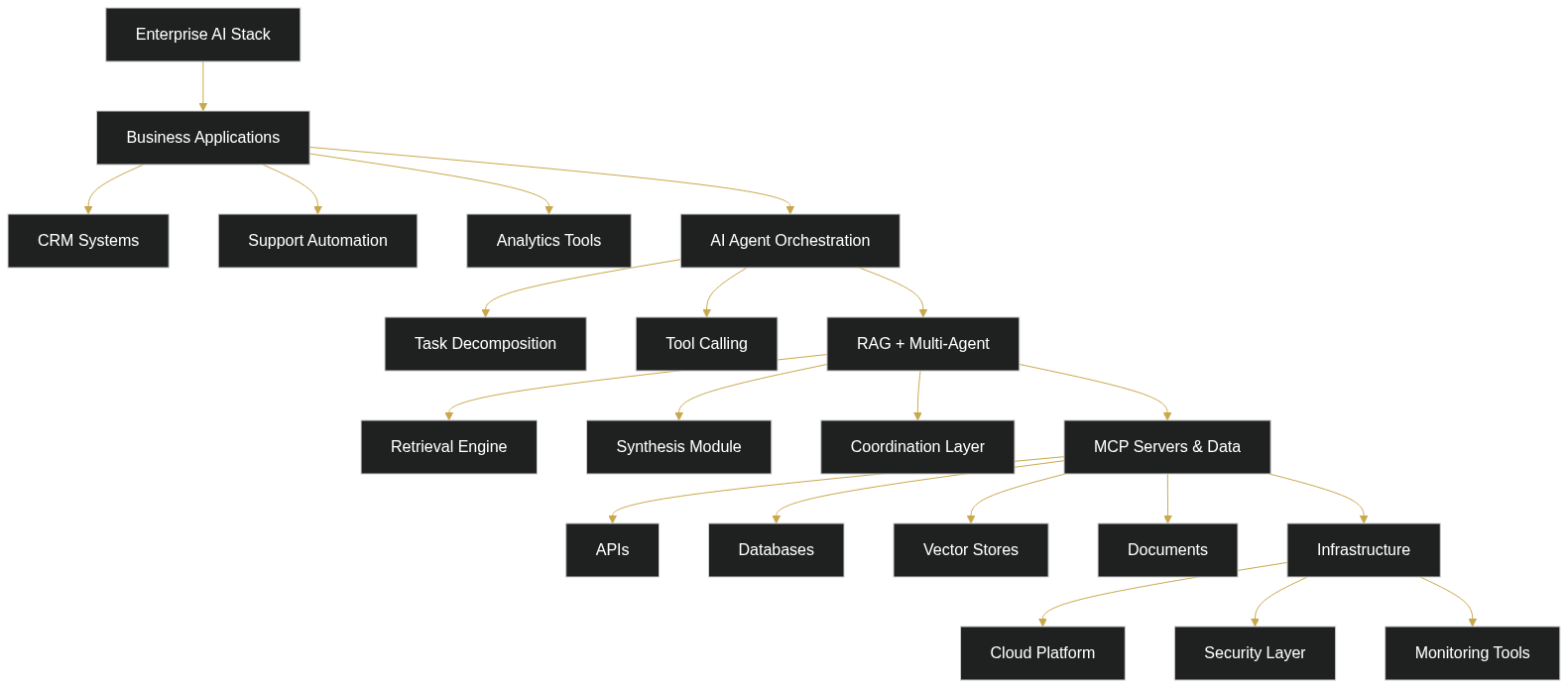
RAG pipelines and multi-agent systems work in concert to solve these challenges. RAG pipelines address data staleness and hallucinations by retrieving relevant documents and data from live sources at inference time. Instead of asking the LLM to recall something from training, you feed it current information and ask it to synthesize an answer grounded in that data. This maintains audit trails. Anyone reviewing the AI’s decision can trace it back to the exact sources it consulted.
Multi-agent systems handle orchestration by decomposing complex tasks into specialized agent roles. One agent researches relevant information. Another analyzes it. A third validates the recommendation. Agents collaborate asynchronously or synchronously via tool calling, with each agent leveraging its domain expertise or functional focus. This approach scales workflows far beyond what a single monolithic LLM can handle.
MCP (Model Context Protocol) servers standardize how agents access enterprise resources. Instead of custom integrations for every data source, an MCP server exposes resources (data, APIs, tools) in a protocol-agnostic way. Agents query MCP servers to access proprietary systems without vendor lock-in or brittle integrations. This reduces implementation complexity and enables portable agent architectures across teams.
Expert Perspective
Here’s what we’ve learned from working with enterprise teams: RAG is the retrieval layer, multi-agent systems are the orchestration layer, and MCP servers are the standardized interface. Together, they transform fragmented enterprise data into trustworthy AI assets. Organizations that implement all three see measurably better outcomes than those using any single component in isolation.
When evaluating a partner for RAG pipelines and multi-agent systems, look for these capabilities:
- Experience implementing RAG at scale, including data pipeline design, embedding model selection, vector database tuning, and retrieval ranking optimization.
- Proven expertise in multi-agent system frameworks and patterns, including state management, tool calling, error recovery, and inter-agent communication.
- Deep knowledge of MCP server deployment, governance, and integration with proprietary enterprise systems.
- Understanding of data engineering requirements: indexing strategies, refresh rate policies, and quality assurance mechanisms.
Core Architecture: How RAG Pipelines and Multi-Agent Systems Work
Understanding the mechanics helps clarify where complexity lives and why implementation matters. RAG pipelines follow a predictable flow. During the indexing phase, documents and data are ingested from source systems, chunked into manageable segments, converted into embedding vectors, and stored in a vector database. This preparation happens offline, independent of user requests.
When a user submits a query, the retrieval phase begins. The query gets embedded using the same embedding model used during indexing. Semantic search retrieves the most relevant documents from the vector database. This is where RAG differs fundamentally from traditional keyword search. Semantic similarity captures meaning, not just string matching.
Next comes the synthesis phase. The retrieved documents and original query are sent to the LLM as context. The LLM reads both, understands the relationship, and generates a response grounded in the retrieved information. A quality gate validates relevance: did the retrieval surface appropriate documents? Is the LLM’s answer actually based on what was retrieved? Are confidence scores adequate, or should the system fall back to an alternative strategy?
Multi-agent systems follow a different orchestration pattern. During agent initialization, each agent receives its role definition, access to relevant tools (including RAG retrieval), and decision-making logic. When a complex request arrives, task decomposition breaks it into sub-tasks assigned to appropriate agents.
Then agents invoke MCP servers or APIs to execute their assigned tasks. Results flow between agents through a coordination layer. Some agents work in parallel; others wait for upstream results. Feedback loops allow agents to evaluate outcomes, refine strategy, or escalate failures. This choreography enables workflows that no single LLM could handle alone.
The data engineering considerations are substantial. Embedding model selection involves trade-offs: higher-dimensional embeddings capture more semantic nuance but require larger storage and slower retrieval. Chunk size optimization balances context availability against precision. Refresh rate strategy determines whether RAG pipelines operate on real-time streaming updates or periodic batch refreshes. Quality assurance mechanisms validate that retrieved data is accurate and that semantic search is performing as expected.

Industry Applications: Where RAG + Multi-Agent Systems Deliver Value
Financial Services: Compliance and Risk Analysis
A multi-agent system orchestrates compliance assessment by having one agent retrieve current regulatory documents via RAG, another agent query transaction databases for patterns, and a third agent synthesize risk findings. The result is rapid, auditable risk assessments grounded in both current regulations and transaction data. Every recommendation includes source attribution. Auditors can verify the decision chain.
Healthcare: Clinical Decision Support
RAG pipelines retrieve the latest clinical guidelines and peer-reviewed research. Multi-agent systems coordinate patient history retrieval, literature analysis, and evidence synthesis. Physicians receive recommendations that cite specific sources, enabling them to review and validate the evidence before acting. This approach maintains the physician’s role as decision-maker while amplifying their access to current medical knowledge.
Enterprise Software: Customer Support at Scale
RAG pipelines ground support agents in current product documentation and historical ticket resolutions. Multi-agent systems route complex cases between a knowledge base agent, a ticket resolution agent, and an escalation agent. Customers get faster resolutions, and support teams avoid the frustration of AI confidently repeating outdated information.
Manufacturing and Supply Chain: Predictive Analytics
Multi-agent systems query IoT data from production equipment, retrieve historical maintenance logs via RAG, and access supplier databases. Agents collaborate on demand forecasting and maintenance scheduling. Predictions account for real-time equipment status, historical failure patterns, and external supply constraints simultaneously. This coordination produces more accurate and actionable forecasts than any single agent could generate.
Challenges & Realistic Considerations
RAG pipelines aren’t a silver bullet. Transparency about limitations builds trust and sets proper expectations. Consider these realistic challenges that every enterprise faces.
First, RAG isn’t perfect at retrieval. Irrelevant documents in the search results can mislead the LLM. If your indexing strategy is flawed or your source data contains errors, RAG amplifies those problems. This is often phrased as “garbage in, garbage out.” The solution requires rigorous data governance and quality assurance.
Second, multi-agent coordination adds operational complexity. More agents means more potential failure points. If one agent crashes, how do downstream agents respond? What happens if an agent produces invalid output? Robust error handling and circuit breaker patterns become essential engineering requirements.
Third, latency trade-offs are real. Retrieval plus synthesis takes longer than simple LLM inference. RAG pipelines and multi-agent systems aren’t suitable for ultra-low-latency use cases like real-time algorithmic trading or instant chat responses. Understanding your latency requirements upfront shapes architecture decisions.
On top of that, cost implications deserve serious consideration. Vector databases, embedding models, and multi-agent orchestration infrastructure require investment. Organizations must quantify the business value gained and ensure it justifies the operational overhead.
Worth noting, hybrid approaches sometimes outperform pure RAG. Organizations with sufficient training data might benefit from fine-tuned models combined with RAG rather than RAG alone. Fine-tuning bakes domain language and patterns into model weights, while RAG handles live data. The combination can outperform either alone.
How to Get Started: A Five-Step Approach
Implementing RAG pipelines and multi-agent systems is a journey, not a single sprint. These five steps provide a realistic path forward.
- Audit Your Data Landscape: Understand where your data lives, quality levels, refresh rates, and access patterns. Map data sources and identify which should feed RAG pipelines versus multi-agent tool integrations. Outcome: clarity on data readiness and integration complexity.
- Define Your Use Case and Success Metrics: Pick one high-value workflow and define what success looks like. Are you optimizing for accuracy, latency, auditability, or cost? Which matters most to your business? Outcome: focused strategy rather than scattered investment.
- Select Your Technology Stack: Choose embedding models, vector databases, agent frameworks, and MCP server standards based on enterprise requirements. Security, scalability, and integration ease vary significantly between options. Outcome: tools that fit your organization rather than forcing your organization into a tool.
- Build a Proof of Concept: Run RAG pipelines and multi-agent systems against real enterprise data. Measure hallucination rates, retrieval accuracy, end-to-end latency, and cost. Validate that your architecture actually solves the problem you identified. Outcome: data-driven confidence before broader rollout.
- Deploy with Governance: Move to production with established audit trails, monitoring dashboards, and escalation paths. Establish data governance policies, agent monitoring, and feedback loops for continuous improvement. Outcome: a maintainable, auditable system rather than a fragile prototype.
At each step, involve your technical team, data engineers, and business stakeholders. RAG pipelines and multi-agent systems bridge technical infrastructure and business value. Buy-in across both sides ensures sustained success.
Frequently Asked Questions
What’s the difference between RAG and fine-tuning for enterprise AI?
RAG retrieves live data at inference time, keeping responses fresh and auditable while minimizing training cost. Fine-tuning bakes knowledge into model weights, enabling faster inference but creating a static system that’s expensive to update. Many enterprises use both: fine-tune for domain language and patterns, RAG for current data. This hybrid approach often delivers better results than either alone.
How do MCP servers fit into our existing AI infrastructure?
MCP servers act as a standardized interface layer between AI agents and your enterprise systems. Instead of building custom integrations for each data source, you deploy MCP servers that expose resources in a protocol-agnostic way. This reduces integration friction and enables agents to access new data sources without code changes. Think of them as a translator between your proprietary systems and AI agents.
Can RAG pipelines eliminate hallucinations completely?
No. RAG reduces hallucinations by grounding responses in retrieved data, but hallucinations can still occur if retrieval surfaces irrelevant documents or if the LLM misinterprets the context provided. The goal is reducing hallucination rates to acceptable levels for your use case, not eliminating them entirely. Quality assurance mechanisms and human oversight remain essential.
Do we need specialized data science skills to implement multi-agent systems?
Multi-agent system implementation requires strong software engineering practices and understanding of distributed systems concepts more than advanced data science. You need expertise in orchestration frameworks, error handling, state management, and integration testing. Data science skills become more critical when fine-tuning models or optimizing embedding strategies, but core multi-agent work is primarily engineering-focused.
How long does it typically take to see ROI from RAG pipelines and multi-agent systems?
ROI depends on your specific use case, data readiness, and internal implementation resources. Some factors that influence timelines include whether your data is already well-organized or requires significant preparation, whether you build internally or work with external expertise, and how quickly you can validate business impact. Rather than a fixed timeframe, we recommend scheduling a discovery conversation to assess your situation and create a realistic roadmap with milestone-based value delivery.
Ultimately, RAG pipelines and multi-agent systems deliver the most value when they’re tailored to your organization’s specific challenges and integrated thoughtfully with your existing infrastructure and processes.
Ready to Build Intelligent, Reliable AI Systems
RAG pipelines and multi-agent systems enable enterprise AI that’s accurate, auditable, and grounded in live data. Our team has architected and deployed these systems across finance, healthcare, and technology sectors. Let’s explore whether this approach fits your organization’s challenges and opportunities.