

How the Latest AI Model Releases Are Reshaping Custom Development Strategy
AI model releases are fundamentally changing how technical leaders approach custom development. Six months ago, a Series B SaaS founder told us their AI roadmap was “obsolete before launch.” Three major model releases later, they’re recalibrating entirely. Custom AI development teams now face a paradox: new capabilities unlock features once impossible to build, yet each release forces difficult decisions about technical debt, model selection, and go-to-market timing.
Key Takeaway
New AI model releases mean you can ship more ambitious features faster. But they also require adopting a dynamic, model-agnostic development philosophy instead of betting everything on a single provider.
In This Article
- Why This Moment Matters for CTOs and Founders
- The Core Challenge: Which Model for Your Use Case?
- How New Model Releases Change the Custom Development Equation
- Evaluating New Models: A Framework for Technical Leaders
- Three Ways to Adapt Your Custom AI Strategy to Model Release Cycles
- Industry Applications: Real-World Use Cases
- Red Flags: When NOT to Jump to the Latest Model
- How to Get Started: A 5-Step Model Evaluation Process
- Frequently Asked Questions
Why This Moment Matters for CTOs and Founders
The AI model landscape has transformed dramatically. OpenAI released GPT-4o, Google launched Gemini 2.0, and Anthropic shipped Claude 3.5 Opus, all within twelve months. Each brings meaningfully different capabilities: multimodality, advanced reasoning, extended context windows, and improved cost efficiency.
Founders who ignore these releases risk building custom AI features that competitors outpace with API-driven solutions. CTOs who over-rotate on the latest models risk architectural churn and wasted engineering effort. The stakes feel higher because they are.
“Seventy-eight percent of enterprises are now experimenting with multiple LLM providers, up from just 29% two years ago.”
Gartner AI Platform Analysis, 2024
This shift reflects a fundamental realization: no single model dominates all use cases. Performance, cost, latency, and capability profiles vary significantly. Organizations that acknowledge this reality and build accordingly move faster than those betting on a single provider.

The Core Challenge: Which Model for Your Use Case?
The abundance of choice creates paralysis. Consider the decisions custom AI teams face today:
- Model Proliferation Paralysis: Too many viable options with unclear differentiation makes initial selection agonizing
- Rapid Deprecation Risk: Models improve or get replaced. How do you future-proof your architecture investment?
- Cost-Performance Trade-offs: Newer models deliver better results but at higher cost. Justifying ROI becomes complex
- Capability Mismatch: Some use cases need specific models (reasoning, context window, multimodality). Others over-specify unnecessarily
- Integration Complexity: Switching models mid-project creates technical debt and retraining costs that multiply
- Vendor Lock-in Anxiety: Over-reliance on a single provider (OpenAI, Google, Anthropic) creates business risk
Teams often respond by making hasty model choices, then face months of refactoring when a better-fit model launches. Alternatively, they stay conservative and miss competitive advantages. Neither path works well.
How New Model Releases Change the Custom Development Equation
Understanding what changed helps you make smarter decisions about your own roadmap. New model releases reshape custom development through three distinct mechanisms.
Capability Expansion and Roadmap Implications
Multimodal capabilities now let you process images, video, and audio natively without separate ML pipelines. Extended context windows (100K, 200K tokens) enable new retrieval-augmented generation (RAG) and agentic workflows previously impossible. Improved reasoning makes complex task automation viable where it wasn’t before.
Here’s the practical implication: if your roadmap assumed a model couldn’t do X, revisit that assumption every six months. That feature you postponed might now be achievable with today’s models.
Cost Efficiency Shifts
New models often arrive with lower pricing per token or higher output quality at the same cost. This isn’t just a line-item savings. It transforms unit economics. A feature that looked unprofitable on GPT-3.5 pricing might become profitable under GPT-4o or Gemini’s cost structure.
That’s why your business case isn’t static. Re-evaluate quarterly whether cost improvements make previously rejected features viable now.
Speed to Market Acceleration
More capable APIs mean less custom model training required. Founders using APIs over fine-tuned models consistently ship faster than those building proprietary models. The trade-off is real: you gain speed and reduced complexity but lose some differentiation.
In practice, this encourages a hybrid approach. Use APIs for core features, invest in fine-tuning only where your proprietary data creates defensibility.
Expert Perspective
We’ve observed successful launches using a layered approach: GPT-4o for user-facing reasoning tasks requiring accuracy, Gemini for cost-optimized background processing and bulk operations, and fine-tuned models only where proprietary data creates measurable advantage. One-model strategies rarely survive their first product pivot intact.

Evaluating New Models: A Framework for Technical Leaders
Evaluation decisions feel less arbitrary when you use a structured framework. Here’s what matters when assessing whether a new model fits your use case:
| Factor | GPT-4o | Gemini 2.0 | Claude 3.5 Opus |
|---|---|---|---|
| Reasoning Strength | ★★★★★ | ★★★★ | ★★★★★ |
| Cost per 1M Tokens | Mid-range | Low | High |
| Multimodal Support | Yes (image, video) | Yes (image, audio, video) | Text-only |
| Context Window | 128K | 1M | 200K |
| API Latency | Moderate | Moderate | Lower |
| Vendor Stability | Proven | Proven | Proven |
Use this comparison to evaluate beyond headline features. What matters specifically is your use case fit, cost structure, latency requirements, data privacy constraints, team expertise, and roadmap lock-in risk. A model that excels at reasoning might be wrong for your high-volume classification task.
On top of that, consider whether you have the operational capacity to test and integrate a new model. Switching models mid-project rarely makes sense. Ship what works. Evaluate alternatives in your next sprint.
Three Ways to Adapt Your Custom AI Strategy to Model Release Cycles
You can’t control when models release. What you can control is your architecture’s flexibility and your evaluation rhythm. Here are three proven strategies for staying ahead without constant churn.
Strategy 1: Embrace Model Abstraction
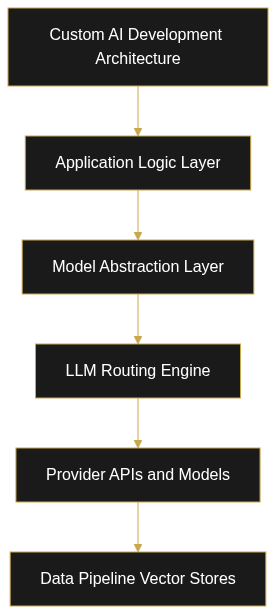
Use an LLM abstraction layer (LangChain, LlamaIndex, or similar tools) so switching models becomes a configuration change, not a complete refactor. This means your application logic remains model-agnostic. When GPT-4o proves cheaper for your use case than Claude, you change one config value instead of rewriting integration code.
Trade-off: You’ll add slight latency overhead and operational complexity. The architectural flexibility usually justifies the cost.
Strategy 2: Hybrid Model Approach
Route requests to the best-fit model for each task. Complex reasoning queries go to GPT-4o. High-volume, low-complexity classification goes to Gemini. This maximizes capability while optimizing cost per operation. On top of that, it reduces vendor lock-in by ensuring no single model is critical to core functionality.
Trade-off: Operational complexity increases. You’ll need robust monitoring, cost tracking, and fallback logic. The performance and cost benefits often justify the investment.
Strategy 3: Invest in Proprietary Data Moats
Don’t compete on base model capability. Instead, use fine-tuning or RAG to build defensibility around your proprietary data. This approach acknowledges that OpenAI, Google, and Anthropic will keep releasing better base models. Your advantage comes from your data, your domain expertise, and your specific training.
Trade-off: This requires higher data quality and ongoing training investment. It pays off only if you have genuine data advantages over competitors.
Industry Applications: Real-World Use Cases
How new model releases reshape strategy depends heavily on your industry. Here’s how leading organizations across sectors are adapting.
Finance and Risk Management
GPT-4o’s reasoning capabilities enable smarter fraud detection and regulatory compliance flagging that rule-based systems can’t match. Extended context windows allow analysis of multi-page financial filings and customer correspondence simultaneously. The result: custom AI features now compete directly with legacy rule-based platforms that dominated this space for years.
Healthcare and Clinical Decision Support
Multimodal models (Gemini, GPT-4o) can analyze medical imaging plus clinical notes together, surfacing patterns humans miss. Improved reasoning helps clinical decision support systems that were previously too unreliable for high-stakes environments. However, HIPAA-compliant deployment becomes critical. This often makes self-hosted options necessary since cloud APIs may not satisfy regulatory requirements.
E-Commerce and Personalization
Models with lower latency and higher throughput enable real-time recommendation systems at scale. Gemini’s pricing, for instance, makes per-user personalization economically feasible where it wasn’t before. Cost-per-inference becomes a core unit economics lever that directly impacts profitability.
SaaS Product Teams
Agentic workflows, orchestrating tool use, reasoning, and memory across multiple steps, unlock AI co-pilots and autonomous agents that were theoretically possible but practically unreliable before. Custom AI becomes a core product feature, not a nice-to-have experimentation area. This shift elevates AI development from a cost center to a revenue driver.
Red Flags: When NOT to Jump to the Latest Model
Chasing every model release creates unnecessary technical debt. Know when to stay put. Avoid upgrading if any of these conditions apply to your situation:
- Your current model solves the problem well for your use case (switching carries risk without clear reward)
- Changing models creates compliance or data residency complications
- Your team lacks capacity to test and properly integrate a new model
- Your business model doesn’t benefit from the new capabilities (new multimodality if you don’t use images, for instance)
- You’re mid-project with tight deadlines (ship first, upgrade later)
Stability and velocity often matter more than cutting-edge capability. A proven model your team knows deeply beats a theoretically superior model your team hasn’t integrated yet.
How to Get Started: A 5-Step Model Evaluation Process
Moving from evaluation paralysis to decision requires a structured process. Follow these steps to build clarity about which model fits your custom AI development needs.
- Clarify your use case constraints. Map functional requirements: reasoning depth, output format, latency tolerance, throughput expectations, and data privacy requirements. This becomes your filter for what’s viable.
- Run small-scale proof-of-concepts. Test your top 2-3 candidate models on representative production data. Measure latency, cost, output quality, and consistency. Real numbers beat theory.
- Design for model portability. Build abstraction layers so switching models later is low-cost. Use LLM gateways, version your prompts, and establish evaluation metrics before you commit to a model.
- Plan for ongoing evaluation. Set quarterly reviews to reassess models against new releases and your evolving business needs. The landscape changes. Your selection process shouldn’t be a one-time decision.
- Organize for rapid iteration. Assign clear ownership (product, engineering, data) for model decisions. Create feedback loops from end users and operations teams. This distributed ownership prevents both analysis paralysis and reckless changes.
Each step yields a clearer picture and reduces switching costs in future model transitions.
Frequently Asked Questions
Should we rebuild our AI feature to use GPT-4o instead of GPT-3.5?
Not automatically. Evaluate whether the performance or cost improvement justifies the engineering effort. If GPT-3.5 meets your latency and quality requirements and costs are acceptable, the switching cost often outweighs the benefit. However, if you’re seeing quality issues or cost per inference is material to your unit economics, the upgrade becomes worthwhile. Test on a subset of production traffic before full migration.
How do we avoid getting locked into one model provider?
Design with model abstraction from day one. Use tools that support multiple provider APIs, avoid hard-coding model names deep in your codebase, and establish fallback logic. Additionally, invest in understanding your data advantages so you’re not purely dependent on API capabilities. When you have your own fine-tuned models or strong RAG implementations, you’re less vulnerable to any single provider’s decisions.
What happens when a model we’ve built on gets deprecated?
OpenAI, Google, and Anthropic maintain backward compatibility longer than you’d expect, typically offering 12+ months notice before sunsetting older models. That said, plan for it. Use abstraction layers so migration is a configuration change. Monitor vendor roadmaps quarterly. And diversify: don’t route all traffic through a single model version.
How often should we evaluate whether new models fit our use case?
Set a quarterly evaluation cadence. Review new model releases against your existing selection. Has performance improved? Have costs dropped? Have new capabilities emerged that unlock features your roadmap previously rejected? A structured quarterly check prevents both unnecessary churn and missed opportunities.
Does multimodal capability matter if we only use text?
Not inherently. Evaluate models based on what you actually need. That said, consider whether your roadmap might evolve. If you suspect future product versions could benefit from image or video processing, choosing a multimodal model today prevents rearchitecting later. But if text is genuinely your only use case, save money by choosing a text-optimized model.
For deeper guidance on building custom AI applications that stay flexible across model generations, explore how to integrate AI APIs effectively into your SaaS architecture. Additionally, understanding MLOps practices for compliance and reliability helps ensure your custom models remain production-ready regardless of which base model powers them.
Navigate AI Model Complexity with Confidence
Model release cycles feel overwhelming. But the right framework clarifies which decisions matter for your business. Our team has guided dozens of technical leaders through model selection for custom AI projects, and we know the questions that separate good decisions from costly mistakes. Let’s talk through your specific use case and build a strategy that adapts as the landscape shifts.