

Agentic AI and Multi-Agent Systems: Enterprise Guide
Agentic AI and multi-agent systems are transforming how enterprises automate complex workflows. They’re moving far beyond traditional chatbots to create orchestrated, collaborative AI architectures that reason independently and coordinate seamlessly. Here’s what we’ve seen: a mid-market logistics company deployed a single AI chatbot to handle customer inquiries. It worked fine for simple questions. But when real-world complexity emerged, coordinating inventory checks, verifying shipping routes, processing returns, and managing exceptions, the system collapsed. The solution wasn’t a bigger model or more training data. It was a multi-agent system where specialized agents collaborated intelligently. Each agent handled its domain while communicating with others to solve problems no single agent could manage alone.
Key Takeaway
Agentic AI multiplies your AI ROI by enabling agents to work autonomously, reason about complex problems, and coordinate with other systems. This dramatically reduces manual oversight, accelerates decision-making, and eliminates the human-in-the-loop delays that plague traditional AI deployments.
In This Article
- Why Agentic AI Matters Now: Market Context and Opportunity
- What Is Agentic AI? Moving Beyond Chatbots to Autonomous Systems
- The Multi-Agent Paradigm: Why One Agent Isn’t Enough
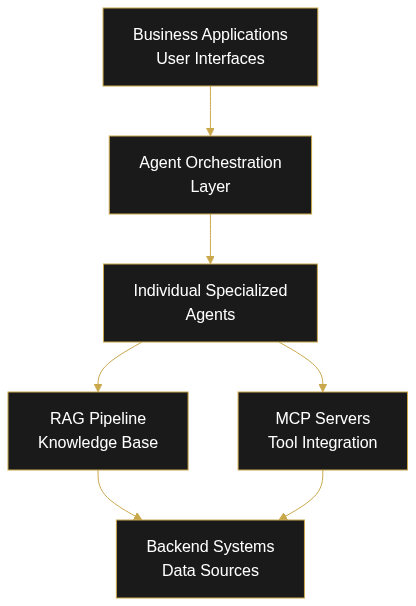
- Key Components: RAG Pipelines and MCP Servers
- The Core Challenge Enterprise Leaders Face
- The Solution: Building Responsible, Scalable Multi-Agent Architecture
- Why Leading Enterprises Choose ViZRR for Agentic AI
- Industry Applications: Real-World Multi-Agent Deployments
- How to Get Started: A 4-Step Roadmap
- Frequently Asked Questions
Why Agentic AI Matters Now: Market Context and Opportunity
Enterprise AI adoption has hit an inflection point. While businesses spent the last few years experimenting with single-purpose language models and retrieval-augmented generation systems, they’re now confronting a hard truth: siloed AI doesn’t scale. Agentic AI and multi-agent systems represent the next maturity level, and the opportunity is substantial.
Here’s what we’re seeing in the current landscape. Most enterprise AI projects follow a predictable pattern: a user asks a question, a system retrieves context, a model generates an answer. That’s it. This works fine for Q&A, customer service automation, and content generation. But it fails spectacularly for workflows that require reasoning, planning, and coordination across multiple steps, systems, and decisions. A compliance officer needs to review loan applications while referencing current regulations, past decisions, and risk assessments. A supply chain manager needs to forecast demand, check inventory levels, compare supplier costs, and trigger reorders. A healthcare scheduler needs to coordinate OR availability, surgeon schedules, patient preferences, and insurance approvals. Sound familiar? None of these workflows fit neatly into a simple question-answer model.
“By 2026, more than 30% of new enterprise applications will incorporate agentic AI capabilities, up from less than 5% today.”
Gartner, 2024
This is where agentic AI changes everything. Unlike traditional AI systems, agentic systems don’t just respond to input. They observe their environment, formulate goals, plan solutions iteratively, and take action. Combine multiple specialized agents that communicate with each other, and they solve problems that would require dozens of manual handoffs or complex custom integrations.
On top of that, the infrastructure to support multi-agent systems has matured rapidly. RAG pipelines now reliably ground AI responses in real data. MCP servers standardize how agents communicate with tools and data sources. Orchestration frameworks handle agent coordination, state management, and error recovery. What felt experimental two years ago is now deployable in production environments.
What Is Agentic AI? Moving Beyond Chatbots to Autonomous Systems
Most business leaders have interacted with a chatbot. You ask a question. The system processes your input and generates a response. The conversation ends. That’s a reactive, request-response model.
Agentic AI operates differently. An agentic AI system is an autonomous entity capable of perceiving its environment, formulating goals, reasoning about solutions, planning sequences of actions, and executing those actions with minimal human intervention. Agency means decision-making authority. It means the system can choose what to do, not just respond to what you ask it to do.
Here’s a concrete example. A traditional chatbot answers, “What’s our current inventory of SKU-12345?” by retrieving data from a database and returning the number. An agentic system not only retrieves the inventory level, it also notices it’s below the reorder threshold, checks supplier lead times, compares costs across vendors, evaluates current cash flow constraints, and autonomously places an order with the optimal supplier. All without waiting for human approval or explicit instruction.
That distinction seems subtle. It’s not. Agentic systems reduce manual oversight. They accelerate decision cycles. They scale reasoning beyond what any single chatbot can accomplish. And they handle exceptions and edge cases more gracefully because they reason about problems rather than just pattern-matching against training data.
Here’s the thing most guides won’t tell you: agency comes with responsibility. Autonomous systems that make decisions or take actions need guardrails, monitoring, and governance. A hallucinating chatbot is annoying. A hallucinating agent that places orders or modifies configurations is dangerous. This is why responsible multi-agent deployment requires robust infrastructure.

The Multi-Agent Paradigm: Why One Agent Isn’t Enough
A single AI agent has inherent limits. No matter how capable one model is, it can’t be an expert in every domain simultaneously. A financial compliance agent understands regulatory frameworks but struggles with real-time market data. A data analyst agent excels at querying databases but doesn’t understand business context or risk tolerance. An operational agent can coordinate workflows but lacks domain expertise to validate decisions.
Multi-agent systems solve this by breaking complex problems into specialized domains. Each agent owns a narrow, well-defined responsibility. Think of it like a corporate org chart translated into AI. A Chief Risk Officer doesn’t make compliance decisions, the Compliance Officer does. A CFO doesn’t execute trades, the Trader does. But they communicate, share context, and coordinate to solve enterprise problems larger than any one role.
In a multi-agent framework, this coordination happens dynamically. Agent A (the data retrieval agent) gathers information. Agent B (the analysis agent) interprets that data in domain context. Agent C (the compliance agent) validates the analysis against regulations. Agent D (the execution agent) takes action. If Agent C flags a risk, Agent D might escalate to a human or modify its action. The agents communicate through standardized protocols, reducing custom integration work.
This architecture delivers three critical advantages. First, specialization improves reliability. Each agent can be optimized for its narrow domain rather than trying to be generalist. Second, parallelization accelerates workflows. Multiple agents can work simultaneously rather than sequentially. Third, resilience increases. If one agent fails or returns questionable results, other agents can validate, flag issues, or request clarification.
That said, orchestrating multiple agents introduces complexity. How do they communicate? What happens when they disagree? Who has authority to make final decisions? How do you prevent agents from entering infinite loops? How do you audit what happened if something goes wrong? These questions aren’t theoretical. They’re operational blockers that determine whether a multi-agent deployment succeeds or fails.
Key Components: RAG Pipelines and MCP Servers
Two critical technologies enable reliable multi-agent systems: RAG pipelines and MCP servers. Both address fundamental challenges that plague naive agent deployments.
RAG Pipelines: Grounding Agents in Real Data
RAG stands for Retrieval-Augmented Generation. At its core, it solves a critical problem with language models: they hallucinate. They generate plausible-sounding but factually incorrect information. For a consumer chatbot answering general questions, occasional hallucinations are annoying but tolerable. For an agentic system making business decisions, hallucination is unacceptable.
RAG pipelines address this by anchoring agent responses in real, authoritative data. Instead of relying solely on what the model learned during training, the agent retrieves contextual information from a knowledge base, a vector database of company documents, a data warehouse, a regulatory compliance database, or historical records. The agent then uses this retrieved information to ground its reasoning and responses.
In practice, here’s what this means. A compliance agent doesn’t guess whether a transaction violates regulations, it retrieves the actual current regulation text and references it explicitly in its analysis. A supply chain agent doesn’t estimate lead times, it retrieves the supplier’s actual stated lead time and incorporates it into its procurement decision. This transforms agentic AI from a pattern-matching system into a reasoning system that cites its sources and operates on current, accurate facts.
Worth noting: RAG pipelines require infrastructure. The knowledge base must be current, indexed for fast retrieval, and version-controlled so you can audit what information was available to an agent at decision time. For regulated industries, this audit trail is non-negotiable. You need to prove what data the agent saw when it made a decision, especially if that decision is later challenged.
MCP Servers: Standardizing Agent Communication
MCP is the Model Context Protocol. It’s an open standard for how AI agents communicate with tools, APIs, and data sources. Think of it as a universal adapter that lets agents talk to any backend system without custom integration work.
Historically, connecting an AI agent to a backend system required custom code. You’d write a wrapper that translated the agent’s tool calls into API requests, handled authentication, parsed responses, and returned structured data. With dozens of tools and systems, this becomes a maintenance nightmare. An MCP server abstracts this complexity. You define what tools an agent needs (e.g., “query customer database”, “approve order”, “send email”). The MCP server handles the how, it knows how to authenticate, call APIs, handle errors, and return results in a format the agent understands.
Here’s what makes MCP powerful: it works across different AI models and platforms. An agent using Claude can use the same MCP server as an agent using GPT or another model. This reduces vendor lock-in and improves interoperability. If you decide to switch models or use multiple models in parallel, your agent infrastructure doesn’t break.
In a multi-agent environment, MCP servers become the nervous system. They enable standardized communication, simplify testing (you test an MCP server once, not per agent), and reduce the integration surface area where bugs hide. And they make observability easier. An MCP server can log every tool call, every API request, and every response, providing the audit trail that enterprises require.
The Core Challenge Enterprise Leaders Face
Agentic AI and multi-agent systems sound powerful. So why do most enterprise deployments struggle? Because the challenges are substantial and often underestimated.
Here’s what enterprises typically encounter:
- Integration Complexity: Connecting agents to legacy systems without major refactoring. Most enterprises run systems built over decades: mainframes, custom databases, proprietary APIs. Getting agents to interact with these systems securely and reliably is non-trivial. Custom integration code balloons. Testing becomes a nightmare.
- Agent Boundary Definition: Ensuring agents operate within defined limits. An unbounded agent might make unauthorized decisions, call expensive APIs repeatedly, access data it shouldn’t, or modify systems without proper approval. Setting guardrails sounds straightforward until you encounter real-world exceptions. How do you stop an agent from doing something harmful without also preventing it from doing something necessary?
- Latency and Cost: Managing performance and spending at scale. A single agent making a decision might call 5 APIs, invoke 3 language model queries, and retrieve data from 2 databases. Multiply that by hundreds or thousands of decisions per day, and your infrastructure costs explode. Additionally, slow response times make the system unusable. Users won’t wait 30 seconds for an agent to make a decision.
- Observability and Auditability: Understanding why agents made specific decisions. This is critical for regulated industries. When an agent denies a loan application or authorizes a transaction, you need to explain why. “The model decided” isn’t sufficient. You need to trace the agent’s reasoning, see what data it considered, understand what rules it applied. Many enterprises lack the logging and monitoring infrastructure to do this.
- Data Security and Privacy: Controlling agent access to sensitive information. Agents need data to reason effectively. But you can’t give an agent access to all customer data, financial records, or personal information. You need fine-grained access control, encryption, data masking, and audit trails. This gets complex fast, especially in multi-agent environments where agents communicate with each other.
- Performance Measurement: Going beyond accuracy metrics to true business value. A traditional ML model gets evaluated on accuracy, precision, recall. But an agentic system is evaluated on business outcomes: did it reduce processing time? Did it improve decision quality? Did it reduce costs? Did it increase customer satisfaction? These metrics are harder to define and measure, especially when agents interact with complex business processes.
The consequence of underestimating these challenges is predictable. Projects slip. Costs overrun. Stakeholders lose confidence in AI initiatives. The system either gets mothballed or limps along delivering mediocre value.
The Solution: Building Responsible, Scalable Multi-Agent Architecture
Agentic AI and multi-agent systems succeed when they’re built on a foundation of five core principles. This isn’t theory. These principles emerge from working with enterprises that deployed agents successfully.
Principle 1: Define Agent Roles with Precision
Each agent should have a narrow, well-defined purpose. A typical mistake is creating a “general purpose” agent that tries to do everything. This creates a system that’s hard to test, easy to break, and impossible to debug. Instead, design agent taxonomy. One agent for document parsing. One for data retrieval. One for compliance validation. One for decision logic. One for user communication. Each agent is simpler, testable in isolation, and specializes in its domain.
Principle 2: Implement Robust RAG Pipelines
Your agents are only as good as the data they access. Invest in RAG infrastructure. Build knowledge bases from authoritative sources. Version control your data. Implement retrieval quality checks: if an agent retrieves information, you want to validate that the retrieval was accurate. For regulated industries, create immutable audit logs showing exactly what information was available to agents at decision time.
Principle 3: Use MCP Servers for Standardized Communication
Don’t write custom integration code for every agent-to-system connection. Define MCP servers that abstract backend complexity. This reduces development time, improves reliability, and makes testing easier. Additionally, it creates a clear boundary between agent logic and system integration. When something breaks, you know whether to blame the agent or the MCP server.
Principle 4: Add Guardrails and Monitoring
Implement multiple layers of safety. Prompt guards that prevent agents from behaving unexpectedly. Output validation that checks agent responses before they reach users or systems. Rate limiting that prevents cost overruns. Real-time alerts for unusual patterns. Escalation paths so questionable decisions bubble up to humans for approval. Monitoring isn’t optional. It’s infrastructure.
Principle 5: Start Small and Iterate
Don’t try to automate your entire business at once. Identify a single workflow that’s painful, well-defined, and lower-risk. Build a small multi-agent system. Deploy it to real users. Measure results. Learn. Expand to adjacent workflows. This approach reduces risk, generates early wins, and builds organizational confidence in agentic AI.
Expert Perspective
Most enterprises fail their first multi-agent deployment because they treat agents as siloed functions rather than collaborative units. They forget that orchestration layer design, how agents communicate, coordinate, and escalate, is as important as the agents themselves. Get the plumbing right before adding features.
When evaluating partners for multi-agent system development, look for three things. First, deep experience with both RAG infrastructure and agentic orchestration. Many vendors understand one or the other, but few understand both. Second, transparency about agent behavior and decision-making. Your partner should be able to explain exactly what an agent did and why. Third, proven frameworks for monitoring and safety. Ask how they ensure agents don’t go rogue, how they handle cost explosions, how they audit decisions.

Why Leading Enterprises Choose ViZRR for Agentic AI
ViZRR’s approach to agentic AI and multi-agent systems differs fundamentally from generic agencies. We combine deep technical expertise with pragmatic enterprise experience. We understand not just how to build agents, but how to deploy them in complex, regulated, mission-critical environments.
| Capability | ViZRR | Generic AI Agencies |
|---|---|---|
| RAG + Agent Integration | Full-stack experience designing knowledge bases, retrieval systems, and agentic reasoning as an integrated system | Often treat RAG and agents as separate problems; integration requires custom work |
| MCP Server Architecture | Build custom MCP servers that abstract your backend complexity; agents use standardized interfaces | Write custom integration code per agent; high maintenance burden |
| Observability & Audit | Design logging and monitoring from day one; every agent decision is traceable and explainable | Observability often added late; difficult to retrofit without breaking deployments |
| Governance & Guardrails | Implement safety frameworks, escalation policies, and cost controls tailored to your risk profile | Deploy basic rate limiting; often blind to compliance requirements |
Additionally, ViZRR partners with enterprises for the long term, not just initial deployment. We help you build internal capabilities so your team can maintain and extend agentic systems. We conduct ongoing optimization, reducing latency and costs as your agents mature. We train your staff on multi-agent architecture so you’re not dependent on external consultants forever.
Most importantly, we’re honest about what agentic AI can and cannot do. Not every workflow needs multiple agents. Some problems solve better with traditional automation or simpler AI. We help you identify the workflows where agentic systems deliver real value, not where they’re just shiny.
Industry Applications: Real-World Multi-Agent Deployments
Agentic AI and multi-agent systems are already solving hard problems across industries. Here’s how:
Financial Services and Compliance
A major retail bank deployed a multi-agent system for loan processing. One agent handles document intake and parsing. A second agent retrieves applicant financial history and credit data. A third agent validates the application against current lending regulations and company policies. A fourth agent calculates risk scoring. A fifth agent communicates with the applicant to request additional information if needed. Instead of manual routing between underwriters, compliance officers, and risk analysts, these agents coordinate autonomously. The system cuts processing time by 40% and creates a complete audit trail for regulators. Every decision is explainable. You can point to the specific data and rules that led to approval or denial.
Healthcare Operations
A hospital system implemented a multi-agent scheduler for operating rooms. One agent monitors OR availability and equipment status. A second agent tracks surgeon schedules and specialties. A third agent manages patient preferences and clinical requirements. A fourth agent optimizes for cost and efficiency. Instead of administrative staff manually coordinating between surgeons, patients, insurance companies, and facility managers, agents handle the coordination. The result is higher OR utilization, fewer scheduling conflicts, and reduced no-shows.
E-Commerce and Supply Chain
A mid-market retailer deployed agents across its supply chain. A demand forecasting agent predicts which products will sell out. An inventory agent monitors current stock levels and reorder thresholds. A supplier agent evaluates vendor costs and lead times. A purchasing agent autonomously reorders before stockouts. Previously, buyers managed inventory manually using spreadsheets and intuition. Now, agents coordinate continuously, reducing carrying costs and preventing backorders.
Manufacturing and Predictive Maintenance
An industrial equipment manufacturer uses agentic systems to predict and prevent equipment failures. A sensor monitoring agent collects data from thousands of devices in the field. An analysis agent identifies patterns that precede failures. A scheduling agent coordinates maintenance with customer production schedules. A vendor coordination agent ensures replacement parts are available. Instead of reactive maintenance (equipment breaks, customer loses production, reputation damaged), agents enable proactive maintenance and dramatically improve customer outcomes.
How to Get Started: A 4-Step Roadmap
If agentic AI resonates with your business challenges, here’s how to move from interest to implementation:
- Audit Existing Processes: Identify workflows where multiple decisions or systems currently operate in sequence or in isolation. Map the handoffs. Document pain points. Your outcome is a prioritized list of workflows best suited for multi-agent automation.
- Design Agent Architecture: With your technical team and a partner like ViZRR, map out agent roles, communication patterns, and required data sources. Identify where RAG pipelines and MCP servers fit into your system. Your outcome is an architecture blueprint approved by technical and business stakeholders.
- Prototype with a Pilot: Build a small proof-of-concept with 2-3 agents focused on a single workflow. Integrate RAG and MCP early; test orchestration under realistic load. Your outcome is concrete lessons learned, a refined architecture, and business metrics (latency, accuracy, cost).
- Evaluate, Refine, and Scale: Instrument your agents with comprehensive logging and monitoring. Gather feedback from end users and stakeholders. Identify gaps, optimize performance, and expand to adjacent workflows. Your outcome is a production-ready multi-agent system with clear governance, escalation paths, and measurable business value.
Frequently Asked Questions
What’s the difference between agentic AI and a chatbot?
A chatbot responds to user input reactively. You ask a question, it answers. An agentic AI system operates autonomously. It perceives its environment, formulates goals, reasons about solutions, and takes action, often without waiting for user prompts. A chatbot is a tool you control. An agent is a system with agency and decision-making authority.
Do we need MCP servers if we already have APIs?
MCP provides a standardized layer for agent communication and tool access, dramatically reducing custom integration work. Your existing APIs can be wrapped in MCP servers, making agents more interoperable and easier to test. Without MCP, you’re writing custom integration code for each agent-system connection. With MCP, you define the connection once and every agent can use it.
How do RAG pipelines reduce agent hallucination?
RAG pipelines retrieve factual information from authoritative sources: databases, documents, knowledge bases. They provide that information to agents as context. This grounds agent responses in real data rather than relying solely on what the model learned during training. Instead of guessing, the agent cites sources. This dramatically improves accuracy, especially in domain-specific tasks where current information matters.
What are the main risks of deploying multi-agent systems?
Common risks include uncontrolled agent behavior (agents making unauthorized decisions or actions), cost overruns (agents calling expensive APIs repeatedly), latency issues (agent chains slow down workflows), and compliance gaps (agents accessing or sharing sensitive data inappropriately). Mitigation requires guardrails, monitoring, clear governance policies, and escalation procedures so questionable decisions bubble up to humans.
How should we approach building internal expertise in agentic AI?
Start by having your team learn the fundamentals of agent architecture, RAG systems, and orchestration patterns. Partner with experienced consultants for your initial deployment so your team learns by doing. As agents mature, gradually shift responsibility from external partners to internal teams. Invest in tools and platforms that make monitoring and maintenance easier. Consider whether hiring a dedicated AI engineering role makes sense for your organization size.
Ready to Deploy Agentic AI at Scale?
ViZRR helps enterprise leaders design and deploy multi-agent systems that automate complex workflows, integrate seamlessly with existing systems, and operate reliably in production. We combine deep technical expertise with pragmatic risk management so your organization gains competitive advantage without uncontrolled complexity or cost.