

The Rise of Agentic AI: Building Smart, Adaptive Systems
Agentic AI systems represent a fundamental shift in how organizations approach automation and decision-making. Unlike traditional rule-based tools that follow rigid scripts, agentic AI learns, reasons, and acts autonomously in real-time, adapting to changing conditions without constant human intervention. This distinction matters because businesses today face mounting pressure to scale operations, reduce manual bottlenecks, and maintain decision quality across distributed teams and departments.
Key Takeaway
Agentic AI isn’t a replacement for machine learning. It’s the next evolution. The difference? True autonomy, real-time adaptation, and the ability to reason through complex problems without being reprogrammed for every edge case.
In This Article
- What Is Agentic AI? Core Concepts Explained
- Why Agentic AI Matters Now: Industry Trends
- The Core Challenges Organizations Face
- How Agentic AI Systems Work: The Solution Framework
- Why Leading Organizations Choose Agentic AI
- Industry Applications: Real-World Use Cases
- How to Get Started: 5-Step Roadmap
- Frequently Asked Questions

What Is Agentic AI? Core Concepts Explained
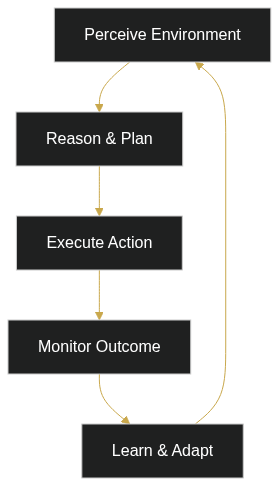
Agentic AI describes autonomous software systems that perceive their environment, reason about problems, take actions, and learn from feedback loops. Think of an agent as a decision-maker with memory, access to tools, and the ability to adjust its behavior based on outcomes. The reasoning loop works like this: the agent observes a situation, considers available options and constraints, selects an action, executes it, and incorporates the results into its future decision-making process.
Here’s where the distinction gets interesting. Rule-based automation follows predetermined if-then logic with no learning capability. Standard machine learning models recognize patterns in data but don’t reason about novel situations or adjust their approach dynamically. Agentic AI systems do both. They operate continuously, make decisions without waiting for human approval, and refine their strategies as they encounter new information.
A foundational technology enabling reliable agentic systems is Retrieval-Augmented Generation (RAG). RAG pipelines connect agents to external knowledge bases, databases, and real-time data sources, grounding their reasoning in factual, current information. This directly addresses one of the biggest risks in autonomous AI: hallucination. Without RAG, agents can confidently state incorrect information. With RAG, they anchor decisions in verifiable data.
“Organizations that implement AI-augmented decision systems report a 30 to 40% reduction in manual review cycles and a measurable improvement in decision consistency.”
McKinsey State of AI 2024
Why Agentic AI Matters Now: Industry Trends
Three forces are converging to make agentic AI adoption urgent. First, organizations face acute skill gaps. Experienced domain experts who understand business processes, risk, compliance, and customer needs are increasingly scarce. Automating their decision workflows through agentic systems preserves institutional knowledge and scales expertise across teams.
Second, most enterprises struggle with data silos and fragmented systems. Legacy applications, cloud services, and third-party platforms operate in isolation, creating blind spots. Agentic AI excels at coordinating across these silos. It pulls information from multiple sources through RAG, synthesizes it, and makes coherent decisions. A single agent can query your CRM, check inventory levels, verify compliance rules, and route approvals. All in seconds.
Third, regulatory scrutiny around AI transparency is intensifying. The EU AI Act, NIST AI Risk Management Framework, and sector-specific guidance, healthcare, finance, and others, all demand explainability and human oversight. Unlike black-box deep learning systems, agentic workflows generate reasoning logs, decision trails, and audit records. This makes governance not just possible but straightforward.
“73% of executives cite AI as essential to competitive strategy, yet only 35% have deployed AI beyond pilots. Complexity of implementation remains the top barrier.”
Forrester AI Investment Survey 2024
Worth noting: the accessibility of agentic frameworks has dropped dramatically. Open-source tools like LangChain, CrewAI, and AutoGPT, combined with managed APIs from OpenAI, Anthropic, and others, mean organizations no longer need to build agents from scratch. Startups and SMBs can prototype serious agentic workflows in days, not quarters.
The Core Challenges Organizations Face
Despite the promise, building and scaling agentic AI systems introduces real obstacles. Understanding these challenges helps you avoid costly mistakes and design implementation strategies that actually work.
- Brittleness and edge cases: Traditional automation relies on hardcoded rules. When an edge case arises, something the rules didn’t anticipate, the system fails or escalates awkwardly. Agentic systems adapt, but they still need guardrails and human oversight to prevent misalignment.
- Multi-agent coordination: A single agent is manageable. Orchestrating five, ten, or fifty agents across departments, ensuring they share context, don’t duplicate effort, and prioritize correctly, becomes architecturally complex.
- The explainability problem: Standard machine learning models struggle with interpretability. Agentic systems improve this through reasoning logs, but explaining why an agent chose action A over action B still requires clear thinking about how you set its objectives and constraints.
- Data fragmentation and RAG reliability: Agentic systems depend on quality data pipelines. If your knowledge bases are outdated, inconsistent, or scattered across platforms, RAG pipelines retrieve garbage. Agents then make decisions on garbage.
- Talent scarcity: Few engineers have shipped multi-agent systems in production. Building and maintaining them requires expertise in LLMs, system design, data engineering, and domain knowledge. This combination is rare and expensive.
- ROI measurement confusion: How do you quantify the value of improved decision quality? Reduced manual time is easy to measure. But avoiding a compliance violation or catching fraud before it happens? That’s harder to attribute to the agent.
The consequence of these challenges is organizational paralysis. Teams either over-invest in rigid, over-engineered systems that fail when business requirements shift, or they avoid agentic AI altogether, losing competitive advantage to faster-moving rivals.
How Agentic AI Systems Work: The Solution Framework
Solving complex business problems with agentic AI requires a deliberate architecture. Rather than deploying a monolithic all-knowing agent, successful implementations break problems into specialized agents, each with a clear role.
A typical agentic system includes several core components. Memory systems allow agents to retain short-term context, the current conversation or transaction, long-term strategic knowledge, learned patterns and rules, and episodic memory, specific past events to reference. Tool-use frameworks let agents invoke APIs, query databases, trigger workflows, and interact with external systems. Without tool access, agents are merely consultants with good ideas. With tool access, they become autonomous executors.
The RAG pipeline, mentioned earlier, grounds reasoning in evidence. When an agent needs to verify a customer’s credit history, confirm inventory, or check policy rules, RAG retrieves relevant information from knowledge bases and real-time data sources. Feedback loops complete the picture. After an agent acts, monitoring systems track outcomes. Unexpectedly poor results trigger retraining, objective refinement, or human escalation.
Expert Perspective
We’ve deployed multi-agent systems in finance, supply chain, and customer service. The organizations that succeed don’t cut corners on guardrails. They implement human-in-the-loop checkpoints, logging, and monitoring from day one. Teams that skip this step invariably face expensive failures that erode executive confidence in AI.

When selecting a partner or framework for agentic AI, prioritize three attributes. First, look for observability and explainability features. You need to see inside the agent’s reasoning, understand what data it accessed, what constraints it applied, and why it selected a particular action. Second, confirm safety guardrails and human-in-the-loop oversight are designed in, not bolted on later. Third, assess scalability and multi-agent orchestration capabilities. Your first agent may be a pilot, but your system needs to grow.
Why Leading Organizations Choose Agentic AI
To illustrate why agentic AI has emerged as a strategic priority, consider how it compares to legacy approaches across key dimensions.
| Dimension | Traditional Automation | Standard ML Models | Agentic AI Systems |
|---|---|---|---|
| Adaptability to change | Low, requires code rewrites | Medium, model drift over time | High, learns and adjusts in real-time |
| Human oversight required | High, constant intervention | Medium, periodic retraining | Adjustable, guardrails replace constant supervision |
| Scalability across complex domains | Limited, rules multiply rapidly | Good at pattern matching, weak at reasoning | Excellent, multi-agent coordination handles complexity |
| Explainability for governance | High, rules are visible | Low, black-box models | Medium to high, reasoning logs provide clarity |
| Speed to initial deployment | Weeks, straightforward logic | Months, data collection, labeling, training | Weeks to months, depends on data readiness |
| Long-term ROI trajectory | Declining, brittleness increases | Strong, continuous improvement with data | Excellent, autonomous optimization compounds value |
Three factors most influence leading organizations to choose agentic AI. Real-time adaptation means systems adjust behavior without requiring engineers to approve and deploy code changes. A logistics agent responding to unexpected traffic patterns or supply disruptions makes smarter routing decisions every day. Reduced human bottlenecks free expert staff from repetitive decisioning. Compliance officers, claims adjudicators, and customer service managers focus on exceptions and high-value judgment calls, not routine cases. Scalable intelligence means you don’t hit a ceiling. Multi-agent systems handle order-of-magnitude increases in problem complexity without architectural overhaul.
Organizations that adopt agentic AI early build proprietary agent ecosystems that become competitive moats. These become harder to replicate as the organization accumulates domain knowledge, tuned objectives, and successful agent patterns. Industries facing acute talent shortages, finance, healthcare, and logistics, see fastest ROI because agentic systems directly reduce dependency on scarce expertise.
Industry Applications: Real-World Use Cases
Agentic AI solves problems across every major industry. Here’s how.
Finance and Risk Management
Compliance monitoring agents scan transaction streams, news feeds, and regulatory updates in real-time, flagging suspicious activity and regulatory risk without human review of routine cases. Portfolio optimization agents balance competing objectives: growth, risk, tax efficiency, ESG constraints, adjusting allocations dynamically as markets shift. Claims processing agents verify documentation, cross-check facts, and approve routine claims autonomously, escalating complex cases to human adjusters.
Healthcare and Clinical Operations
Clinical decision support agents augment physician judgment by retrieving relevant patient history, clinical guidelines, and peer-reviewed research, surfacing evidence-based options without replacing medical judgment. Workflow automation agents manage patient scheduling, referral coordination, and appointment reminders across clinics and specialists, reducing no-shows and improving throughput. Diagnostic triage agents assess symptoms and prioritize urgent cases, ensuring high-risk patients reach specialists faster.
Retail and E-Commerce
Inventory optimization agents forecast demand at store and SKU level, coordinate replenishment across warehouses and suppliers, and adjust pricing dynamically based on stock levels and competitors. Customer service agents handle routine inquiries, process returns, and escalate disputes intelligently based on customer lifetime value and issue complexity. Personalization agents retrieve browsing history, purchase patterns, and peer preferences, recommending products in real-time on websites and via email.
Logistics and Supply Chain
Route optimization agents adapt to disruptions: weather, congestion, vehicle breakdowns, recalculating efficient routes in seconds instead of hours. Demand forecasting agents pull data from sales, events, weather patterns, and social signals, predicting demand spikes before they occur. Warehouse management agents coordinate inventory levels, picking sequences, and shipment consolidation, minimizing storage costs and delivery times simultaneously.
How to Get Started: 5-Step Roadmap
Implementing agentic AI doesn’t require starting with a massive transformation. A phased, evidence-based approach reduces risk and builds organizational confidence.
- Define Your Problem Clearly. Identify a specific workflow or decision where rigid automation has failed or manual effort remains high. Document the cost of the current state: hours spent, errors made, decisions delayed. Your clearest wins come from bottlenecks you quantify.
- Audit Your Data. Assess whether your data is accessible, current, and trustworthy enough to ground an agent via RAG. Can you build a knowledge base or connect an agent to live data sources? Data fragmentation is the most common reason pilots stumble.
- Prototype with Existing Frameworks. Use managed services, OpenAI API, Anthropic, or open-source frameworks, LangChain, CrewAI, to test agentic workflows at minimal cost. A working prototype in a week proves viability faster than month-long architecture debates.
- Build Safety and Observability First. Before expanding, establish logging, monitoring, and human-in-the-loop checkpoints. Set up alerts for anomalous agent behavior. Review decision logs regularly. This groundwork prevents expensive failures.
- Iterate and Scale. Only after validating an agent’s performance and earning stakeholder confidence should you expand to additional agents, more autonomous decision thresholds, or broader business functions.
Frequently Asked Questions
What’s the difference between agentic AI and a chatbot?
Chatbots respond reactively to user queries, providing information or guidance. Agentic systems act proactively and autonomously, making real-world decisions, invoking tools, and taking actions without waiting for human input. A chatbot answers questions about your refund policy. An agentic system processes the refund, updates inventory, and notifies the customer, all on its own.
How do I know if my organization is ready for agentic AI?
You need three preconditions. First, a clear business problem where manual effort or decision delays have measurable cost. Second, reliable data pipelines and knowledge bases that an agent can trust via RAG. Third, team capacity to monitor, iterate, and adjust agents as they operate. Skip any of these and you’ll struggle.
Aren’t agentic systems too complex and risky?
Complexity is real, but modern frameworks have lowered the barrier significantly. Risk is manageable with proper guardrails, human oversight, and phased rollouts. Start small, monitor closely, and expand only after proving the agent’s judgment in low-stakes scenarios.
Can agentic AI handle domain-specific knowledge and proprietary business logic?
Absolutely. RAG pipelines connect agents to your proprietary knowledge bases, internal documentation, and business rules. By retrieving domain-specific context, agents reason accurately within your industry’s constraints and best practices. This is one of agentic AI’s greatest strengths.
What should I expect during the early phases of agentic AI adoption?
Early pilots typically focus on narrow, well-defined problems. You’ll spend significant effort on data preparation, guardrail design, and monitoring infrastructure. Success looks like agents handling 80 to 90% of routine cases correctly, with human escalation for edge cases. As you gain confidence, expand scope gradually.

Start Building Intelligent Autonomous Systems Today
Agentic AI is no longer theoretical. It’s a competitive necessity for organizations scaling operations and reducing manual bottlenecks. The right implementation combines technology, data readiness, and organizational alignment. Let’s explore how adaptive agentic systems can unlock new efficiency in your organization. Reach out to discuss your specific challenges and opportunities.