

How AI Chatbot Development Transforms Internal Employee Support
AI chatbot development has become essential for HR and IT leaders drowning in repetitive helpdesk tickets. An HR director managing 5,000 employees receives 2,000+ support requests monthly, with 70% asking the same questions: “How do I request PTO?” “How do I reset my password?” “What’s my health plan deductible?” Without intelligent employee chatbots, teams remain trapped in manual response cycles, unable to focus on strategic initiatives that actually move the business forward.
Key Takeaway
AI chatbots can handle 60-80% of routine employee inquiries, freeing your HR and IT teams to focus on complex issues, employee engagement, and strategic workforce planning.
In This Article
- Why Internal Employee Support Is Under Pressure Now
- The Core Challenge: Overwhelmed HR and IT Teams
- The Solution: Enterprise Chatbot and Conversational AI
- Why Leading Businesses Choose ViZRR for AI Chatbot Development
- Industry Applications: How Different Sectors Use Employee Chatbots
- How to Get Started: The Implementation Process
- Frequently Asked Questions
Why Internal Employee Support Is Under Pressure Now
Global organizations are scaling faster than ever. Remote and hybrid workforces span time zones, office locations, and regional regulations. Meanwhile, employee expectations have shifted dramatically. Workers now expect instant, self-service answers, just like they get from consumer apps. Traditional 9-to-5 helpdesks can’t keep pace.
Consider the market reality: According to SHRM’s 2024 State of the Workplace survey, 67% of HR leaders cite support scalability as a top operational challenge. Gartner projects that by 2026, organizations using conversational AI for employee support will reduce helpdesk costs by 30% while improving satisfaction scores. The gap between demand and supply has created an urgent need for intelligent automation.
“72% of employees expect 24/7 access to HR and IT support, yet only 31% of organizations provide round-the-clock availability. This gap drives frustration, reduces employee engagement, and increases turnover risk.”
McKinsey Global HR Technology Study, 2024
And here’s the thing: compliance has tightened significantly. HR teams must ensure consistent policy interpretation across departments, locations, and time zones. A chatbot powered by AI answers from a single source of truth, reducing the risk of conflicting responses that could lead to compliance violations.
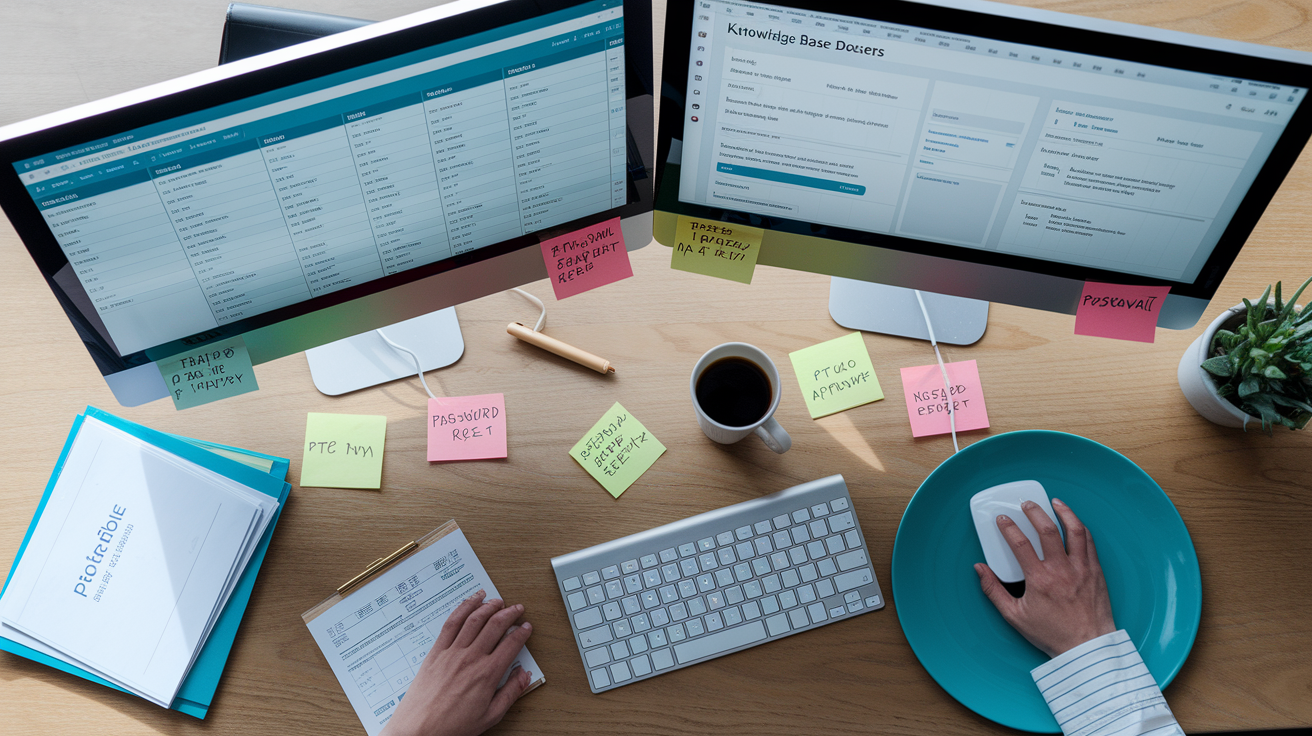
The Core Challenge: Overwhelmed HR and IT Teams
The problem is straightforward: demand vastly exceeds capacity. We’ve seen this consistently across organizations of every size. Here are six interconnected challenges that drain resources and degrade employee experience.
- Ticket Volume Overload. Routine inquiries, benefits clarification, PTO requests, password resets, policy questions, consume 60-70% of helpdesk time, leaving no bandwidth for strategic work or employee engagement initiatives.
- Slow Resolution Times. Employees wait hours or days for answers to questions that could be resolved instantly. This frustration erodes morale and signals that the organization doesn’t value their time.
- Inconsistent Responses. When multiple HR team members answer the same question, answers vary. One person says PTO rolls over, another says it doesn’t. This inconsistency creates compliance risk and erodes trust.
- Poor Employee Experience. A frustrated employee who can’t get timely support is more likely to disengage, reduce productivity, or leave. Poor internal support directly impacts retention and culture.
- Scalability Barrier. As headcount grows, support costs grow linearly. It’s nearly impossible to justify hiring more HR and IT staff just to answer the same questions repeatedly.
- Data Silos. HR systems (Workday, BambooHR), IT systems (ServiceNow, Jira), and knowledge bases live in separate places. Employees must jump between portals. Staff can’t access real-time employee data to answer questions accurately.
The consequence of ignoring these challenges is severe. Poor internal support erodes employer brand, increases voluntary turnover, drives HR and IT burnout, and creates compliance exposure. Meanwhile, the organization’s talent, technology, and operations teams lack the support infrastructure they need to perform at their best.
The Solution: Enterprise Chatbot and Conversational AI
AI chatbot development solves these challenges by replacing rule-based FAQ bots with intelligent, adaptive conversational systems. True AI chatbots understand natural language, learn from every conversation, and integrate directly with backend systems to deliver dynamic, personalized answers.
Here’s how AI chatbot development addresses each pain point:
- Automates Routine Inquiries. Instead of keyword matching, conversational AI understands intent. An employee can ask “Can I take time off next month?” or “How much PTO do I have left?” and the chatbot grasps the intent and delivers the right answer.
- 24/7 Availability. Employee chatbots work around the clock across time zones. A shift worker in Tokyo gets instant answers at 3 AM. A remote employee in São Paulo gets support during their local evening. No more waiting for business hours.
- Consistent, Compliant Responses. Chatbots answer from a single source of truth: your policies, your data, your approved language. This eliminates policy drift and reduces compliance risk.
- Better User Experience. Modern conversational interfaces feel natural. Employees interact with chatbots like they’d message a colleague, not navigate a rigid FAQ site.
- Scales Without Headcount. A chatbot’s capacity grows without proportional cost. One platform serves 500 employees or 50,000 with the same infrastructure investment.
- Integrated Data Access. Enterprise chatbots connect to your HRIS, ticketing systems, and knowledge bases in real time. An employee can ask their benefits question and get live answers pulled directly from Workday or SuccessFactors.

Expert Perspective
Here’s the thing most guides won’t tell you: the most successful employee chatbots aren’t just FAQ bots, they’re fully integrated with your HR and IT ecosystem. A mature AI chatbot can confirm an employee’s PTO balance from Workday, submit a ticket to ServiceNow, retrieve policy documents in seconds, and escalate complex requests to a human agent, all within a single conversation. This integration depth determines whether your chatbot actually solves the problem or just shifts frustration elsewhere.
Worth noting: choosing the right development partner matters enormously. Look for firms with deep expertise in HRIS integrations (Workday, BambooHR, SuccessFactors), IT ticketing systems (ServiceNow, Atlassian), compliance requirements (GDPR, HIPAA, SOC 2), and enterprise-scale conversational AI. They should have proven experience across multiple industries and be transparent about what chatbots can and can’t do.
Why Leading Businesses Choose ViZRR for AI Chatbot Development
ViZRR specializes in enterprise AI chatbot development for internal employee support. We combine deep conversational AI expertise with hands-on experience building integrated systems for Fortune 500 companies, mid-market tech firms, and regulated industries across financial services, healthcare, manufacturing, and logistics.
| Factor | ViZRR | Generic Dev Agency |
|---|---|---|
| HRIS & Ticketing Integration | Native integrations with Workday, ServiceNow, BambooHR, SuccessFactors, and custom systems via secure APIs | Basic API integration; often requires custom development; slow iteration |
| Conversational AI Approach | Advanced NLP with RAG pipelines and agentic AI; learns and improves from real conversations; handles context and edge cases | Rule-based chatbots or generic LLM wrappers; limited learning; often frustrating for users |
| Compliance & Security | Built-in GDPR, HIPAA, SOC 2, and data privacy workflows; audit logging; role-based access control; encrypted APIs | Generic security; may not handle sensitive HR and employee data appropriately; compliance gaps |
| Industry Experience | Deployed across financial services, healthcare, manufacturing, and tech; familiar with regulated environments, shift-based workforces, and global requirements | Generalist approach; may lack domain knowledge specific to HR and IT support |
On top of that, ViZRR owns the entire development lifecycle. We handle discovery and audit, conversation design, training data preparation, model development, system integration, pilot deployment, and ongoing optimization. This end-to-end ownership means faster iteration, fewer handoffs, and a chatbot that actually improves over time based on real usage patterns.
Here’s the thing: we’re transparent about limitations. A great AI chatbot recognizes when a request needs human judgment and escalates gracefully to an HR representative with full context passed along. This hybrid approach combines automation efficiency with human empathy, delivering the best of both worlds.

Industry Applications: How Different Sectors Use Employee Chatbots
Financial Services and Insurance
Compliance and audit trails are non-negotiable. Employee chatbots in financial services handle benefits enrollment, PTO policies, regulatory FAQs, and compliance questions while maintaining immutable audit logs. The chatbot answers from approved policy language, reducing legal risk and freeing compliance officers to focus on strategic audits rather than repetitive inquiries.
Healthcare and Life Sciences
Hospitals and health systems operate 24/7 across shifts. Frontline clinical staff work odd hours and need instant access to scheduling, benefits, shift-swap protocols, and credentialing information. Employee chatbots provide round-the-clock support for these time-sensitive requests, reducing administrative burden on already-stretched HR teams and improving staff satisfaction.
Technology and SaaS
High-growth tech companies hire constantly and operate globally. Employee chatbots accelerate onboarding by automating new-hire orientation, provisioning IT accounts, explaining benefits and equity plans, and directing employees to team directories and role-specific resources. This reduces ramp time and lets HR focus on strategic talent initiatives.
Logistics, Manufacturing, and Retail
Large hourly workforces spanning multiple locations and languages need accessible support. Employee chatbots support shift workers who may not have immediate access to computers, offering multilingual support via mobile interfaces for PTO requests, shift-swap coverage, paycheck questions, and basic policy FAQs. This reduces HR helpdesk congestion and improves frontline employee satisfaction.
How to Get Started: The Implementation Process
Implementing an enterprise AI chatbot for employee support follows a structured, proven approach. Each stage builds on the last, ensuring your chatbot is grounded in your actual workflows, data, and compliance requirements.
- Assessment and Planning. We audit your current HR and IT support processes, identify the top 50-100 employee questions, map your system integrations (HRIS, ticketing, intranet), and define success metrics. Outcome: A clear roadmap of use cases, integrations, and ROI drivers.
- Design and Training Data Preparation. We design conversation flows for priority use cases, compile Q&A data, collect policies and system responses, and prepare training datasets. Outcome: A structured foundation ready for AI model development.
- Development and Integration. We build the conversational AI model using advanced NLP and RAG pipelines, integrate with your backend systems via secure APIs, and establish escalation paths to human agents. Outcome: A fully functional chatbot in a controlled pilot environment.
- Pilot and Optimization. We deploy to a small employee group, gather feedback, refine responses based on real conversations, and improve intent recognition. Outcome: A validated, optimized chatbot ready for enterprise-wide rollout.
- Full Deployment and Continuous Improvement. We launch the chatbot enterprise-wide, monitor performance metrics, update content regularly, and refine the model based on ongoing feedback. Outcome: A mature, self-improving system that evolves with your business needs.
Throughout this process, we prioritize your data security, employee privacy, and compliance requirements. Every step is documented, tested, and aligned with your organizational standards.
Frequently Asked Questions
What’s the difference between an AI chatbot and a traditional FAQ bot for employee support?
Traditional FAQ bots use keyword matching to find pre-written answers. They often frustrate users with rigid responses and fail when employees ask questions in unexpected ways. AI chatbots use natural language processing to understand intent, handle variations in how people phrase questions, and deliver contextual, dynamic answers. They can pull live data from connected systems, like real-time PTO balances, and learn from conversations to improve over time.
How do you ensure an employee chatbot keeps sensitive HR data secure?
Enterprise chatbots employ multiple security layers: encrypted APIs that protect data in transit, role-based access control so employees only see their own information, detailed audit logging for compliance, and secure authentication protocols. A reputable development partner will outline their full security architecture and provide certifications like SOC 2, GDPR compliance, or HIPAA compliance depending on your industry.
Can an AI chatbot for HR handle complex or unusual employee requests?
No, and that’s intentional. A well-designed chatbot recognizes when a request requires human judgment, like a sensitive interpersonal issue or an exception to standard policy, and escalates gracefully to an HR representative with full context already captured. This hybrid approach combines the efficiency of automation with the empathy and judgment of human professionals.
How long does it take to see ROI from an employee chatbot?
ROI depends on your current ticket volume, support costs, and implementation scope. Many organizations observe measurable reductions in routine ticket volume within the first month as the chatbot begins handling frequent questions. Longer-term gains emerge as HR and IT teams redirect freed-up capacity toward strategic work like talent development, organizational design, and technology innovation. We recommend tracking specific metrics like average resolution time, employee satisfaction scores, and support cost per ticket over at least a full quarter.
What integrations does a modern enterprise chatbot support?
Leading platforms integrate with HRIS systems like Workday, BambooHR, and SuccessFactors; IT ticketing systems like ServiceNow and Jira; communication tools like Slack and Microsoft Teams; and internal knowledge repositories. Custom API integrations are common for specialized systems. The depth of integration directly impacts the chatbot’s usefulness. A fully integrated chatbot that can confirm PTO balance, submit tickets, and retrieve policies is far more valuable than one limited to static FAQ responses.
Ready to Reduce Support Costs and Improve Employee Experience?
AI chatbot development transforms how HR and IT teams operate. ViZRR combines deep conversational AI expertise with hands-on experience building integrated systems for enterprise clients. Let’s discuss how an intelligent employee chatbot can eliminate routine tickets, delight your workforce, and free your teams to focus on what truly drives business value.