

The Hidden Costs of Poorly Designed RAG Pipelines and How to Avoid Them
RAG pipelines have become essential infrastructure for enterprises deploying generative AI at scale. Yet we consistently see organizations discover that their implementations are hemorrhaging cost, reliability, and compliance value. A poorly designed RAG pipeline doesn’t just underperform, it creates technical debt, multiplies infrastructure expenses, and amplifies the very hallucination risks that RAG is supposed to eliminate. This guide reveals the hidden costs of RAG implementation failures and provides a roadmap to avoid them.
Key Takeaway
RAG pipelines are only as reliable as their underlying data infrastructure. Hidden costs emerge from inadequate vector database architecture, poor retrieval relevance tuning, and insufficient data governance, not from the technology itself.
In This Article
Why RAG Pipelines Matter Now for Enterprise AI
The shift toward production AI deployments has exposed a critical gap. Generic large language models (LLMs) trained on public web data can’t reliably answer questions about proprietary business logic, real-time market conditions, or sensitive operational data. Here’s where RAG comes in: it augments LLMs with enterprise-specific knowledge retrieval.
According to McKinsey’s 2024 AI adoption survey, 65% of enterprises report that LLM hallucinations represent a significant blocker to production deployment. Meanwhile, vector database platforms like Pinecone, Weaviate, and Milvus have grown into multi-billion-dollar market categories because enterprises recognize that knowledge grounding is non-negotiable for trustworthy AI.
“The enterprise AI infrastructure market is expanding at 28% CAGR through 2027, with vector databases and retrieval systems representing the fastest-growing segment.”
Forrester Wave: AI Data Infrastructure Platforms, 2024
Worth noting: regulatory bodies increasingly demand explainability. When an AI system makes a consequential decision, approving credit, recommending treatment, or flagging fraud, auditors want to know where did this answer come from? RAG pipelines provide citation trails directly to source documents, making them essential for regulated industries including healthcare, financial services, and legal.

The Core Challenges Enterprise Leaders Face
Organizations that rush RAG implementations without proper planning encounter several cascading problems. Understanding these challenges upfront prevents costly rework and production failures.
- Poor Retrieval Quality Erodes Trust. When RAG returns irrelevant documents, the LLM either hallucinates around gaps or produces confabulated answers using wrong context. This defeats the entire purpose of grounding.
- Vector Database Scaling Costs Spiral. Undersized or poorly optimized vector indexes force expensive re-indexing, duplicate queries, or vendor platform transitions mid-implementation.
- Data Integration Creates Bottlenecks. Enterprise knowledge lives in silos: ERPs, CRMs, data warehouses, document repositories, APIs. Building connectors to all of these is time-consuming and fragile.
- Latency Kills Production Adoption. Slow retrieval-augmented queries frustrate end users and consume budget on compute. Enterprises abandon RAG systems before measuring ROI.
- Compliance and Audit Trails Fall Apart. Without proper logging of retrieval decisions and source attribution, enterprises can’t defend their AI answers to regulators.
- Team Expertise Gaps Compound Issues. RAG requires cross-functional skills: vector mathematics, embedding models, prompt engineering, data governance. Few enterprises have these in-house, leading to external vendor dependence.
The consequence is significant. Organizations deploy RAG systems that perform worse than their baseline LLM implementations, cost more to operate, and ultimately get deprioritized. Meanwhile, competitors who invested in proper RAG architecture gain compounding advantages in AI reliability and cost efficiency.
The Solution: Building Production-Grade RAG Pipelines
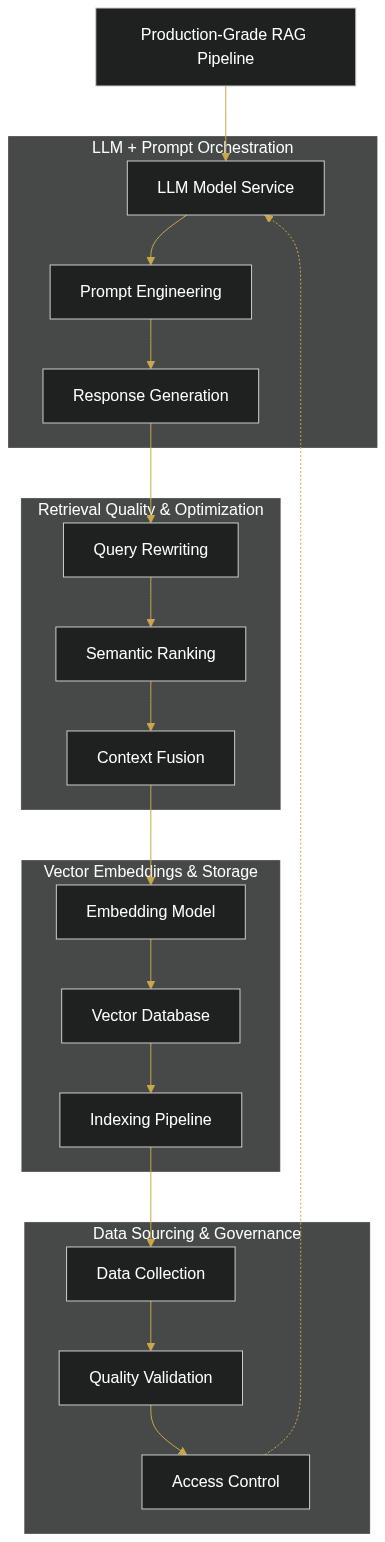
RAG pipelines are fundamentally an architectural choice, not a point product. A production-grade RAG pipeline consists of four interdependent layers: data sourcing, vector embedding and storage, retrieval optimization, and LLM prompt orchestration. Hidden costs emerge when any layer is neglected.
Layer 1: Data Sourcing and Governance
The first hidden cost is inadequate data preparation. RAG isn’t a substitute for data quality, it amplifies whatever data you feed it. Organizations must establish clear ownership of source systems, implement version control for documents, enforce metadata tagging, and define refresh cadences. On top of that, data governance becomes critical for compliance: which systems of record feed retrieval indexes? Are PII and sensitive data properly excluded? How do you audit what the AI retrieved?
Layer 2: Vector Embeddings and Storage
The choice of embedding model directly impacts retrieval relevance. Open-source models like Sentence Transformers are cost-effective but may underperform on domain-specific queries. Commercial models like OpenAI’s text-embedding-3-large or Anthropic Embed offer superior quality at higher cost per query. Here’s the thing: vector database selection, whether Pinecone, Weaviate, Qdrant, or Milvus, involves trade-offs between cost, latency, and scalability. A poorly tuned database creates two hidden costs: wasted compute on inefficient similarity searches, and missed optimization opportunities like batch indexing and hybrid retrieval strategies.
Layer 3: Retrieval Quality Tuning
Most implementations use pure semantic search, vector similarity alone. But enterprise queries often require hybrid retrieval: combining semantic relevance with keyword matching and metadata filtering. This requires ongoing tuning. Consider a financial compliance query. It might need to match exact regulatory terms through keyword match AND find semantically related guidance documents. Neglecting this complexity causes low recall, forcing expensive manual relevance annotation and model retraining.
Layer 4: Prompt Orchestration and Feedback Loops
The prompt engineering for RAG is different from zero-shot LLM prompting. The system must instruct the LLM to cite sources, handle cases where retrieval returns no relevant documents, and avoid extrapolating beyond retrieved context. Without a structured approach, LLMs revert to hallucination patterns even when grounded data is available. Additionally, organizations need feedback mechanisms, user corrections, relevance thumbs-up and down, failed queries, to iteratively improve both retrieval and prompting.
Expert Perspective
The most common RAG failure we observe is treating the vector database as a set-and-forget component. In reality, retrieval tuning is ongoing work. As new data enters the system, embedding drift occurs, irrelevant documents accumulate in indexes, and user feedback reveals blindspots in retrieval logic. Organizations that build feedback mechanisms and iterate on retrieval quality see 3 to 5x improvements in LLM answer quality compared to first-pass implementations.
When evaluating RAG pipeline partners or building in-house, prioritize these capabilities: multi-source data integration, not just document upload, hybrid retrieval support, explicit feedback mechanisms for retrieval improvement, and transparent cost modeling. Organizations that skip these elements discover them during production operations, when costs are highest and pressure to stabilize systems is acute.
Why Leading Enterprises Choose Strategic RAG Design
The hidden costs of poor RAG design become visible when comparing strategic approaches. Consider three common patterns: generic “just-add-retrieval” implementations, vendor lock-in approaches, and carefully architected enterprise RAG systems.
| Dimension | Strategic RAG Pipeline | Generic Retrieval Add-On |
|---|---|---|
| Retrieval Quality (First Pass) | 60 to 75% precision via hybrid search tuning | 35 to 45% precision via semantic-only search |
| Cost Scaling (10M queries/month) | Optimized through batch indexing and local retrieval | Uncontrolled API costs due to inefficient queries |
| Data Freshness | Real-time indexing pipelines for operational data | Periodic bulk uploads, stale in fast-moving domains |
| Compliance Auditability | Full retrieval trail logging, source document attribution | Minimal traceability, difficult regulatory defense |
| Model Flexibility | Embedding and LLM models swappable without rearchitecture | Tight coupling to vendor LLM and vector DB |
| Operational Complexity | Upfront investment in monitoring and feedback systems | Apparent simplicity masks downstream failures |
Leading financial services firms, healthcare systems, and logistics companies have moved beyond proof-of-concept RAG toward strategic implementations. Why? Because they recognized that retrieval quality and cost efficiency compound over time. A 10% improvement in retrieval precision saves millions in misguided LLM outputs and manual review cycles. A 20% reduction in per-query cost, multiplied across millions of monthly queries, justifies significant architectural investment.
On top of that, organizations pursuing regulatory compliance or data sovereignty requirements discover that generic RAG approaches create risk. EU financial services firms deploying RAG can’t use US-based LLM APIs for sensitive queries without explicit data processing agreements. Strategic RAG designs enable hybrid deployments: local retrieval on proprietary data, selective use of external APIs only when appropriate, full audit trails for compliance.
Industry-Specific RAG Use Cases
Financial Services and Risk Management
RAG pipelines ground trading signals, credit decisions, and risk assessments in real-time market data, client histories, and regulatory guidelines. When a risk officer queries an AI system about counterparty exposure, RAG retrieves recent credit events, market ratings, and internal exposure metrics. This prevents the LLM from relying on stale training data that may reflect outdated market conditions or client relationships. Compliance auditors can trace every risk assessment back to source documents, satisfying MiFID II and Dodd-Frank auditability requirements.
Healthcare and Clinical Decision Support
Clinical systems use RAG to ground LLM responses in evidence-based guidelines, patient EHR data, and the latest medical literature. When a physician queries a system about a rare diagnosis, RAG retrieves relevant case studies, clinical protocols, and the patient’s complete history. This enables the AI to provide personalized, evidence-grounded guidance rather than generic medical knowledge frozen in model training data. Privacy-sensitive deployments use RAG with local vector databases to avoid transmitting patient data to external LLM APIs.
E-Commerce and Retail Personalization
Customer service agents and recommendation engines use RAG to retrieve live inventory, pricing, and customer purchase history. When a chatbot answers product availability questions or generates personalized recommendations, RAG grounds responses in real-time data. This eliminates the frustration of out-of-stock recommendations or stale pricing. Retailers also use RAG to retrieve customer service policies and previous interaction history, enabling contextual support without customers repeating information.
Supply Chain and Logistics Optimization
Procurement and logistics teams deploy RAG-powered agents that query warehouse management systems, supplier databases, and demand forecasts in real-time. An AI system can recommend optimal reorder points, flag supplier risks, and adjust inventory, all grounded in current operational data rather than training data frozen months ago. RAG also supports contract analysis, enabling systems to retrieve relevant supplier agreements and terms before making automated procurement decisions.
How to Get Started With RAG Pipelines
A phased approach to RAG implementation reduces risk and allows organizations to validate assumptions before scaling infrastructure.
- Audit Your Knowledge Sources. Document where critical business knowledge lives. Which systems are authoritative? Which updates frequently? Which contain regulated data requiring special handling? This audit becomes your roadmap for data integration priorities.
- Start With a High-Value Use Case. Choose a single workflow where hallucination risk is highest and proprietary context is most critical. Finance, compliance, or customer support often provide quick wins. Success in one domain builds organizational confidence for broader rollout.
- Establish Data Governance Foundations. Before connecting any data source to a vector database, implement metadata tagging, version control, and refresh cadences. Define policies: which employee roles can query which data? How long are queries logged? Who owns data quality?
- Design Hybrid Retrieval From Day One. Don’t default to semantic-only search. Plan for keyword matching and metadata filtering. Test retrieval quality against your use case. Aim for at least 60% precision in initial retrieval before the LLM sees results.
- Build Feedback and Monitoring Systems. Implement logging for retrieval decisions, LLM outputs, and user feedback. Monitor retrieval drift, embedding quality, and query costs continuously. Use feedback to iteratively improve both retrieval tuning and prompt engineering.
Organizations that follow this structured approach avoid the hidden cost spiral that derails rushed implementations. Additionally, this methodology creates organizational knowledge and builds confidence in the team executing RAG projects.

Frequently Asked Questions
What is the difference between RAG and fine-tuning an LLM?
Fine-tuning updates the LLM’s weights based on training data, essentially rewriting the model. This is expensive, slow, and creates a static model with a knowledge cutoff. RAG keeps the LLM frozen and instead retrieves current data at query time. RAG is faster to iterate, enables real-time knowledge updates, and provides explainability through source citation. For proprietary, time-sensitive knowledge, RAG typically outperforms fine-tuning on both cost and relevance metrics.
How does RAG impact data privacy and compliance?
RAG is often more privacy-friendly than sending all data to external LLM APIs. Organizations can keep sensitive data in local vector databases and control exactly what gets sent to external models. However, RAG itself doesn’t eliminate privacy concerns. Organizations must still implement proper access controls on retrieval indexes, encrypt data at rest and in transit, and maintain audit logs. For highly regulated domains like healthcare and finance, RAG enables on-premise deployments where data never leaves your infrastructure.
What happens if the RAG retrieval returns irrelevant or outdated documents?
This is a primary failure mode of poorly designed RAG pipelines. The LLM may hallucinate around gaps or craft plausible-sounding answers from mismatched context. Prevention requires high-quality embeddings matched to your domain, hybrid retrieval combining semantic plus keyword plus metadata approaches, continuous monitoring of retrieval precision, and feedback mechanisms that alert when users correct AI outputs. Additionally, prompts should instruct the LLM to explicitly state when retrieved documents don’t answer the question rather than extrapolate.
How much does a RAG pipeline cost to build and operate?
Cost varies dramatically based on data volume, query frequency, and architectural choices. Factors influencing cost include: embedding model selection between open-source and commercial options, vector database platform choices between self-hosted and managed services, data integration complexity, and query volume. We recommend conducting a discovery assessment of your specific use case to build accurate cost projections. Reach out for a conversation about your requirements, and we can help you model economics for your scenario.
What skills does a team need to implement RAG pipelines?
Successful RAG implementations require cross-functional expertise: data engineers to build connectors and maintain data quality, ML engineers familiar with embeddings and vector similarity, prompt engineers who understand LLM behavior and citation patterns, and architects who can design end-to-end systems. Many organizations partner with specialists to fill skill gaps during initial implementation, then retain internal expertise for ongoing optimization and monitoring.
Why You Can’t Ignore RAG Pipelines in Modern Enterprise AI
The market is clear. McKinsey’s enterprise AI research shows that organizations deploying retrieval-augmented generation report higher confidence in AI outputs and faster time to production compared to those relying on fine-tuning alone. Similarly, Gartner’s Magic Quadrant for AI Platforms increasingly emphasizes retrieval and knowledge integration capabilities as core differentiators between leading and lagging vendors.
On top of that, the open-source ecosystem has matured significantly. Projects like LangChain, LlamaIndex, and Llamaindex provide abstraction layers that simplify RAG implementation, democratizing access to enterprise-grade architectures. However, this same accessibility creates risk: it’s easy to deploy non-production RAG systems that appear functional in development but fail under real-world scale, data variety, and quality demands.
The hidden costs of poor RAG design accumulate silently: wasted infrastructure spend, low retrieval quality masquerading as LLM limitations, compliance violations due to unauditability, and deferred ROI. Strategic organizations investing in proper RAG architecture now are building competitive advantages that will compound as enterprise AI adoption accelerates.
The path forward is clear. Multi-agent systems and agentic AI will increasingly depend on reliable knowledge grounding through RAG. Organizations that master RAG pipelines today will be positioned to deploy more sophisticated AI agents tomorrow without reinventing foundational infrastructure.
Ready to Build Production-Grade RAG Systems
Strategic RAG implementation requires expertise in data architecture, vector mathematics, and enterprise AI patterns. Our team has guided enterprises through RAG design, data integration, and optimization to reduce hidden costs and accelerate time to value.