

Why Your AI Pilot Never Made It to Production, And How to Change That
The gap between an AI pilot and production is where most enterprises get stuck. You invested months and real budget into building an AI proof-of-concept. The model performed beautifully in the lab. Your team celebrated. Then came the question that matters: How do we actually move this to production? And everything stalled.
Key Takeaway
Most AI pilots don’t fail because the technology breaks. They stall because the strategy, governance, and organizational readiness aren’t there. Getting AI from pilot to production takes far more than good engineering. It demands a complete operating model shift.
In This Article
- The Scale Gap: Why 60% of AI Pilots Never Go Live
- The Five Reasons AI Pilots Stall at Scale
- The Strategic Framework: Moving AI from Pilot to Production
- Why Leading Enterprise Buyers Choose AI Strategy Consulting
- Industry Applications: How Different Sectors Scale AI Successfully
- How to Get Started: A 5-Step Process
- Frequently Asked Questions

The Scale Gap: Why 60% of AI Pilots Never Go Live
The gap between an AI pilot and production deployment is real, measurable, and it’s costing enterprises billions. According to Gartner’s 2023 AI adoption survey, roughly 60% of enterprise AI initiatives get stuck somewhere between prototype and production. Here’s the thing most people miss: it’s not a technical failure. It’s organizational.
“60% of enterprise AI projects stall between pilot and scale. The primary reason? Not technical capability, but strategic misalignment and lack of governance infrastructure.”
Gartner AI Adoption Report, 2023
Here’s what typically happens with an AI pilot. A dedicated team, usually data scientists and engineers, builds a model in isolation. They’re working with clean, labeled datasets. They iterate quickly. They optimize for accuracy. The model works. Everyone’s happy. Then production reality hits.
And that’s where everything changes. Data quality issues that looked minor in the lab multiply at scale. Infrastructure that handled 100,000 records breaks when you try 100 million. Regulatory compliance questions pop up that nobody thought to answer during experimentation. Security and legal teams have concerns nobody addressed. The business stakeholders who funded this want ROI metrics the team never tracked. Teams that worked seamlessly together in the lab suddenly clash over who owns what in production. Budget freezes happen. The project stalls.
This isn’t a technology failure. It’s a strategy failure. The organizations that actually move AI from pilot to production? They treat it as an organizational transformation, not just an engineering project. They establish governance before scaling. They design for data quality at scale. They align cross-functional ownership. They define business outcomes before they write any code.
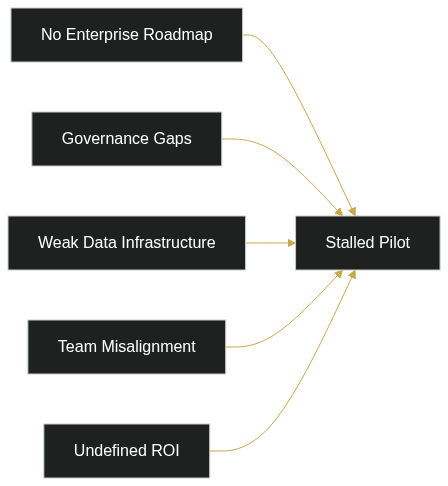
The Five Reasons AI Pilots Stall at Scale
We’ve watched this pattern repeat across dozens of enterprise transformations. Understanding why these stalls happen is your first line of defense against experiencing them yourself.
- No Clear Enterprise AI Roadmap. The pilot exists in a vacuum. It’s disconnected from your broader business strategy, your IT architecture, and your digital transformation goals. When it’s time to scale, nobody can answer the basic question: where does this fit into the bigger picture? Budget approval stalls. Executives ask hard questions nobody can answer. The project quietly dies.
- Governance and Compliance Gaps. Pilots operate under experimental assumptions. Production requires audit trails, risk frameworks, regulatory alignment, and security sign-off. If you’re in financial services, healthcare, or other regulated industries, you can’t deploy to production without governance. Legal and security teams will block it. This is often where the stall happens.
- Data Infrastructure Isn’t Ready. Pilot data doesn’t behave like production data. In the pilot, someone spent weeks manually cleaning and labeling datasets. In production, you need automated data pipelines, quality monitoring, schema management, and data lineage. If this infrastructure doesn’t exist, scaling the model scales all your problems exponentially. The infrastructure becomes the blocker.
- Misaligned Teams and Skill Gaps. Data scientists, data engineers, DevOps, product managers, and business teams don’t speak the same language. The pilot team celebrated model accuracy. DevOps wants operational stability. The business team wants revenue impact. Product wants user adoption. Without shared ownership and clear roles, these teams pull in different directions. Miscommunication becomes your stall point.
- Undefined ROI and Success Metrics. The pilot succeeded at what, exactly? Accuracy? Cost reduction? Risk mitigation? Different stakeholders will give you different answers. When scaling requires real investment, budget gatekeepers ask for ROI. If you can’t articulate it clearly, the project gets deferred. This ambiguity is frequently what kills production deployment.
Each of these five gaps can independently stop an AI pilot from reaching production. Most organizations face all five at once. The organizations that scale AI successfully? They address all five in parallel through a deliberate strategy.
The Strategic Framework: Moving AI from Pilot to Production
Here’s what we’ve noticed: AI pilot to production success follows a predictable pattern. Organizations that get there fastest share a common strategic framework. They don’t stumble through by accident. They move deliberately.
The difference between companies that ship AI and those that stall comes down to four core pillars.
Pillar 1: Clarify Business Outcomes
Start with the business outcome. Not the model. Not the technology. The business outcome. What does production success look like in your business? Cost savings? Revenue lift? Risk reduction? Operational efficiency? Get specific. “Improve predictions” doesn’t work. “Reduce customer churn by 15% and improve retention revenue by $2M annually” does.
This sounds obvious. Most pilots skip it anyway. They focus on model accuracy because it’s measurable in the lab. Business outcomes are messier. They depend on adoption, operational changes, and market factors you can’t control. But this clarity is critical when you’re asking for production budget approval.
Pillar 2: Build a Governance Foundation
Governance isn’t bureaucratic overhead. Governance is what lets AI scale safely. Establish decision rights upfront: Who approves models for production? Who monitors for bias or data drift? Who owns the data? Create audit and compliance frameworks that satisfy your legal and security teams before you need them. Build change management processes so teams know who does what when you’re live.
This is where pilots typically stall. Security, legal, and compliance weren’t involved in the experiment. Now they have concerns. No governance structure exists. Their concerns block production. Design governance upfront and those teams become enablers, not blockers.
Pillar 3: Architect Data Infrastructure
The data pipeline that works for a pilot won’t work for production. You need to move from one-off data prep to a scalable, governed data platform. Establish who owns each dataset. Create automated quality checks. Build monitoring for data drift. Design data lineage so you can trace every input to every output for audit purposes.
This pillar takes the longest to build. It’s also the most critical. We’ve seen poor data infrastructure stall more AI projects than poor models ever have.
Pillar 4: Organize Cross-Functional Teams
The pilot team won’t scale the pilot. Pilots get built by small, specialized groups. Production needs cross-functional ownership. Some organizations create a Center of Excellence for AI. Others use an AI Steering Committee. The structure matters less than clarity. Who owns the model? Who owns the data? Who owns the infrastructure? Who represents the business? These roles need clear accountability.
Expert Perspective
We’ve consistently found that the difference between a stalled pilot and successful production deployment isn’t the model quality. It’s the operating model. Organizations that appoint a Chief AI Officer or establish an AI Steering Committee with real authority see 3 to 5x faster adoption rates. The technology rarely changes. The accountability structure changes everything.
Worth noting: successful organizations also invest heavily in capability building. They don’t assume their existing teams can manage production AI without new skills. They upskill data engineers on MLOps. They train product managers on AI-specific metrics. They prepare business analysts for the organizational change that AI automation brings.
What to Look For in a Partner
If you’re considering AI strategy consulting, find a partner who prioritizes strategy before tooling. Most vendors want to sell you software. The right partner helps you build the operating model first, then identifies which tools fit that model.
Look for deep experience with enterprise governance, not just data science. You need someone who understands regulatory compliance, security architecture, and change management. Look for evidence of cross-functional alignment work, not just technical implementation. And here’s the thing most guides won’t tell you: find a vendor-agnostic partner. The best ones don’t lock you into their tools. They help you build independence within your organization.

Why Leading Enterprise Buyers Choose AI Strategy Consulting
Here’s the reality: moving AI from pilot to production isn’t a technology decision. It’s an organizational strategy decision. This is why enterprise leaders are increasingly turning to AI strategy consulting rather than generic management consulting or trying to DIY it.
| Critical Factor | In-House (Ad Hoc) | Generic Management Consulting | AI Strategy Consulting |
|---|---|---|---|
| End-to-End Ownership | Scattered across teams; no single accountability | Strategy doc delivered; execution falls to you | Dedicated AI expertise; accountability for outcomes, not just deliverables |
| Governance & Compliance | Often missing until production requires it; becomes blocker | Surface-level risk assessment; doesn’t address AI-specific compliance | Built-in compliance frameworks and audit trails from day one; security enables, doesn’t delay |
| Production Infrastructure | Experimentation only; not scalable for 10M+ records | Architecture recommendations; requires you to hire and build it | Strategy plus architecture guidance plus execution support; MLOps embedded in the plan |
| Team Alignment | Data science, engineering, and business pull in different directions | Organizational recommendations; execution accountability unclear | Facilitated cross-functional workshops; clear roles, ownership, and ongoing alignment |
| Time to Production | High; multiple false starts and rework cycles | Medium; typical consulting timeline plus internal execution delay | Lower total time; risk reduction at each stage means fewer delays |
Here’s the key difference: AI strategy consulting partners embed themselves in your operating model. They don’t hand off a strategy document and leave. They facilitate the conversations between data science, engineering, product, and business that need to happen for alignment. They ensure governance is designed before it becomes a blocker. They guide infrastructure architecture so it scales rather than breaks.
On top of that, good AI strategy consultants stay involved through production. A typical engagement starts with strategy and diagnostic work, then continues through architecture design, team capability building, and deployment. This continuity matters. The teams that scale AI fastest have consistent accountability throughout, not just during planning.
Industry Applications: How Different Sectors Scale AI Successfully
AI pilots stall differently depending on your industry. Governance requirements differ. Data complexity differs. Business outcomes differ. Understanding how your sector successfully moves AI from pilot to production helps you anticipate where you might get stuck.
Financial Services: From Fraud Detection Pilot to Enterprise Risk Platform
Financial services faces heavy regulation. A fraud detection pilot might look promising, but production requires regulatory approval, bias auditing, explainability documentation, and audit trails for every single prediction. The stall point is almost always governance and compliance. Organizations that scale successfully design regulatory alignment into the strategy from the start, not as an afterthought. They involve compliance and legal teams during the pilot, not after it’s built.
Healthcare and Life Sciences: Clinical Optimization to System-Wide Patient Outcomes
Healthcare pilots around clinical trial optimization or patient outcomes prediction face HIPAA compliance, data privacy, and clinical validation challenges. The stall point is typically data infrastructure. Patient data is fragmented across systems. It requires complex de-identification. Consent management is intricate. Organizations that scale successfully invest heavily in health data infrastructure and privacy-by-design principles before they scale the model.
Retail and CPG: From Demand Forecasting to Supply Chain Optimization
Retail AI pilots around demand forecasting show quick wins in pilot environments. Production scale requires integrating data from POS systems, inventory management, supplier systems, and external data sources. The stall point is data integration and organizational ownership. Organizations that scale successfully establish clear data ownership across the supply chain, build automated data pipelines, and create shared metrics across teams.
Logistics and Transportation: Route Optimization to Autonomous Routing
Logistics AI pilots around route optimization or fleet management look attractive. Production scale introduces complex requirements: real-time data, GPS integration, vehicle management systems, plus safety certification requirements, and operational change management that affects drivers, dispatchers, and management layers. Organizations that scale successfully treat this as an operational transformation, not just a model deployment.
How to Get Started: A 5-Step Process to Move Your AI Pilot to Production
If you’re ready to move beyond the stall point, here’s the framework we guide enterprise clients through.
- Assess Current State and Define Success. Conduct a diagnostic audit of your existing pilot, business outcomes, technical readiness, and governance gaps. Outcome: you’ll have clarity on what “production ready” actually means for your organization and where your biggest stall risks are.
- Design the Enterprise AI Strategy and Operating Model. Co-create a roadmap with your leadership team that defines governance structure, data architecture, team roles, and phased rollout. Outcome: alignment across business, IT, and data teams on how you’ll scale together.
- Build or Upgrade Infrastructure and Governance. Establish data pipelines, MLOps infrastructure, monitoring, compliance frameworks, and audit readiness. Outcome: production-grade systems in place so the model can scale safely.
- Develop Cross-Functional Capabilities. Upskill teams on new processes, tools, and roles. Establish clear ownership structures. Outcome: sustained execution ownership within your organization so you’re not dependent on external support forever.
- Launch and Monitor with Built-In Feedback Loops. Deploy to production with rigorous monitoring, feedback mechanisms, and continuous improvement cadence. Outcome: models stay accurate and business value compounds over time.
Throughout this process, treat AI pilot to production as a strategy transformation, not just a technical lift. Every step requires cross-functional alignment. Every step builds organizational capability you’ll use for the next AI initiative after this one.

Frequently Asked Questions
How long does it typically take to move an AI pilot to production?
Timelines vary based on data complexity, organizational readiness, governance requirements, and team skill gaps. Rather than focus on a fixed timeframe, successful organizations focus on critical milestones: governance sign-off, infrastructure readiness, cross-functional team alignment, and executive sponsorship clarity. We help you identify which milestones are your biggest bottlenecks so you can de-risk the timeline and accelerate where it counts most.
What’s the biggest mistake enterprises make when scaling AI?
The biggest mistake is treating production scale as a technology problem when it’s actually organizational. The team that built the pilot, usually two to five data scientists working in isolation, rarely has the infrastructure, governance discipline, or operational processes to scale reliably. Successful organizations invest in people, processes, and platforms simultaneously. They upskill their teams, redesign their operating model, and build production-grade infrastructure in parallel.
Do we need a formal Center of Excellence for AI?
A formal CoE isn’t mandatory, but you do need clear ownership, accountability, and cross-functional coordination. The right structure depends on your organization’s size, maturity, and AI ambitions. Smaller organizations might use an AI Steering Committee. Larger enterprises benefit from a dedicated CoE. What matters most is that someone or some team has clear accountability for AI strategy, governance, and outcomes across the entire organization.
How do we measure AI success in production?
Start with business metrics, not model metrics. Don’t measure success by accuracy or AUC alone. Measure revenue impact, cost reduction, risk mitigation, operational efficiency, or customer satisfaction. Link every AI initiative to a business outcome with a clear baseline and target. Track adoption rates, user satisfaction, and operational overhead alongside model performance. This balanced approach ensures the model creates real business value, not just statistical performance.
What should enterprise AI governance include?
Governance at minimum should include: decision rights (who approves models for production deployment?), audit and risk frameworks (how do you monitor for bias, data drift, security threats?), data governance (who owns each dataset, how do you ensure quality and lineage?), and compliance alignment with your regulatory environment. Effective governance enables innovation and scales quickly. Poor governance becomes a blocker that kills projects. We help you build governance that accelerates production deployment, not governance that slows it down.
Ready to Scale AI Beyond the Pilot?
The framework above is what separates organizations that ship AI to production from those that stall. Let’s assess where your biggest bottlenecks are. We’ll identify which of the five stall points affects you most and show you the path forward.