

Multi-Agent Systems: How They’re Reshaping AI Chatbot Development
Multi-agent systems represent a fundamental shift in how AI chatbots get built and deployed across enterprises. Unlike traditional single-agent chatbots that rely on one large language model to handle every query, multi-agent systems partition complex reasoning across specialized agents, each with distinct expertise, tools, and knowledge domains. This architecture transforms how organizations handle customer interactions, internal automation, and real-time decision support, delivering measurable improvements in accuracy, scalability, and user satisfaction.
Key Takeaway
Multi-agent systems solve the scalability ceiling that single-agent chatbots hit when query complexity increases. By routing requests to specialized agents with access to domain-specific data and tools, these systems reduce hallucination, improve response accuracy, and enable seamless integration with legacy systems and proprietary databases.
In This Article
- What Are Multi-Agent Systems?
- Why Multi-Agent Chatbots Matter Now
- Core Challenges Multi-Agent Chatbots Solve
- Architecture Patterns: How Multi-Agent Chatbots Work
- Real-World Use Cases and Industry Applications
- Key Benefits: Why Business Leaders Should Care
- Implementation Considerations and Challenges
- Multi-Agent Systems in Your Tech Stack
- Getting Started: A Strategic Roadmap
- Frequently Asked Questions

What Are Multi-Agent Systems?
Multi-agent systems are architectures where multiple independent or semi-autonomous AI agents collaborate to solve complex problems. Each agent possesses specialized capabilities, knowledge, or access to particular tools and data sources. Think of it like a customer service team: one agent handles billing inquiries, another manages technical support, and a third processes returns. Each one knows their domain deeply and can execute actions within their area of expertise.
The critical difference from single-agent chatbots comes down to specialization. A traditional chatbot relies on one large language model trained on broad knowledge to answer all questions. Multi-agent systems distribute this responsibility, allowing each agent to be smaller, more focused, and optimized for specific tasks. An orchestrator agent acts as a router, analyzing incoming queries and directing them to the most appropriate sub-agent for handling.
This design pattern enables what’s called “agentic reasoning.” Rather than generating a response directly, agents can think through multi-step problems, call tools (APIs, databases, external services), verify results, and iterate until they deliver accurate answers. The combination of specialization, tool access, and orchestrated reasoning is what makes multi-agent systems fundamentally different from conversational AI systems built around a single monolithic model.
Why Multi-Agent Chatbots Matter Now
Enterprise demand for AI-powered automation has shifted dramatically in the past two years. Organizations are moving beyond chatbots that answer FAQs to systems that execute transactions, synthesize data across multiple sources, and support complex multi-step workflows. The market’s responding accordingly. Research from leading analyst firms shows that 75% of enterprise software will incorporate AI capabilities by 2025, with conversational interfaces becoming a standard interaction model.
“Enterprise adoption of AI-powered customer service solutions is accelerating, with 68% of organizations planning to increase AI investments in conversational systems over the next 18 months.”
IDC Enterprise AI Adoption Survey, 2024
Here’s where single-agent chatbots hit their limits. Consider a customer calling a bank to “transfer 500 to my savings account and show me my investment portfolio balance.” A single-agent chatbot struggles because it must simultaneously access account data, verify permissions, execute a transaction, and retrieve investment information. Each step requires different logic, different data sources, and different risk profiles. Sound familiar?
Multi-agent systems excel here. The orchestrator routes the request to a transaction agent, which can execute transfers with proper compliance checks, while simultaneously triggering a portfolio agent that retrieves investment data. Both agents work in parallel, reducing latency. Each agent is specialized enough to include proper guardrails, audit trails, and error handling for its specific domain.
And here’s the thing: adding new capabilities to a multi-agent system doesn’t require retraining a monolithic model. You simply build a new agent with access to the relevant APIs and knowledge base, integrate it with the orchestrator, and deploy. This modularity is essential for large enterprises managing hundreds of business domains.
Core Challenges Multi-Agent Chatbots Solve
Multi-agent systems directly address several hard problems that single-agent chatbots can’t solve effectively:
- Accuracy and hallucination reduction: By constraining each agent to a narrow domain and pairing agents with retrieval-augmented generation (RAG) pipelines, agents reference real data instead of relying solely on model knowledge. This dramatically reduces false or fabricated answers.
- Scalability without retraining: Adding a new business capability means developing a new agent and integrating it with the orchestrator, not rebuilding the entire system. You’re not retraining anything.
- Legacy system integration: Organizations rarely operate on a single technology stack. Multi-agent systems allow each agent to wrap existing APIs, databases, and legacy services. Integration happens at the agent layer, not at the model layer.
- Real-time responsiveness: Parallel agent execution improves response latency for complex queries. Instead of a single model processing a request sequentially, multiple agents can work simultaneously and combine results.
- Audit and compliance: Agent actions (with full context and reasoning) can be logged and traced. This is critical for regulated industries like finance and healthcare where proving decision provenance is required.
- Cost optimization: Smaller, specialized models can outperform large generalist models at specific tasks. You’re not paying for a 70-billion-parameter model to handle simple billing lookups when a specialized 7-billion-parameter agent works better and cheaper.
Architecture Patterns: How Multi-Agent Chatbots Work
Understanding the structural components of a multi-agent system is essential for evaluating whether this approach fits your needs. The core elements remain consistent across implementations, though specific tools and frameworks vary.
The orchestrator agent serves as the decision-making center. It receives user queries, analyzes the intent and required actions, and decides which sub-agents to invoke. Think of it as a dispatcher that understands the full range of capabilities available in your system. The orchestrator doesn’t execute complex logic itself. Instead, it orchestrates other agents and synthesizes their responses into a coherent answer.
Domain-specific agents handle narrow, well-defined responsibilities. A billing agent accesses account data and processes payments. An inventory agent queries warehouse systems. A compliance agent checks fraud patterns and regulatory constraints. Each agent is built around a specific domain, giving it deep expertise within that area. This specialization enables better error handling, more precise reasoning, and easier testing.
Tool-using agents leverage APIs, databases, and external services to retrieve real-time information and perform actions. Rather than relying on a model’s training data, agents call the actual systems of record. A hotel booking agent connects directly to the reservation system. A shipping agent queries logistics APIs. This approach ensures that responses are always current and accurate.
The orchestration layer determines how agents interact. Sequential orchestration invokes agents one at a time. Parallel orchestration runs multiple agents simultaneously. Hierarchical orchestration creates agent chains where output from one agent feeds as input to another. Dynamic orchestration uses the orchestrator’s reasoning to decide at runtime which agents to invoke and in what order.
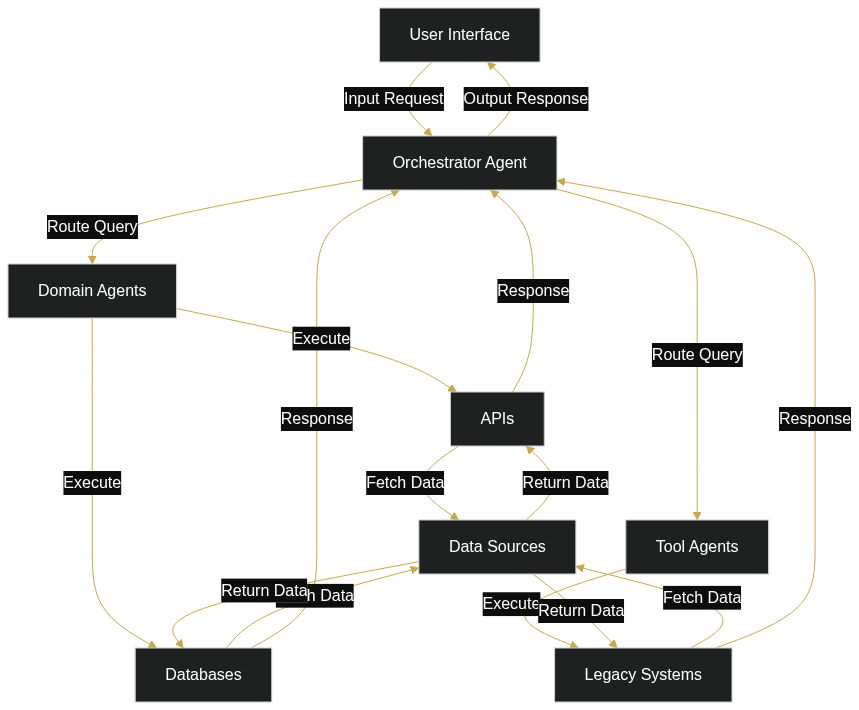
RAG pipeline integration sits within this architecture as a critical component. Rather than agents relying on model knowledge, retrieval-augmented generation enables agents to fetch relevant documents, data, or context from a knowledge base before generating responses. A support agent might retrieve customer history and product documentation before crafting a response. This combination of retrieval plus reasoning dramatically improves accuracy.
Expert Perspective
The most scalable multi-agent systems separate decision logic from execution logic. Which agent should handle this? That’s a separate concern from what the agent does. This decoupling allows you to swap underlying language models, add new agents, or update knowledge bases without refactoring the orchestration layer. Architectural clarity here saves enormous complexity during maintenance and iteration.
State management ensures that conversation history, user context, and inter-agent communication persist correctly. As agents hand off work to other agents, they pass not just the query but the conversation history and any constraints discovered so far. Proper state management prevents agents from making contradictory decisions or losing important context mid-conversation.
Real-World Use Cases and Industry Applications
Multi-agent systems have moved from research to production across diverse industries. The patterns are repeatable, even as the specifics vary by domain.
Financial Services and Banking
A financial services multi-agent chatbot routes account inquiries to a balance-checking agent, transfer requests to a transaction agent, investment questions to an advisory agent, and fraud concerns to a compliance agent. Each agent accesses different systems with appropriate permission levels. A customer asking “transfer 10,000 to my mortgage account and show me my latest statement” triggers multiple agents in parallel, each accessing its system of record, with the orchestrator synthesizing results.
Healthcare and Patient Services
Healthcare organizations deploy multi-agent systems for patient intake, appointment scheduling, prescription refills, and insurance verification. A patient intake agent collects symptoms and medical history. A triage agent analyzes the information and recommends urgency levels. A scheduling agent checks provider availability. An insurance verification agent confirms coverage. Each agent operates within strict compliance guardrails (HIPAA), and the orchestrator ensures smooth handoffs while maintaining privacy boundaries.
E-Commerce and Retail
Retail platforms use multi-agent systems to handle product discovery, inventory checks, order tracking, returns processing, and recommendation engines. When a customer asks “do you have the blue version in size medium, and when can it arrive in London?” a product search agent finds matching items, an inventory agent checks stock across warehouses, and a logistics agent estimates delivery times. Results come back in seconds, with real data from multiple systems.
Customer Support and Technical Services
Support organizations leverage multi-agent chatbots to route issues intelligently. An intent classification agent determines whether the issue is billing, technical, or account-related. It passes the query to the appropriate specialist agent, each with access to different knowledge bases, ticket systems, and escalation protocols. Complex issues still escalate to humans, but the multi-agent system handles 60-80% of inquiries end-to-end, freeing support staff for genuinely complex cases.
Key Benefits: Why Business Leaders Should Care
The business case for multi-agent systems extends beyond technical elegance. Organizations adopting this architecture report measurable improvements across multiple dimensions.
Reduced operational risk: Specialized agents are easier to test, monitor, and update than monolithic systems. You can deploy a new billing agent without touching the support agent. A bug in the recommendation engine doesn’t affect transaction processing. This isolation reduces blast radius and makes production updates less risky.
Faster feature iteration: Adding new capabilities means developing a new agent and integrating it with the orchestrator, not rebuilding the entire system. Organizations we work with report 40-60% faster feature development cycles compared to monolithic chatbot platforms because each agent can be developed and deployed independently.
Better cost efficiency: Smaller, specialized models can outperform large generalist models at specific tasks. You’re not running a 100-billion-parameter model for every interaction when specialized 10-billion-parameter agents handle most queries cheaper and faster. Cost per query typically drops 30-50% compared to a single large model approach.
Improved user experience: Parallel execution reduces response times. Specialized agents provide more accurate answers. Better error handling means users see helpful recovery paths instead of generic “I don’t understand” messages. The combination produces measurable improvements in customer satisfaction scores.
Compliance and auditability: Agent decisions can be traced and justified, which is critical for regulated industries. When an agent denies a loan application or blocks a transaction, you have a clear log of which agent made the decision, what data it accessed, and what constraints it applied. This is often a requirement for regulatory compliance.
Implementation Considerations and Challenges
Multi-agent systems solve real problems, but they introduce complexity in other areas. Understanding these trade-offs is essential before committing to this architecture.
Orchestration complexity: More agents mean more orchestration logic. The system must decide not just which agent to invoke, but in what order, with what context, and how to synthesize multiple responses. This is more complex than a single-agent system and requires careful design and ongoing refinement.
Agent coordination and conflict: Agents can contradict each other or create loops if not designed carefully. One agent might approve an action while another agent’s constraints suggest it shouldn’t happen. Preventing these conflicts requires explicit coordination logic, proper testing, and monitoring.
Inference cost scaling: Multiple LLM calls per query increase compute costs compared to a single-agent approach. Optimizing this requires careful decisions about which agents to invoke in parallel versus sequentially, when to cache responses, and which models to use for different agents.
Latency debugging: When a user query takes 10 seconds to respond, diagnosing why becomes harder with multiple agents. Is agent A slow? Did agent B fail and trigger a retry? Is the orchestrator making inefficient routing decisions? Proper observability infrastructure is essential but adds complexity.
Team skill requirements: Multi-agent systems require different expertise than single-agent chatbots. You need ML engineers comfortable with orchestration patterns, prompt engineers who understand agent design, infrastructure teams familiar with distributed tracing, and product managers who understand the architectural implications of feature requests.
LLM model selection: Not all language models are equally good at multi-agent reasoning. Larger, instruction-tuned models like GPT-4 and Claude 3 Opus excel at complex orchestration tasks. Smaller models work well for specialized sub-agents. Getting the right model for each role requires experimentation and benchmarking.
Multi-Agent Systems in Your Tech Stack
Building multi-agent systems requires selecting frameworks, models, and integration patterns that fit your organization’s constraints.
Framework and orchestration tools: Open-source frameworks like LangGraph, AutoGen, and CrewAI provide building blocks for multi-agent systems. LangGraph excels at complex orchestration patterns. AutoGen focuses on agent-to-agent communication. CrewAI provides high-level abstractions for rapid prototyping. Each has different trade-offs around flexibility, maturity, and ease of use. Proprietary platforms from major cloud providers offer managed experiences at the cost of vendor lock-in.
Language model selection: For orchestration agents, larger instruction-tuned models (GPT-4 Turbo, Claude 3 Opus) are worth the cost because orchestration decisions are critical to system quality. For specialized sub-agents, smaller models (GPT-3.5, Claude 3 Sonnet) often perform adequately and reduce costs. Tool-using agents benefit from models with strong function-calling capabilities. This heterogeneous approach optimizes cost and performance.
Integration with legacy systems: Multi-agent chatbots should layer on top of existing infrastructure without requiring major refactoring. Each agent wraps specific APIs or databases independently. This allows you to integrate with legacy systems incrementally. Start with high-value agents that access critical systems, then expand gradually.
Monitoring and observability: Multi-agent systems generate rich operational data that traditional chatbot monitoring misses. Key metrics include agent response times, routing accuracy (is the orchestrator sending queries to the right agent?), cost per query, user satisfaction by agent, and agent error rates. Building observability infrastructure early prevents surprises in production.
Getting Started: A Strategic Roadmap
Adopting multi-agent systems doesn’t require a complete rewrite of your existing chatbot infrastructure. A phased approach reduces risk and allows validation at each stage.
- Define your agent domains. Identify which areas of your business would benefit from specialized agents. Don’t try to convert everything at once. Typically, three to five agent domains work well for initial launches. These should map to existing business functions (billing, support, fulfillment) where you already have systems and expertise.
- Map user journeys and multi-step queries. Understand which queries actually require multi-step reasoning or data from multiple sources. These are the best candidates for multi-agent routing. A simple FAQ query doesn’t need multi-agent complexity, but a complex account-related transaction absolutely does.
- Prototype with a minimal system. Build a single orchestrator agent with two to three sub-agents. Keep the prototype small and focused. This lets you validate orchestration patterns, test agent coordination, and understand operational requirements before scaling.
- Integrate data sources and build RAG pipelines. Connect each agent to the APIs, databases, and knowledge bases it needs. Implement retrieval-augmented generation pipelines so agents can access current data. This step is where multi-agent systems begin delivering real value.
- Deploy with comprehensive monitoring. Set up logging, latency tracking, error rate monitoring, and user satisfaction metrics before production launch. Establish feedback loops that let you see which agents work well and which need refinement. Iterate based on real-world usage.
This roadmap typically reveals the specific challenges unique to your organization. You’ll discover which agent coordination patterns work best for your domain, which data sources need rearchitecting, and which team capabilities need development.
Frequently Asked Questions
What’s the difference between a multi-agent chatbot and a single-agent chatbot?
Single-agent chatbots use one language model for all tasks. Multi-agent systems route queries to specialized agents with distinct knowledge, tools, or reasoning patterns. Multi-agent systems improve accuracy and scalability for complex workflows because each agent can be optimized for its specific domain. Single-agent chatbots are simpler to build and operate but hit scaling limits as query complexity increases.
How do multi-agent systems reduce hallucination in AI chatbots?
Hallucination occurs when language models generate plausible-sounding but false information. Multi-agent systems reduce this by constraining each agent to a narrow domain and pairing them with RAG pipelines (retrieval-augmented generation). Instead of relying solely on model knowledge, agents retrieve real data from systems of record. This grounds responses in actual information rather than model inference, dramatically reducing false or fabricated answers.
Is a multi-agent chatbot right for my business?
Multi-agent systems excel when your business has multiple distinct domains (billing, support, fulfillment), users ask complex multi-step questions, you operate legacy systems that need integration, or you want agents to execute transactions rather than just provide information. If your chatbot primarily answers FAQs with single-step queries, single-agent systems are simpler and sufficient. The right choice depends on your specific use cases and operational complexity.
How much does it cost to build a multi-agent chatbot?
Costs vary significantly based on complexity, number of agents, integration scope, and whether you build in-house or work with a partner. Several factors influence investment, including the number of business domains you need to support, the complexity of orchestration logic required, the extent of legacy system integration needed, and your team’s existing AI expertise. We recommend a discovery conversation to understand your specific requirements and provide realistic guidance.
How long does it take to deploy a multi-agent chatbot?
Timeline depends on your organization’s readiness, not on inherent complexity. Organizations that already have clear APIs and data architecture see faster deployment. Those requiring significant backend refactoring take longer. Rather than general timelines, we focus on identifying your specific dependencies and blocking factors during initial planning. Working with experienced partners typically accelerates deployment compared to building in-house.
Since single AI agents are becoming obsolete compared to multi-agent systems, organizations are increasingly evaluating this architecture. The key is moving at your organization’s pace with proper planning and governance.
Why Leading Organizations Choose Multi-Agent Architecture
Organizations that prioritize accurate, scalable conversational AI are moving toward multi-agent systems deliberately. The architecture solves real business problems that single-agent chatbots can’t address.
| Factor | Multi-Agent System | Single-Agent Chatbot |
|---|---|---|
| Accuracy on complex queries | High (specialized agents + RAG) | Moderate (single model, broad training) |
| Feature deployment speed | Fast (add new agents independently) | Slow (retrain or fine-tune entire model) |
| Legacy system integration | Easy (wrap each system in an agent) | Complex (single model must handle all APIs) |
| Operational complexity | Higher (orchestration and coordination) | Lower (single model to manage) |
The decision to move to multi-agent systems isn’t about following trends. It’s about addressing specific scaling challenges that organizations hit when single-agent chatbots reach their limits. When query complexity increases, when you need to integrate multiple business domains, or when accuracy becomes mission-critical, multi-agent systems justify their additional complexity.
For organizations exploring AI chatbot development, understanding multi-agent systems ensures you’re building architecture that grows with your business. MCP servers are increasingly becoming the backbone of modern AI agents, providing standardized interfaces for agent communication. Consider this context as you evaluate your chatbot platform.

Ready to Evaluate Multi-Agent Architecture?
Multi-agent systems transform how AI chatbots handle complex business logic and scale with your organization. Discover whether this architecture fits your specific use cases and operational constraints. Reach out to discuss your chatbot roadmap with AI specialists who’ve built these systems in production environments.