

Prompt-to-Product vs Traditional Development: What Indian Founders Should Know
Prompt-to-product vs traditional development is reshaping how Indian startup founders ship features and validate ideas. You’ve got limited runway, a backlog that would take your team a year to build, and everyone’s asking if you should just use AI to code instead. This guide cuts through the hype and shows you the real tradeoffs, so you can decide which approach fits your stage, resources, and risk tolerance.
Key Takeaway
Prompt-to-product excels at rapid validation and early hypothesis testing. Traditional development wins at scale, maintainability, and regulatory compliance. Most successful startups eventually use both.
In This Article
- Why This Matters Now for Indian Founders
- Understanding Prompt-to-Product Development
- Understanding Traditional Development
- Head-to-Head Comparison: 5 Critical Dimensions
- The Core Trade-offs You Need to Understand
- When Prompt-to-Product Makes Sense for Indian Founders
- When Traditional Development is the Better Bet
- The Hybrid Approach: How Most Smart Founders Do It
- Industry Applications in India
- Quality, Reliability, and Risk Mitigation
- How to Choose What’s Right for You
- Frequently Asked Questions
Why This Matters Now for Indian Founders
Indian startups face a unique squeeze. Your engineering salaries are lower than Silicon Valley, which makes traditional development attractive from a cost perspective. But you’re competing globally, and global customers expect features shipped at lightning speed. That tension’s created real urgency around prompt-to-product development as a faster alternative.
The shift is real. According to NASSCOM’s 2024 AI adoption report, over 60% of Indian startups are now experimenting with generative AI tools in their product development workflows. Yet most are doing it without a clear framework for when to use prompts versus code. The result: some founders ship impressive MVPs in weeks, while others paint themselves into technical debt corners that become expensive to escape.
Indian startup founders cite time-to-market as their number one constraint, ahead of funding and hiring. This makes the speed advantage of prompt-to-product development particularly seductive.
Multiple Indian startup ecosystem surveys, 2023-2024
The real question isn’t which approach is objectively “better.” It’s which risk you’re willing to take right now. Speed and fragility, or slowness and solidity? Understanding both helps you make that choice deliberately.

Understanding Prompt-to-Product Development
Prompt-to-product development means using large language models and generative AI tools to generate, refine, and deploy product features with minimal manual coding. You write a prompt describing what you want. An LLM generates code. You refine it. You integrate it. You iterate. In theory, this cycle repeats in days instead of weeks.
Here’s how it actually works in practice. You start with a natural language description of a feature. ChatGPT, Claude, or Copilot generates a first draft of the code. You review it for logic errors and security issues. You test it against a few edge cases. If it breaks, you adjust the prompt and regenerate. If it works, you ship it. The entire cycle happens much faster than sitting down with a blank text editor and building from first principles.
Prompt-to-product excels at several things. Rapid MVP validation is the obvious one. You can go from feature idea to customer feedback in a matter of days. It’s also ideal for features that are content-heavy or logic-light. Recommendation systems, summarization tools, customer support flows, and data transformation scripts all benefit from this approach. Your initial cost is low. You’re paying API fees, not engineer salaries. And you can iterate quickly without getting bogged down in architectural discussions or code reviews.
But prompt-to-product has real limitations that many founders discover too late. AI hallucinations are the most visible problem. An LLM can generate plausible-sounding code that’s actually wrong. It might miss edge cases or generate security vulnerabilities. Model drift is another hidden cost. As the underlying LLM updates, the same prompt might produce different outputs. Versioning and debugging become harder because you’re relying on external APIs, not code you fully control. And there’s integration complexity. Connecting an LLM-generated feature to your existing database, authentication system, or payment processor often requires custom logic that wasn’t obvious in the prompt.
Expert Perspective
We’ve seen founders ship impressive prompt-to-product MVPs that get genuine customer excitement. The danger isn’t in the speed. It’s in treating prompt-to-product as a permanent architecture rather than a temporary validation tool. Without a plan to refactor into traditional code once you’ve proven the concept, technical debt accelerates quickly.
Understanding Traditional Development
Traditional development means building from a written specification, through design and architecture phases, into coded implementation, followed by testing and deployment. It’s the approach most engineering teams still follow. You plan before you build. You version everything in Git. You run automated tests. You deploy through a CI/CD pipeline. It’s disciplined, predictable, and slower.
The process typically looks like this. You define requirements and create technical specs. Engineers design the system architecture and identify dependencies. Developers write code against those designs. QA tests the code against the spec. Once it passes, you deploy to production. The entire cycle takes weeks to months depending on complexity.
Traditional development wins at several critical points. Quality and reliability are the most important. Because every step is documented and tested, you catch bugs before they hit production. You can scale features to millions of users without unexpected performance cliffs. Maintenance becomes easier because the codebase is clear and documented. If someone leaves the team, the next engineer can understand how it works. And if you’re in a regulated industry like fintech or healthtech, traditional development isn’t optional. It’s a requirement.
The downsides are real too. Time to launch is significantly longer. You need experienced engineers who can design systems, not just write code. Pivoting mid-project is expensive. And the upfront cost in salaries and tooling is high. For a bootstrapped founder or a team on a tight runway, traditional development can feel prohibitively slow.
Head-to-Head Comparison: 5 Critical Dimensions
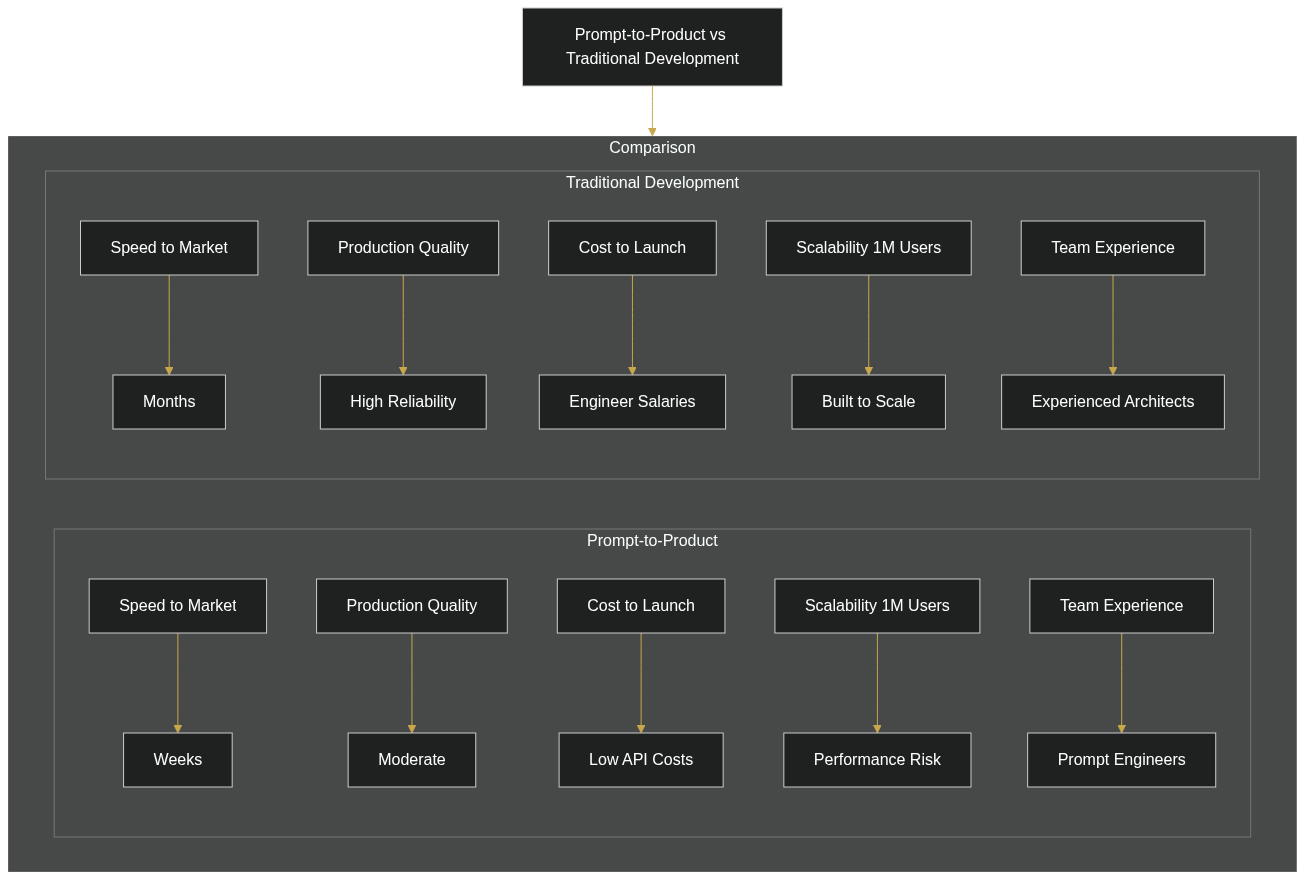
Let’s compare prompt-to-product and traditional development across the dimensions that matter most to early-stage founders.
Speed to MVP. Prompt-to-product wins decisively here. You can launch a basic feature in a few days. Traditional development takes weeks. If your primary goal is to test a hypothesis quickly, prompt-to-product is the faster path.
Quality and Reliability. Traditional development wins. Test coverage is higher, edge cases are caught before launch, and behavior is more predictable. You’ll have fewer production incidents and customer complaints about unexpected bugs.
Cost to Launch. Prompt-to-product wins on initial spend. You’re paying API costs, not full-time engineer salaries. But if you need to refactor later because the code wasn’t production-ready, traditional development eventually costs less because you avoid rework.
Maintainability at Scale. Traditional development wins decisively. As your codebase grows, prompt-to-product approaches become harder to maintain. The code is less consistent, debugging is harder, and introducing new team members to the system becomes painful.
Risk of Technical Debt. Prompt-to-product carries higher risk here. If you use it as a permanent solution rather than a temporary validation tool, you’ll accumulate technical debt that becomes very expensive to fix. Traditional development moves slower but avoids that trap.
The Core Trade-offs You Need to Understand
The real choice isn’t about which approach is objectively better. It’s about which risk you’d rather take. Let’s name them clearly.
Speed vs. Predictability. Prompt-to-product is faster but less predictable. You might launch in half the time, but you’ll also hit unexpected bugs and edge cases that traditional development would have caught. Traditional development is slower but more certain. You know what you’re getting.
Cost vs. Control. Prompt-to-product outsources work to external APIs. You save money upfront, but you lose control over the implementation details. Changes to the LLM provider’s pricing, API limits, or model quality directly impact your product. Traditional development keeps everything in-house, which costs more but gives you complete control.
Flexibility vs. Scalability. Prompt-to-product pivots easily. You change the prompt and regenerate. You can test new ideas without months of rearchitecture. But as you scale to millions of users, these flexible approaches often hit performance walls that traditional engineering would have anticipated and avoided.
Talent vs. Tooling. Prompt-to-product requires good prompt engineering and AI literacy. Traditional development requires experienced architects and full-stack engineers. Both are hard to find in India, but the specific skills you need are different. Some founders find it easier to hire junior developers and teach them prompt engineering than to hire senior architects.
Regulatory and Compliance Risk. If you’re building in fintech, healthcare, or any regulated space, traditional development is often non-negotiable. Regulators want to understand exactly what your system does, and that requires documentation and testing that prompt-to-product doesn’t naturally produce.
When Prompt-to-Product Makes Sense for Indian Founders
Prompt-to-product development is the right choice for specific use cases and specific stages. If you recognize your situation in one of these scenarios, prompt-to-product probably makes sense for you.
Best-fit use cases. Content discovery and recommendation systems work well with prompts. Customer support chatbots and FAQ automation are natural LLM use cases. Data processing, ETL pipelines, and document automation often benefit from prompt-to-product approaches. Internal tools and dashboards can be built quickly with prompts. Early-stage MVP experiments that need validation before you invest engineering resources are ideal candidates.
Green flags for your startup. You’ve got less than 12 months of runway and need validation urgently. Your product logic isn’t deeply complex. You’re not handling real-time transactions or high concurrency. You’re building in an unregulated space or you’re pre-compliance stage. You’ve got a co-founder who’s good at prompt engineering and iteration. You’re specifically trying to validate whether customers want this feature, not build a production-ready system.
Real example. An Indian founder building a B2B SaaS tool to summarize contracts could launch an LLM-powered MVP in a few days with prompts. Take it to 100 potential customers. Get feedback on whether this feature actually solves their problem. If customers love it, then invest in traditional engineering to build a production-grade version. If they don’t, you’ve lost minimal time and money. That’s the power of prompt-to-product at early stages.
When Traditional Development is the Better Bet
There are equally clear scenarios where traditional development is the only sensible choice. If your situation matches any of these, building with traditional approaches saves you headaches later.
Best-fit use cases. Fintech platforms, lending apps, and payment processors need traditional development. Healthtech applications, especially those handling patient data, require it. High-concurrency consumer apps that might process millions of transactions need architected systems. Complex integrations with third-party systems benefit from the control traditional development provides. Products where user data security is a core competitive advantage shouldn’t rely on external LLM APIs.
Red flags for prompt-to-product. You’re in a regulated industry. Your product handles financial transactions. You’ve already raised institutional funding and investors expect stability. Your user base is large enough that quality issues cause brand damage. You’re building something that needs to work identically for all users without variation.
Real example. An Indian fintech startup building a lending platform can’t afford to ship on prompts. Regulatory requirements around data security and fraud prevention are non-negotiable. Your default approach has to be traditional development with comprehensive testing and documentation. You might use prompts for supporting features like customer onboarding communications, but the core lending engine must be built and tested the traditional way.
The Hybrid Approach: How Most Smart Founders Do It
The best strategy most founders miss is the hybrid approach. You don’t have to choose one or the other. You can use both, intentionally, at different phases and for different parts of your product.
Here’s how it works in practice. Weeks 1-4: Use prompt-to-product to build an MVP for customer discovery. Invest minimal time and money. Get real feedback from real users. Weeks 5-12: Use traditional development to refactor the validated features into production-grade code. Now you’re building something you know customers want. Ongoing: Use prompts for new experiments and features you haven’t validated yet. Use traditional development for anything going to production.
Why this works is clear. You get speed-to-learning without sacrificing stability once you know what matters. You validate demand before over-engineering. You build scalable systems only for features customers actually want. And you avoid the trap of treating a validation tool as a permanent architecture.
The team structure matters here too. Pair a good prompt engineer with a backend engineer. Let them collaborate instead of compete. The prompt engineer moves fast and explores ideas. The backend engineer ensures those ideas are built to last. Together, they’re faster and more thoughtful than either could be alone.

Industry Applications in India
FinTech and Financial Services
Use prompts for customer onboarding flows, KYC documentation review assistance, and FAQ systems. Use traditional development for transaction processing, fraud detection engines, settlement logic, and regulatory reporting. The split is clear: anything touching money or regulatory compliance gets traditional development. Everything supporting the customer experience can explore prompts.
EdTech
Prompts excel at personalized learning path generation, essay grading assistance, and adaptive content recommendations. Traditional development handles the assessment engine, student data storage, school integrations, payment systems, and any compliance with education regulations. Again, the pattern holds: use prompts for intelligence and personalization, traditional development for data integrity and integrations.
B2B SaaS and Enterprise Software
Use prompts for report generation, analytics summarization, and data exploration features. Traditional development handles the core data pipeline, API layer, user authentication, and anything that integrates with customer systems. Enterprise customers expect stability and documented behavior, which traditional development delivers naturally.
E-Commerce and Marketplaces
Product descriptions, personalized recommendations, and search result explanations are ideal for prompts. Order processing, payment settlement, inventory management, and seller integrations require traditional development. The customer-facing experience can move fast. The backend transaction handling must be bulletproof.
Quality, Reliability, and Risk Mitigation
Whichever approach you choose, you need to understand the specific risks and how to mitigate them.
Prompt-to-product risks and mitigation. AI hallucinations can generate wrong outputs that confuse users or break integrations. Add guardrails that validate outputs against your data before shipping to users. Include human review loops for critical decisions. Log everything so you can debug failures. Model drift happens as LLM providers update. Plan regular testing against new model versions. Data privacy concerns arise when you send user information to third-party APIs. Use local models or provider guarantees where sensitive data is involved. Vendor lock-in happens when you depend heavily on one LLM provider. Design your system so you can swap providers if needed.
Traditional development risks and mitigation. Human coding errors still happen, but they’re easier to catch through testing and code review. Over-engineering early wastes time and money. Follow the Lean Startup principle of building only what you need to test your hypothesis. Team turnover and knowledge loss hurt long-term maintainability. Invest in documentation and code comments. Make systems simple enough that new team members can understand them quickly.
The reality is that both approaches have risks. The question is which risk profile fits your current situation. Early-stage validation? Accept the risk of brittleness. Your product is growing and customers depend on stability? Accept the risk of slower iteration.
How to Choose What’s Right for You
Decision-making should follow a clear framework. Here’s how to work through it.
Step 1: Assess your stage and runway. If you’ve got less than 6 months of runway and need customer validation urgently, speed matters most. Prompt-to-product makes sense. If you’ve got 12+ months and you’re building for scale, stability matters more. Traditional development is safer.
Step 2: Evaluate your use case. Is your feature logic-light and content-heavy? Is it something customers will use daily with high expectations for reliability? Logic-light and experimental? Prompt-to-product fits. High-reliability and complex? Traditional development is better.
Step 3: Consider your team composition. Do you have a co-founder or early employee who’s strong with prompt engineering and can iterate quickly? Prompt-to-product works. Do you need to hire engineers and they’re more available than prompt engineers? Traditional development might be faster to staff.
Step 4: Check regulatory requirements. Are you in fintech, healthcare, or any regulated space? Traditional development is non-negotiable. Everything else has some flexibility.
Step 5: Commit to a hybrid plan. Don’t treat prompt-to-product as permanent. Plan to refactor validated features into traditional code. Don’t over-engineer features you haven’t validated yet. Use both approaches intentionally for different phases of your product.
Frequently Asked Questions
Can I use prompt-to-product for a regulated product like fintech?
Not as your primary development approach. Regulators expect documented, tested, and auditable systems. You can use prompts for supporting features like customer communications or internal tools. But core business logic, especially anything touching transactions or customer data, must be built with traditional development practices. The regulatory risk is simply too high otherwise.
How do I know when to stop using prompts and refactor to traditional code?
Refactor when you’ve validated that customers want the feature, when it’s becoming central to your product, or when you’re shipping to customers daily. If a feature is still experimental and you’re testing different approaches, keep using prompts. Once it’s proven and stable, invest in traditional engineering.
What skills do I need on my team for prompt-to-product development?
Good prompt engineering skills matter most. Someone who can write clear descriptions of what you want, interpret what the LLM generates, and iterate on the results. You also need basic technical literacy to integrate generated code. And you need someone who can catch hallucinations and security issues before they reach users. This isn’t a replacement for engineering judgment, just different judgment applied faster.
Is prompt-to-product cheaper than hiring engineers?
Initially yes, on the direct cost. You pay API fees instead of salaries. But if you end up refactoring later because the code wasn’t production-ready, you’ll pay more total. The real advantage isn’t cost savings. It’s speed-to-learning. You spend less money to find out whether customers want the feature. If they do, you then invest properly. That’s a better investment strategy than hiring three engineers to build something customers don’t need.
What happens if the LLM provider changes their API pricing or discontinues the model I’m using?
This is real vendor lock-in risk. Mitigate it by designing your system so the LLM is pluggable. Don’t hardcode assumptions about a specific model. Add an abstraction layer so you can swap providers if needed. Monitor your dependency on any single provider. And keep your core business logic independent from the LLM layer.
Build Faster Without Sacrificing Stability
The best approach combines speed with reliability. ViZRR helps Indian founders navigate this choice, whether you’re validating a hypothesis or scaling to production. Reach out to discuss your specific situation and get guidance tailored to your stage, industry, and runway.