

How Fintech & Healthtech Startups in India Validate Ideas Through Rapid Prototyping
Rapid prototyping fintech India solutions isn’t a nice-to-have anymore. It’s the difference between validating a $5 million market opportunity and burning through runway on a feature nobody wants. Fintech teams have 6 or 9 months before their first investor check-in. Healthtech startups face a regulatory gauntlet that makes “move fast and break things” a liability, not a philosophy. Both need a repeatable way to test core assumptions, gather real user feedback, and move from concept to MVP without betting the company on untested guesses.
Key Takeaway
Rapid prototyping isn’t about speed for its own sake. It’s about learning fast what your customers actually need, and pivoting before you run out of capital or investor patience.
In This Article
- Why Rapid Prototyping Matters for Indian Fintech & Healthtech Now
- The Core Challenges Fintech & Healthtech Founders Face
- The Solution: Structured Rapid Prototyping for Fintech & Healthtech
- Why Leading Fintech & Healthtech Teams Choose ViZRR
- How Rapid Prototyping Works Across Fintech & Healthtech Use Cases
- How to Get Started with Rapid Prototyping
- Frequently Asked Questions
Why Rapid Prototyping Matters for Indian Fintech & Healthtech Now
India’s fintech and healthtech ecosystems are growing faster than anywhere else in Asia. But here’s the thing: founder success isn’t determined by access to capital or market size. It’s determined by how quickly your team can validate whether customers actually want what you’re building.
According to NASSCOM India Tech Reports, over 40% of Indian fintech startups fail due to market fit issues, not technical challenges. Translation: teams build the wrong thing really well. Healthtech faces a different but equally real challenge. Regulatory uncertainty around data localization, payment integration with RBI systems, and HIPAA-equivalent compliance requirements means founders often delay prototyping while waiting for legal clarity. That delay costs months and burns capital.
“Startups that validate their core MVP in under eight weeks are 3x more likely to raise Series A funding than teams that build for six months before seeking user feedback.”
YourStory Startup Trends Report, 2024
Meanwhile, investor expectations have shifted completely. Even pre-seed founders are now expected to show validated metrics, not just whitepapers and pitch decks. A working prototype with real user engagement data opens doors that a theoretical product roadmap simply won’t.
The Core Challenges Fintech & Healthtech Founders Face
The path from idea to Series A is full of decision traps. Here’s what we see slow down, or derail, fintech and healthtech teams:
- Unclear scope leading to feature bloat: Should the payment gateway integration come first, or user onboarding? Without a clear answer, teams build both, tripling development timelines.
- Regulatory uncertainty paralyzing decisions: Teams ask, “What compliance features do we prototype vs. defer?” and end up building things that won’t pass audit, or skipping features they should have built early.
- Investor expectations outpacing execution: Pre-seed investors now expect traction metrics. A prototype without user data won’t convince them. A prototype with engagement metrics will.
- Technical debt becoming a production albatross: “Quick and dirty” prototypes turn into production code. Shortcuts in architecture, testing, and security breed issues that cost 5x to fix later.
- User discovery done in isolation: Teams build features in a vacuum, then launch and discover that customer workflows differ completely from assumptions.
- Hiring and talent constraints: Attracting senior architects for pre-seed is hard. Junior teams often repeat architectural mistakes, extending timelines unpredictably.
The consequence is brutal: 12 or 18 month development cycles with no validated demand, leading to either a costly pivot or shutdown. By the time founders realize the market doesn’t want what they built, their runway is gone.

The Solution: Structured Rapid Prototyping for Fintech & Healthtech
Rapid prototyping fintech and healthtech products isn’t about throwing out quality or bypassing compliance. It’s about building the right thing at the right speed, with structured feedback loops that de-risk product decisions.
Here’s how the right approach addresses each pain point:
- Scope clarity through MVP frameworks: Instead of guessing, use techniques like MoSCoW prioritization or RICE scoring combined with user research workshops. By week one, your team knows what’s a “must-have” and what’s a Series A feature.
- Compliance-first prototyping: Build KYC, payment, and data flows early, not as an afterthought. This surfaces blockers while you’re still in prototype mode, not after you’ve built the entire system.
- Investor-ready traction metrics: Rapid iteration plus a measurement dashboard means by month three, you have a story to tell investors: user engagement rates, feature adoption, validation data.
- Code quality by design: Prototype architecture is designed for transition, not throwaway. You’re not writing production-grade security infrastructure, but you’re not creating technical debt either.
- User-centric iteration: Weekly validation loops mean prototype changes are driven by data, not gut feel. You’re talking to users every week, not every quarter.
- Team scaling through mentorship: Junior builders level up during the prototype phase, so when you move to production, your team is stronger.
Expert Perspective
In our work at ViZRR, we’ve watched founders spend three months debating “payments first vs. user experience first.” With a structured four-week prototype sprint, this answer becomes obvious through data. You don’t argue theory anymore. You watch what users actually do.
When evaluating partners for rapid prototyping fintech or healthtech work, look for these characteristics. First, hands-on engagement. If your partner is at arm’s length, design decisions get made without product context. Second, experience with India’s specific regulatory nuances. Payment gateway integration looks different for NPCI/UPI flows than Stripe. Healthtech data localization isn’t the same as GDPR compliance. Third, clarity on the post-prototype path. What transitions from prototype to production? Why does that step matter? If your partner can’t articulate this, you’re setting yourself up for refactoring debt.
Finally, partners who push back on scope. The best prototyping teams say “that feature can wait until Series A” with evidence, not opinion. That discipline is what keeps timelines realistic.
Why Leading Fintech & Healthtech Teams Choose ViZRR
Rapid prototyping fintech India startups is fundamentally different from generic app development. You need partners who’ve shipped in regulated sectors, who understand compliance as a feature, and who know how to iterate at speed without cutting corners that matter.
| Factor | ViZRR | Generic Dev Agency | In-House Startup Team |
|---|---|---|---|
| Regulatory & Compliance Mindset | Built-in fintech and healthtech context | Generic web/app expertise, learns on your dime | Learning as you go, costly mistakes |
| Iteration Speed | 1 or 2 week sprints with embedded feedback loops | Waterfall-style, slower iteration cycles | Fast but no external perspective or rigor |
| Post-Prototype Clarity | Clear transition plan to Series A scope and architecture | Often leaves technical debt and gaps | Unclear path forward, major refactoring likely |
| Cost Transparency | Outcome-focused pricing, no hidden scope creep | Time & materials risk, endless iterations | Fixed payroll plus opportunity cost of founder time |
Here’s why this matters in practice. Fintech and healthtech aren’t “another app.” A telemedicine MVP isn’t a social network MVP. Payment infrastructure isn’t e-commerce checkout. Teams that partner with generalist agencies discover mid-sprint that payment gateway integration requires regulatory approval timelines they didn’t budget for, or that EHR integration standards are more complex than a simple API call.
ViZRR’s methodology ensures prototype feedback informs architecture decisions from the start. You’re not building for speed and hoping architecture scales. You’re building prototypes whose code, patterns, and decisions transition cleanly into Series A production systems. That’s the difference between rapid prototyping and rapid prototyping that sticks.
How Rapid Prototyping Works Across Fintech & Healthtech Use Cases
Use Case 1: Payment and Lending Fintech
A founder wants to test whether SME lending via WhatsApp is viable. The initial question is unclear: Is KYC the biggest friction point, or is it something else entirely? With rapid prototyping fintech approaches, the team builds a two-week prototype featuring a WhatsApp bot plus a simplified KYC flow, then validates with twenty pilot users. The learning: KYC is only 10% of the friction. The real drop-off happens at the disbursal timeline stage. Users expect money in 24 hours; the founder’s manual process takes five days. That insight, discovered in week two instead of month six, changes the entire product roadmap.
Use Case 2: Healthtech Diagnostics and Telemedicine
A diagnostic startup is uncertain: Will doctors use an AI triage tool, or will it feel like a threat to their expertise? Rapid prototyping healthtech in this case means building a low-fidelity triage interface, then running eight to ten structured interviews with target doctors, iterating the UI based on feedback. The learning: Doctors loved the tool but wanted deep integration with their existing EHR systems. That’s not a blocker for the prototype, but it becomes a Series A priority feature. The founder now has data to tell investors: “Doctors are ready for this. Integration is the next lever.”
Use Case 3: Embedded Finance and API-First Platforms
A B2B SaaS founder wants to embed payment rails into their product. The question is strategic: white-label approach or custom integration? Through rapid prototyping fintech methodology, the team builds a three-week API prototype and tests it with three beta customers. The learning: Customers want webhooks and reconciliation dashboards, not just payment processing. These features aren’t deal-breakers for the prototype phase, but they shift the Series A roadmap. The founder now pitches investors with proof: “Early customers need X, Y, and Z. Here’s our plan to deliver it.”

How to Get Started with Rapid Prototyping
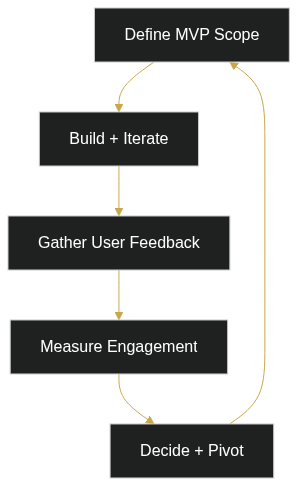
Moving from idea to a validated prototype doesn’t have to be complicated, but it does require structure. Here’s a repeatable process that fintech and healthtech teams follow:
- Align on MVP Definition: Run a collaborative session lasting two to four hours to define “what does done look like?” Use user story mapping to articulate the core user journey. The outcome is a one-page MVP specification that everyone agrees on.
- Conduct User Research Sprint: Spend one week interviewing ten to fifteen target users, either customers or domain experts. Validate your core problem statement and prioritize features based on real feedback. The outcome is a validated problem statement and ranked feature list.
- Build and Test the Prototype: Execute a two to four week prototype sprint with weekly demos to internal stakeholders plus early user feedback sessions. The outcome is a working prototype and a detailed log of user feedback by feature.
- Measure Engagement and Decide: Analyze user engagement rates, NPS scores, and task completion metrics. Based on data, decide whether to pivot the concept, persevere with the current direction, or move forward to Series A production planning. The outcome is a clear next-step roadmap grounded in evidence.
- Plan Your Transition: Define which prototype code becomes production code vs. what needs refactoring as you scale. Document your architecture decisions and technical roadmap so the next team (internal or external) understands what you built and why. The outcome is a handoff document that prevents rework.
Each step depends on the previous one. Skipping user research to move faster creates more work later. Skipping the transition planning means your prototype becomes a liability, not an asset.
Frequently Asked Questions
How long does a rapid prototype actually take?
For fintech and healthtech projects, factor in research, build, and iteration cycles. The timeline depends heavily on scope clarity and how intensively you conduct user research, not marketing promises about “building in days.” Your partner should be transparent about what drives timeline variation and help you balance speed against learning.
What’s the difference between a prototype and an MVP?
A prototype answers the question: “Do users want this?” An MVP answers: “Can we build a sustainable business around this?” Prototypes can have shortcuts in architecture, security, and scalability. MVPs can’t. Prototypes are meant to be iterated and often discarded. MVPs are the foundation of your Series A product. The best partners clarify this distinction and help you plan the transition deliberately.
Can rapid prototyping replace compliance planning in fintech?
Absolutely not. Rapid prototyping fintech means building compliance workflows and permission models early, not skipping them. You’re not building production-grade security infrastructure in a prototype, but you’re testing whether your compliance approach is feasible. This is non-negotiable in regulated sectors.
What happens to prototype code after validation?
Some of it becomes production code. Some of it gets refactored. Some of it gets discarded. The key is having a plan for which is which before you start building. If your partner says “we’ll figure it out later,” that’s a red flag. The best partners document architectural decisions as they prototype, making the transition predictable.
How do we know if the prototype succeeded?
Define success metrics before you build. For payment prototypes, it might be adoption rate or transaction volume. For telemedicine, it might be doctor activation or patient completion rates. For embedded finance, it might be API call volume or integration ease. Success isn’t “the prototype works technically.” It’s “users engage with the core feature and tell us why or why not.”
For a deeper dive into how rapid prototyping translates to investor conversations, read Why Your App Prototype Isn’t Convincing Investors (And How to Fix It). If you’re building with AI components, MVP in Days: How AI-Assisted Development Cuts Launch Time by 70% breaks down how modern development techniques compress timelines. And for understanding the full cost and timeline landscape, How Much Does It Cost to Build an MVP in India in 2026 gives you realistic benchmarks.

Validate Your Fintech or Healthtech Idea Today
ViZRR has guided fintech and healthtech founders from concept to investor-ready prototypes. Let’s talk about your specific challenge and build a structured prototype that de-risks your next milestone.