

AI Readiness Assessment: What Indian Enterprises Get Wrong
AI readiness assessment is the foundation of every successful AI strategy, yet most Indian enterprises approach it like a checkbox exercise rather than a strategic diagnostic. They conduct a technical audit, declare themselves “ready,” and then watch their million-rupee AI pilots stall when they hit organizational, data, or governance roadblocks that should’ve been visible from the start. The real cost isn’t just the wasted budget. It’s the erosion of stakeholder confidence that makes the next AI initiative twice as hard to fund.
Key TakeawayGenuine AI readiness spans technology, talent, governance, and culture. Miss even one dimension, and your strategy will stall before it scales.
In This Article
- Why AI Readiness Assessment Matters for Indian Enterprises Right Now
- The 7 Core Mistakes in AI Readiness Assessment
- The Right AI Readiness Assessment Approach
- How Leading Indian Enterprises Approach AI Readiness
- AI Readiness in Key Indian Sectors
- How to Build Your AI Readiness Assessment in 5 Steps
- Frequently Asked Questions
Why AI Readiness Assessment Matters for Indian Enterprises Right Now
India’s AI adoption trajectory is accelerating faster than most boards anticipated. According to NASSCOM’s latest AI adoption survey, over 65% of mid-to-large Indian enterprises have initiated some form of AI pilot. Yet the gap between pilot initiation and production-scale deployment remains stark. Here’s the thing: the enterprises that succeed aren’t the ones rushing to deploy AI fastest. They’re the ones who invested time upfront in understanding what true readiness actually looks like.
The Indian business context adds unique complexity. Your enterprise operates within RBI’s emerging AI governance frameworks, state-level data localization mandates, and sector-specific regulatory requirements that don’t apply uniformly across BFSI, healthcare, or manufacturing. A generic AI readiness assessment built for multinational standards will miss the regulatory and infrastructure nuances that trip up Indian deployments.

On top of that, the AI talent ecosystem in India remains bifurcated. You can hire data scientists. What’s harder to source at scale is the combination of domain expertise, governance discipline, and change management capability that turns AI pilots into business transformations. An AI readiness assessment that ignores this talent reality will set unrealistic timelines and roadmaps.
“Only 28% of Indian enterprises that initiated AI pilots have progressed to production-scale deployments within 18 months of pilot completion.”
NASSCOM AI Adoption in India Report, 2024
The 7 Core Mistakes in AI Readiness Assessment
Most AI readiness assessments fail not because they ask the wrong questions, but because they ask the right questions in the wrong sequence and with insufficient depth. Here’s what we see repeatedly across Indian enterprises:
1. Overestimating Data Readiness
The most common error: conflating data availability with data readiness. Your enterprise has accumulated years of transaction logs, customer interactions, and operational records. That’s data volume, not AI readiness. True data readiness requires quality (completeness, accuracy, consistency across sources), governance (clear ownership, audit trails, lineage documentation), and infrastructure (accessible APIs, real-time pipelines, scalable storage). An AI readiness assessment that doesn’t evaluate these three layers independently will miss critical blockers that emerge during model development.
2. Ignoring Organizational and Cultural Readiness
Technology is the easy part. An AI readiness assessment focused purely on infrastructure and tools ignores the organizational muscle required to adopt AI at scale. This includes cross-functional alignment (does your supply chain team understand why AI is being deployed in their process?), change management discipline (are you prepared for role evolution and upskilling?), and executive commitment (will leadership fund Phase 2 if Phase 1 shows promise but not immediate ROI?). Enterprises that skip this assessment dimension are building AI in a cultural vacuum.
3. Misaligning AI Strategy with Business Outcomes
Too many enterprises assess AI readiness in the abstract. They answer questions like “How mature is our data infrastructure?” without first anchoring to “What are the 2-3 business problems where AI will create measurable value?” Sound familiar? An honest AI readiness assessment starts with business outcomes, not technical capability. It asks: Can we identify a use case that matters to the P&L? Do we have the business process stability to test an AI solution? Is the problem worth solving even if the solution is imperfect? Assessments that skip this step produce technical readiness scores disconnected from business reality.
4. Underestimating Talent Gaps
Hiring one data scientist does not equal AI capability. A comprehensive AI readiness assessment evaluates the full talent ecosystem: data engineers who can build scalable pipelines, domain experts who understand the business problem deeply enough to validate model outputs, governance specialists who know regulatory landscape, and change management leaders who can navigate organizational adoption. Most Indian enterprises have one or two of these roles filled competently. The rest are either external consultants or unfilled gaps that will cascade into implementation delays.
5. Skipping Governance and Risk Assessment
This mistake is costly in regulated sectors like BFSI and healthcare, but dangerous across all industries. An AI readiness assessment must evaluate your organization’s capability to build accountability (who owns model performance and failure?), detect bias (how will you test for demographic or historical biases in training data?), and ensure compliance (does your AI solution meet RBI guidelines, data localization rules, and sector-specific approvals?). Enterprises that treat governance as a post-deployment concern invariably face model audits, regulatory pushback, or customer trust erosion.
6. Treating Readiness as a One-Time Event
An AI readiness assessment conducted once and filed away is outdated before the pilot completes. Technology moves faster than organizational capability. Regulations evolve. New competitive threats emerge. Leading enterprises treat readiness as a continuous evolution metric, revisited quarterly or at minimum bi-annually. They ask: As we’ve grown our talent capability, have new use cases become viable? As data infrastructure matured, what was previously blocked? As regulatory guidance clarified, which risks can we now address? One-time assessments miss these evolutionary opportunities.
7. Choosing the Wrong Assessment Partner
Not all AI readiness frameworks are created equal. A generic, vendor-neutral framework that works equally well for enterprises in Silicon Valley and Mumbai is probably designed for neither. Enterprises often choose assessment partners based on brand recognition or proximity rather than India-specific expertise. The cost: assessments that don’t account for infrastructure variance across regions, salary expectations in India’s talent market, regulatory nuances in RBI and MeitY guidance, or the operational reality of legacy systems in manufacturing and logistics sectors.
Each of these mistakes compounds the next. Data readiness gaps surface during model training, wasting months. Organizational misalignment crops up when the pilot’s deemed “successful” but leadership won’t fund scaling. By the time leadership asks “Why didn’t we know this before?”, the enterprise has already lost budget, momentum, and team morale.
The Right AI Readiness Assessment Approach
An effective AI readiness assessment is multi-dimensional, business-led, and honest about gaps. Rather than a single readiness score, leading enterprises use a maturity matrix across five interconnected domains.
Expert PerspectiveIn our work with clients, we’ve observed that enterprises using a five-dimensional readiness framework (technology, data, talent, governance, and organizational alignment) progress from pilot to production 40% faster than those using single-dimension technical assessments. The difference isn’t the questions asked. It’s the willingness to be transparent about dependencies and sequence investments accordingly.
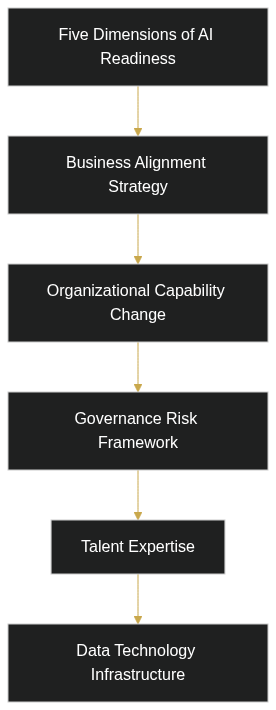
This multi-dimensional approach reframes each of the seven mistakes as a solution requirement. Instead of “overestimating data readiness,” you’re now systematically evaluating data quality, governance maturity, and infrastructure scalability as separate but interdependent factors. Instead of skipping governance, you’re building accountability mechanisms and bias detection into the readiness assessment from the start.
A business-led assessment starts with clarity on strategic outcomes. Your AI readiness assessment should identify 2-3 high-impact use cases that align with your enterprise’s competitive priorities. For each use case, you evaluate: Do we have access to the business process owners? Can we define success metrics tied to P&L outcomes? Is the problem stable enough to test an AI solution, or does the underlying process change monthly? This business anchoring transforms the assessment from “Are we technically ready?” to “Are we ready to solve this specific business problem with AI?”
Finally, an India-contextualized framework accounts for your unique operating environment. It asks: What does data localization mean for your AI architecture? Which RBI or sector-specific guidelines affect model governance? Where are talent gaps most acute, and how will you address them (hiring, outsourcing, upskilling, or hybrid)? What’s the realistic infrastructure maturity in your enterprise (cloud-native, hybrid legacy-cloud, or on-premises)? Generic frameworks skip these questions entirely.
What to look for in an AI readiness assessment partner: demonstrated experience with Indian enterprises across multiple sectors, transparent understanding of RBI and regulatory constraints, willingness to acknowledge gaps rather than overselling opportunity, and a framework that integrates technology, talent, and organizational dimensions rather than treating them separately.
How Leading Indian Enterprises Approach AI Readiness
The most mature Indian enterprises share a common approach to AI readiness assessment. They diverge from generic best practices in three critical ways.
| Dimension | Leading Indian Enterprises | Typical Approach |
|---|---|---|
| Assessment Focus | Business outcomes + technical capability | Technical capability only |
| Data Evaluation | Quality, governance, lineage, infrastructure | Volume and accessibility |
| Talent Assessment | Skills, experience, upskilling plan, domain expertise | Role count and certifications |
| Governance Scope | Accountability, bias detection, compliance frameworks | Compliance checklist |
| Readiness Timeline | Continuous quarterly evolution | One-time annual assessment |
| Outcome Definition | Phased roadmap with sequenced priorities | Go/no-go binary decision |
The first differentiator is executive alignment. Leading enterprises ensure that the C-suite agrees on AI’s strategic role before the assessment begins. This isn’t about getting permission. It’s about anchoring the assessment to business priorities rather than technical aspirations. When the CIO leads the assessment without CFO and COO input, the resulting roadmap often prioritizes infrastructure modernization over business outcomes.
The second is cross-functional input. An AI readiness assessment led solely by IT will miss business process constraints. One led by business units without IT input will overlook technical dependencies. Leading enterprises convene IT, business units (operations, supply chain, customer success), compliance, HR, and finance. Each function contributes unique perspective on readiness, bottlenecks, and sequencing.
The third is regulatory awareness built into the assessment itself. Rather than treating compliance as a post-assessment concern, leading enterprises ask: How do RBI guidelines affect our model governance? Does our data localization posture support the AI architecture we’re considering? Which sector-specific approvals will we need? This front-loads regulatory complexity rather than discovering it during pilot execution.
AI Readiness in Key Indian Sectors
BFSI (Banks, Financial Services, Insurance)
AI readiness assessment in BFSI centers on fraud detection, credit risk, and customer personalization. The unique challenge: RBI’s evolving AI governance expectations and regulatory reporting requirements. Your assessment must evaluate model explainability (can you explain why the model denied a loan application?), data privacy controls (does the data pipeline meet data localization mandates?), and governance frameworks (who audits model performance, and how frequently?). BFSI enterprises often overestimate readiness because they have robust data infrastructure. They underestimate organizational readiness to operate under AI governance disciplines unfamiliar to legacy risk management.
Healthcare and Pharmaceuticals
Healthcare AI readiness assessment prioritizes diagnostic imaging, drug discovery acceleration, and patient data analytics. The unique challenge: data sensitivity across hospital systems, cross-institutional data integration complexity, and clinical validation pathways. Your assessment must evaluate data governance maturity (can you integrate patient records across systems while maintaining privacy?), clinical expertise availability (do you have clinicians who can validate model outputs?), and regulatory approval processes (does your AI solution require CDSCO or institutional review board approval?). Healthcare enterprises frequently skip the clinical validation dimension, building AI models that physicians don’t trust because the underlying logic wasn’t validated against clinical standards.
Manufacturing and Logistics
Manufacturing and logistics AI readiness assessment focuses on predictive maintenance, supply chain optimization, and inventory forecasting. The unique challenge: legacy OT (operational technology) infrastructure, fragmented data across plants and regions, and an upskilling burden on non-technical workforce. Your assessment must evaluate IoT readiness (do sensors exist, and can data be extracted in real-time?), operational data quality (is production data consistently recorded across facilities?), and workforce capability (will plant engineers adopt AI-based maintenance recommendations?). Manufacturing enterprises often overestimate readiness because they conflate “we have sensors” with “data is AI-ready”. Sensors generate volume, not intelligence.
Retail and E-Commerce
Retail and e-commerce AI readiness assessment emphasizes personalization, demand forecasting, and dynamic pricing. The unique challenge: data velocity (transaction volume requires real-time processing), customer privacy concerns, and competitive pressure for rapid deployment. Your assessment must evaluate infrastructure scalability (can your data pipeline handle peak traffic?), real-time capability (is your tech stack built for sub-second model inference, or batch-only?), and analytics talent (do you have practitioners who understand recommendation systems and causal inference for pricing?). E-commerce enterprises underestimate the organizational challenge of model governance at scale. Every product variant, every promotion, every geographic market creates a new model variant. Managing that operational complexity is rarely built into readiness assessments.
How to Build Your AI Readiness Assessment in 5 Steps
You don’t need to wait for a consultant to start understanding where your enterprise truly stands. Here’s a practical five-step approach.
- Define Strategic North Star. Identify 2-3 high-impact use cases aligned with your enterprise’s competitive priorities. For each, document the business outcome you’re targeting (cost reduction, revenue uplift, risk mitigation, customer satisfaction). This clarity becomes the lens through which you’ll evaluate readiness across all other dimensions.
- Assess Current State Across Five Dimensions. For each use case, evaluate technology maturity (data infrastructure, model development capability, deployment infrastructure), data maturity (quality, governance, accessibility, lineage), talent maturity (skills, domain expertise, governance roles), governance maturity (model accountability, bias detection, compliance frameworks), and organizational maturity (cross-functional alignment, change management capability, executive commitment).
- Identify Critical Gaps and Dependencies. Map not just what’s missing, but the sequence of dependencies. Some gaps block others. You can’t deploy a real-time model without infrastructure that supports real-time inference. Some gaps are enablers: upskilling a governance team unlocks model reuse across use cases. Honest dependency mapping prevents you from pursuing solutions that depend on prerequisites you haven’t established.
- Design Phased Roadmap. Sequence initiatives by impact and dependency. Your first phase might focus on data governance and talent hiring, creating the foundation for model development in phase two. Your second phase might build proof-of-concept models while simultaneously developing governance frameworks. Your third phase scales successful models while establishing continuous monitoring disciplines. This sequencing reflects realistic organizational capability rather than technical sequencing alone.
- Establish Continuous Refresh Cadence. Plan quarterly or bi-annual reassessment. As your talent capability evolves, new use cases become viable. As infrastructure matures, technical constraints disappear. As regulations clarify, governance frameworks can shift. Readiness assessment is continuous evolution, not a once-and-done checkpoint.
Each step is collaborative, not consultant-dependent. Your executive team defines North Star. Cross-functional teams assess current state. Dependency mapping surfaces organizational assumptions you can test. The roadmap becomes a shared artifact that aligns IT, business, compliance, and finance around sequenced investment.
Frequently Asked Questions
What’s the difference between AI readiness assessment and AI maturity assessment?
Readiness is a snapshot diagnostic focused on whether your enterprise is prepared to start AI initiatives right now. Maturity is a staged evolution model showing how capability evolves over years. Readiness assessment answers: “Can we start this use case?” Maturity assessment answers: “Where are we on the journey from novice to expert, and what’s our trajectory?”
How do we know if our data is truly AI-ready?
True data readiness requires evaluation across three dimensions, not a single metric. Quality dimension: Is the data complete (do you have the features needed for the use case?), accurate (have errors been identified and corrected?), and consistent (do data definitions align across source systems?)? Governance dimension: Is ownership clear (who maintains data quality?), is lineage documented (where did this data originate?), and is compliance understood (does the data meet regulatory requirements for the use case)? Infrastructure dimension: Is the data accessible (can models retrieve it at development speed and at inference speed?), is it scalable (can infrastructure handle volume growth?), and is it secure (does access control align with sensitivity)?
Do we need external consultants for a readiness assessment, or can we do it internally?
Internal teams can conduct rigorous self-assessment using a structured framework. However, external perspective catches blind spots that internal stakeholders miss. Everyone has invested reputation in current capability, creating optimism bias. External assessors also provide credibility for roadmap prioritization when you’re competing for budget across competing initiatives. A hybrid approach often works best: external partners facilitate and challenge, internal teams do the assessment work and own the roadmap.
How often should we revisit our AI readiness assessment?
At minimum, annually or when significant organizational changes occur (leadership transition, M&A, major technology shift, regulatory guidance clarification). Quarterly check-ins on specific dimensions, particularly talent capability and infrastructure evolution, are even better. The goal is catching readiness shifts before they derail execution rather than discovering capability gaps mid-project.
What’s the biggest risk if we skip a formal readiness assessment?
You’ll invest in the wrong initiatives, miss critical dependencies, and face unexpected delays when scaling. Then you’ll misattribute the delay to “AI wasn’t ready” when the real issue was strategy gap, not technology gap. This misattribution erodes executive confidence in AI as a lever for transformation, making the next AI investment proposal twice as hard to fund.
Build Your AI Readiness Roadmap
A clear understanding of where your enterprise stands is the foundation for every successful AI strategy. Talk with our team about where gaps exist and how to sequence your investments for maximum impact.